
[论文解读] accelerating wrf i/o performance with adios2 and network-based streaming
本文提出在气象研究与预报模型(WRF)中集成ADIOS2作为高性能I/O后端,以克服长期存在的I/O瓶颈。通过利用ADIOS2的可持续分段传输(SST)技术,结合UCX数据传输、节点本地突发缓冲区及内联压缩,作者实现了I/O时间减少逾十倍,并将整体求解时间缩短50%,证明了现代I/O框架可在极少代码修改的前提下,显著加速传统HPC应用。
With the approach of Exascale computing power for large-scale High Performance Computing (HPC) clusters, the gap between compute capabilities and storage systems is growing larger. This is particularly problematic for the Weather Research and Forecasting Model (WRF), a widely-used HPC application for high-resolution forecasting and research that produces sizable datasets, especially when analyzing transient weather phenomena. Despite this issue, the I/O modules within WRF have not been updated in the past ten years, resulting in subpar parallel I/O performance. This research paper demonstrates the positive impact of integrating ADIOS2, a next-generation parallel I/O framework, as a new I/O backend option in WRF. It goes into detail about the challenges encountered during the integration process and how they were addressed. The resulting I/O times show an over tenfold improvement when using ADIOS2 compared to traditional MPI-I/O based solutions. Furthermore, the study highlights the new features available to WRF users worldwide, such as the Sustainable Staging Transport (SST) enabling Unified Communication X (UCX) DataTransport, the node-local burst buffer write capabilities and in-line lossless compression capabilities of ADIOS2. Additionally, the research shows how ADIOS2's in-situ analysis capabilities can be smoothly integrated with a simple WRF forecasting pipeline, resulting in a significant improvement in overall time to solution. This study serves as a reminder to legacy HPC applications that incorporating modern libraries and tools can lead to considerable performance enhancements with minimal changes to the core application.
研究动机与目标
- 为应对WRF中日益严重的I/O性能瓶颈,尽管其计算能力差距持续扩大,但该模型已超过十年未进行更新。
- 评估将ADIOS2作为下一代WRF I/O后端的可行性,以实现高吞吐量、可扩展的数据I/O。
- 通过ADIOS2的先进功能(如突发缓冲区支持与原位分析)展示I/O写入时间与整体求解时间的性能提升。
- 在WRF生态系统中引入现代数据管理能力,如无损/有损压缩与双向数据耦合。
提出的方法
- 在WRF中集成ADIOS2作为新型I/O后端,取代传统的MPI-I/O与PnetCDF后端。
- 利用ADIOS2的可持续分段传输(SST)引擎配合统一通信X(UCX),实现高性能、低延迟的数据传输。
- 利用节点本地突发缓冲区,通过将数据从主内存卸载至快速本地存储来加速写入操作。
- 在ADIOS2中应用内联无损与有损压缩,以提升有效I/O带宽。
- 利用ADIOS2的数据耦合与流式传输能力,实现原位分析流水线,降低后处理开销。
- 配置ADIOS2的SST传输中QueueLimit参数,以优化UCX与EVPATH中间件的异步数据传输性能。
实验结果
研究问题
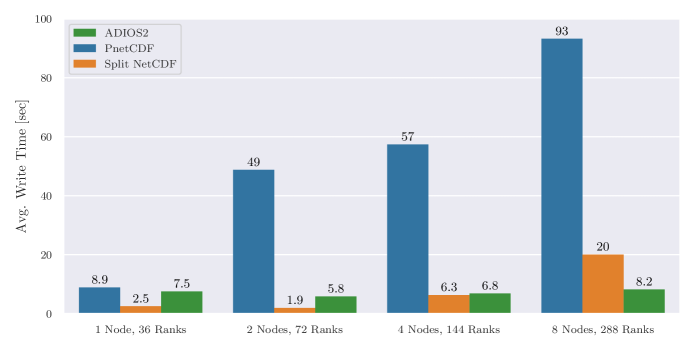
- RQ1与传统MPI-I/O和PnetCDF后端相比,ADIOS2能否显著降低WRF的I/O写入时间?
- RQ2在ADIOS2的SST引擎中集成基于UCX的传输机制,对WRF中的数据传输性能与延迟有何影响?
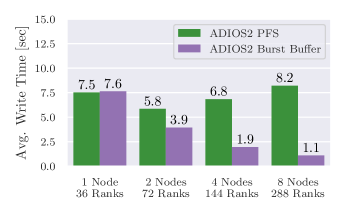
- RQ3ADIOS2中的突发缓冲区与内联压缩功能在多大程度上提升了WRF模拟中的有效I/O吞吐量?
- RQ4利用ADIOS2实现的原位分析流水线能否减少WRF预报工作流的整体求解时间?
- RQ5针对不同传输后端,调优ADIOS2的SST引擎中QueueLimit参数对性能有何影响?
主要发现
- ADIOS2的集成使WRF的I/O写入时间相比传统MPI-I/O与PnetCDF后端减少了逾十倍。
- 采用ADIOS2的SST引擎与UCX传输,使WRF预报流水线的整体求解时间减少了50%。
- 基于UCX的数据传输在吞吐量与延迟方面均优于EVPATH中间件层,尤其在大规模场景下表现更优。
- 将QueueLimit参数优化为0(异步模式)显著提升了UCX与EVPATH传输的性能。
- 该集成实现了节点本地突发缓冲区写入与内联无损压缩,显著提升了I/O效率,且无需修改WRF核心代码。
- 本研究证明,ADIOS2的原位分析能力可无缝集成至WRF中,减少对后处理的依赖,加速科学工作流。
阅读本论文
在 Nubint 阅读器中打开原文,边读边就任意段落提问。
在 Nubint 中阅读本论文本解读由 AI 根据论文原文生成,引用前请核对原文。