
[论文解读] Accessing GPT-4 level Mathematical Olympiad Solutions via Monte Carlo Tree Self-refine with LLaMa-3 8B
引入 MCT Self-Refine (MCTSr),一种将 LLM 与蒙特卡洛树搜索结合的框架,能够迭代地自我优化并评估数学解答,在多项奥林匹克风格基准测试中通过增加自回合实现了接近 GPT-4 的性能。
This paper introduces the MCT Self-Refine (MCTSr) algorithm, an innovative integration of Large Language Models (LLMs) with Monte Carlo Tree Search (MCTS), designed to enhance performance in complex mathematical reasoning tasks. Addressing the challenges of accuracy and reliability in LLMs, particularly in strategic and mathematical reasoning, MCTSr leverages systematic exploration and heuristic self-refine mechanisms to improve decision-making frameworks within LLMs. The algorithm constructs a Monte Carlo search tree through iterative processes of Selection, self-refine, self-evaluation, and Backpropagation, utilizing an improved Upper Confidence Bound (UCB) formula to optimize the exploration-exploitation balance. Extensive experiments demonstrate MCTSr's efficacy in solving Olympiad-level mathematical problems, significantly improving success rates across multiple datasets, including GSM8K, GSM Hard, MATH, and Olympiad-level benchmarks, including Math Odyssey, AIME, and OlympiadBench. The study advances the application of LLMs in complex reasoning tasks and sets a foundation for future AI integration, enhancing decision-making accuracy and reliability in LLM-driven applications.
研究动机与目标
- 推动提升基于 LLM 的数学推理的准确性与可靠性,特别是针对具有策略性和多步骤推理的问题。
- 提出一个统一框架,将蒙特卡洛树搜索与自我优化与自我评估结合于 LLMs。
- 在标准数学基准测试(包括 GSM8K、GSM Hard、MATH 及奥林匹单位数据集)上证明有效性。
提出的方法
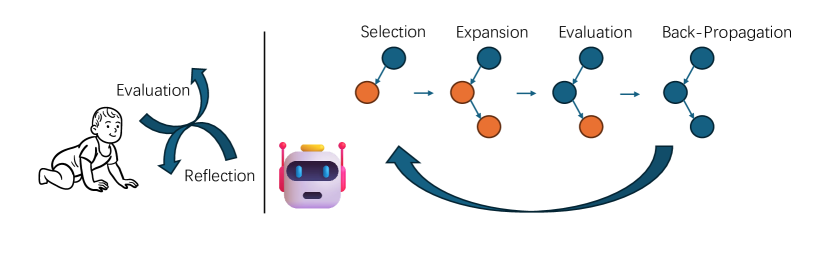
- 构建一个蒙特卡洛树搜索(MCTS),具备一个新颖的自我优化循环,其中节点表示不同的答案版本。
- 在基于 LLM 的改进自我优化中,使用改进的基于 UCT 的选择以平衡探索与利用。
- 从聚合的自我奖励样本中为每个答案定义一个 Q 值并向后传播以细化树。
- 采用带有改进 UCB 公式的动态剪枝策略来决定完全展开并引导搜索。
- 自我优化:生成反思性反馈,然后通过多轮提示产出改进的答案。
- 自我评估:在带约束(提示约束、满分抑制、重复采样)的情况下抽样奖励,以将 Q(a) 计算为最小值与均值奖励的半和。
实验结果
研究问题
- RQ1在引导自我优化的 MCTS 是否能提升 LLM 生成的数学解答的正确性与可靠性?
- RQ2自回合次数(4 次与 8 次)如何影响不同难度水平和数据集的成功率?
- RQ3较小的开源模型(LLaMA-3 8B)在奥林匹克风格问题上在多大程度上可接近 GPT-4 的性能?
- RQ4在高度具有挑战性的奥林匹克基准测试上,MCTSr 的实际极限是什么?
主要发现
- 随着自回合次数的增加,MCTSr 在 GSM8K 和 GSM Hard 上的成功率提高,对较简单的 GSM8K 获得更大增益。
- 在 MATH 上,8 次自回合的 MCTSr 在五个层级的总和达到 58.24%(相比之下零-shot 连锁思维为 24.36%)。
- 奥林匹克基准测试在更多自回合时显示显著增益:AIME 从 2.36% 增至 11.79%,Math Odyssey 从 17.22% 增至 49.36%,OlympiadBench 从 1.25% 增至 7.76%。
- 与一些闭源 SOTA 模型相比,启用 MCTSr 的 LLaMA-3-8B 在所测试的数据集上接近 GPT-4 水平。
- 研究确认了一条可扩展路径,通过在 MCTS 框架内进行迭代自我优化来提升开源模型的数学推理能力。
阅读本论文
在 Nubint 阅读器中打开原文,边读边就任意段落提问。
在 Nubint 中阅读本论文本解读由 AI 根据论文原文生成,引用前请核对原文。