
[论文解读] Accurate deep learning sub-grid scale models for large eddy simulations
两类基于深度学习的亚网格尺度(SGS)模型用于 LES 已开发:一个具备完整不变量性的张量基神经网络,以及一个更简单的 Galilean 不变网络;更简单的模型在学习 SGS 应力方面效果更好,两者在通道流 Reτ ≈ 395 和 590 的前验和后验测试中表现良好。
We present two families of sub-grid scale (SGS) turbulence models developed for large-eddy simulation (LES) purposes. Their development required the formulation of physics-informed robust and efficient Deep Learning (DL) algorithms which, unlike state-of-the-art analytical modeling techniques can produce high-order complex non-linear relations between inputs and outputs. Explicit filtering of data from direct simulations of the canonical channel flow at two friction Reynolds numbers $Re_τ\approx 395$ and 590 provided accurate data for training and testing. The two sets of models use different network architectures. One of the architectures uses tensor basis neural networks (TBNN) and embeds the simplified analytical model form of the general effective-viscosity hypothesis, thus incorporating the Galilean, rotational and reflectional invariances. The other architecture is that of a relatively simple network, that is able to incorporate the Galilean invariance only. However, this simpler architecture has better feature extraction capacity owing to its ability to establish relations between and extract information from cross-components of the integrity basis tensors and the SGS stresses. Both sets of models are used to predict the SGS stresses for feature datasets generated with different filter widths, and at different Reynolds numbers. It is shown that due to the simpler model's better feature learning capabilities, it outperforms the invariance embedded model in statistical performance metrics. In a priori tests, both sets of models provide similar levels of dissipation and backscatter. Based on the test results, both sets of models should be usable in a posteriori actual LESs.
研究动机与目标
- 在基于 DL 的 SGS 建模中引入物理不变性(Galilean、旋转和反射)以适用于壁面有界湍流。
- 在 DL 框架内利用解析 SGS 应力展开提高鲁棒性和一致性。
- 比较一个具有不变量展开的张量基神经网络(A1)与包含不变量嵌入展开的 A1,与一个专注于 Galilean 不变性的更简单网络(A2)。
- 使用来自不同滤波宽度和雷诺数的 DNS 派生数据进行评估,以实现可靠的 LES 闭合。
提出的方法
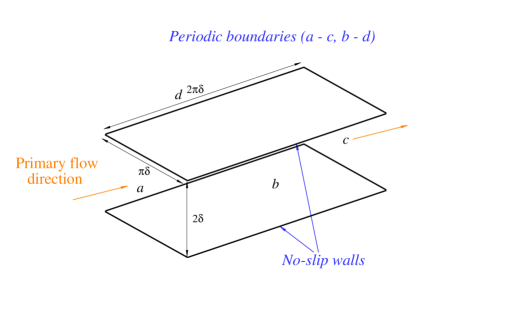
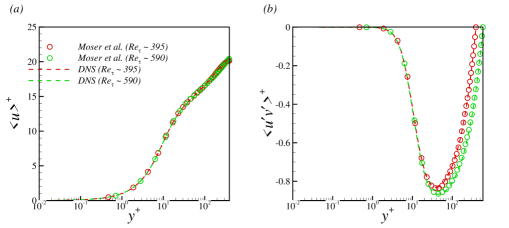
- 在 Reτ ≈ 395 和 590 的通道流显式滤波的 DNS 数据上训练两大 DL/SNS 模型族。
- 架构 A1:张量基神经网络(TBNN),嵌入 Pope–Lund–Novikov SGS 展开形式以强制实现 Galilean、旋转和反射不变性。
- 架构 A2:更简单的网络,使用整体基张量和不变量输入,但仅强调 Galilean 不变性。
- 输入特征来自分解态的对称部分和反对称部分的速度梯度 (S, R) 以及它们的不变量标量。
- 使用光谱简单截断滤波器进行显式滤波,以在 SGS 预测中保留 Galilean 不变性。
- 对在不同滤波宽度和雷诺数下预测的 SGS 应力进行前验和后验评估。
实验结果
研究问题
- RQ1当在显式滤波的 DNS 数据上训练时,基于 DL 的 SGS 模型能否准确再现壁面有界湍流的 SGS 应力?
- RQ2嵌入 DL 架构的不变量(Galilean、旋转、反射)是否提升 SGS 预测在壁面有界流动中的性能?
- RQ3两种架构(A1:通过 TBNN 完整不变量 vs A2:仅 Galilean 不变性)在不同滤波宽度和雷诺数下的前验和后验评估中如何比较?
- RQ4学习到的 SGS 模型是否在不同的 DNS 派生的训练/测试数据集和网格分辨率下具有鲁棒性?
主要发现
- 在前验测试中,两类模型族在耗散和反向散射方面具有相似水平。
- 具有更好特征学习能力的更简单架构(A2)在统计指标上优于嵌入不变量的模型(A1)。
- 尽管架构不同,但基于测试结果,两种模型在后验 LES 应用中都被认为可用。
- 不变量嵌入方法(A1)通过嵌入解析 SGS 展开形式受益,而 A2 则从基张量的跨分量特征提取获得更强的特征提取能力。
- 训练使用在两个 Reτ 值下显式滤波的 DNS 数据,针对各种滤波宽度和雷诺数预测 SGS 应力。
阅读本论文
在 Nubint 阅读器中打开原文,边读边就任意段落提问。
在 Nubint 中阅读本论文本解读由 AI 根据论文原文生成,引用前请核对原文。