
[论文解读] ACLM: A Selective-Denoising based Generative Data Augmentation Approach for Low-Resource Complex NER
ACLM 提出了一种基于选择性去噪和条件生成的数据增强方法,用于低资源复杂命名实体识别(NER),通过在新型文本重建任务上微调 BART 模型,并结合注意力图增强的关键字选择机制,以保留命名实体和语境相关关键词。该方法在单语、跨语言和多语言设置下相比基线模型显著提升 1%–36%,生成的增强样本更具连贯性、多样性和事实性,有效缓解了上下文-实体不匹配问题。
Complex Named Entity Recognition (NER) is the task of detecting linguistically complex named entities in low-context text. In this paper, we present ACLM Attention-map aware keyword selection for Conditional Language Model fine-tuning), a novel data augmentation approach based on conditional generation to address the data scarcity problem in low-resource complex NER. ACLM alleviates the context-entity mismatch issue, a problem existing NER data augmentation techniques suffer from and often generates incoherent augmentations by placing complex named entities in the wrong context. ACLM builds on BART and is optimized on a novel text reconstruction or denoising task - we use selective masking (aided by attention maps) to retain the named entities and certain keywords in the input sentence that provide contextually relevant additional knowledge or hints about the named entities. Compared with other data augmentation strategies, ACLM can generate more diverse and coherent augmentations preserving the true word sense of complex entities in the sentence. We demonstrate the effectiveness of ACLM both qualitatively and quantitatively on monolingual, cross-lingual, and multilingual complex NER across various low-resource settings. ACLM outperforms all our neural baselines by a significant margin (1%-36%). In addition, we demonstrate the application of ACLM to other domains that suffer from data scarcity (e.g., biomedical). In practice, ACLM generates more effective and factual augmentations for these domains than prior methods. Code: https://github.com/Sreyan88/ACLM
研究动机与目标
- 为解决低资源复杂 NER 中因上下文-实体不匹配导致标准数据增强方法失效的数据稀缺问题。
- 生成连贯、多样且事实准确的增强样本,以保留复杂命名实体的真实词义。
- 克服现有方法在未保持语言和上下文一致性的情况下替换或重述实体的局限性。
- 开发一种条件生成框架,在不改变实体本身的情况下引入围绕实体的新上下文模式。
- 证明该方法在其他低资源领域(包括生物医学和科学文本)中的可迁移性。
提出的方法
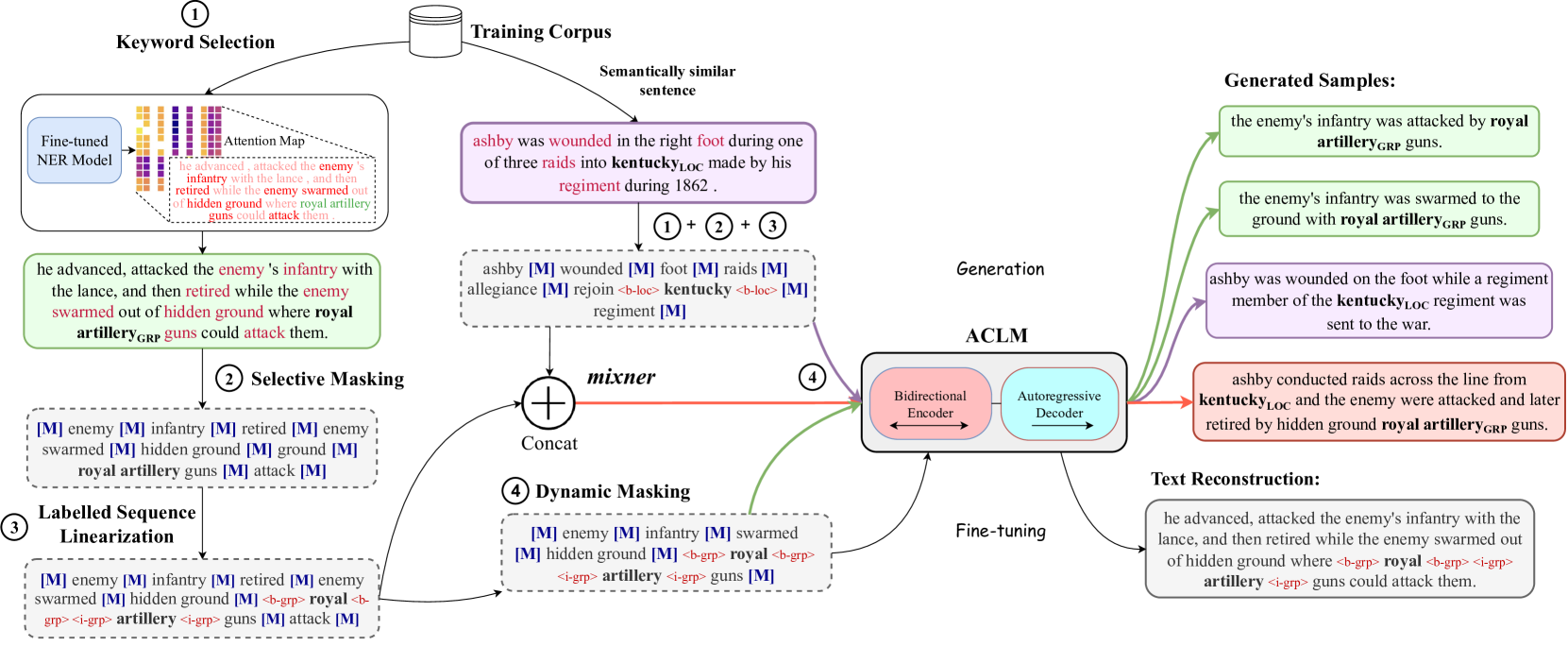
- ACLM 在修改后的去噪目标上微调 BART 模型,采用选择性掩码机制,保留命名实体和从注意力图中提取的语境相关关键词。
- 通过注意力图分析识别关键词,以保留复杂实体周围的语义和句法相关上下文。
- 损坏的输入(模板)由掩码的非实体词组成,仅保留命名实体和选定关键词,作为生成的输入。
- 模型基于该模板生成完整句子,产出多样且语境连贯的增强样本。
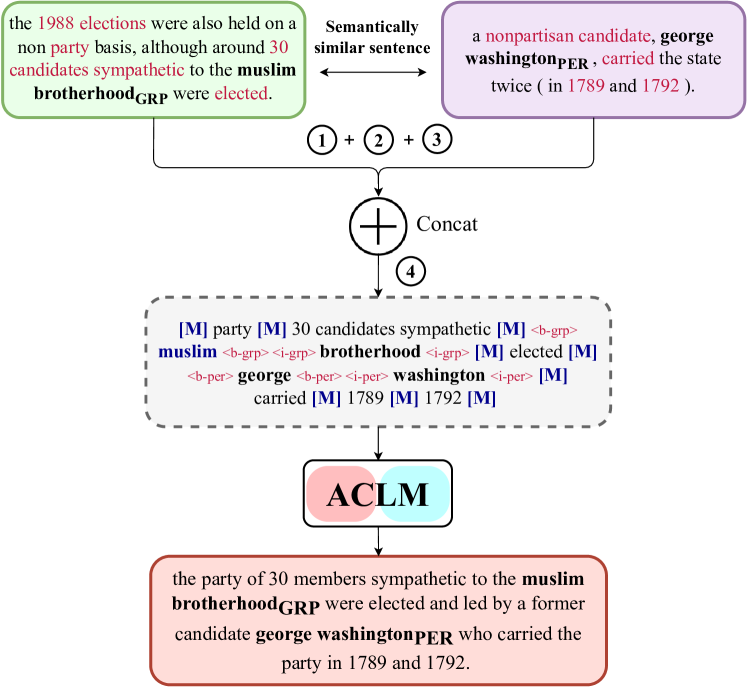
- 通过混合器策略在推理阶段结合多个模板,进一步提升生成多样性。
- 无需外部知识,但该方法设计为未来可扩展以集成知识。
实验结果
研究问题
- RQ1基于条件生成的数据增强方法是否能有效解决低资源复杂 NER 中的数据稀缺问题,且不引入上下文-实体不匹配?
- RQ2与随机掩码或仅实体掩码相比,基于注意力图引导的选择性掩码在提升生成增强样本质量与连贯性方面效果如何?
- RQ3ACLM 在多大程度上能生成多样、事实准确且语境恰当的增强样本,同时保留复杂命名实体的原始词义?
- RQ4ACLM 是否能在新闻以外的低资源设置和领域(如生物医学和科学文本)中实现泛化?
- RQ5在 NER F1 分数和生成质量指标方面,该模型与现有神经网络基线相比表现如何?
主要发现
- ACLM 在单语、跨语言和多语言低资源复杂 NER 设置下,F1 分数相比所有神经网络基线提升 1% 至 36%。
- 在仅使用 500 个训练样本的 MultiCoNER 上,ACLM 的性能下降为 31.8%,而 SOTA 方法为 23%,表明其具有更强的鲁棒性。
- 在定量生成评估中,ACLM 在 200 个训练样本下取得最高多样性得分(实体:22.48,长度:5.67)和最低困惑度(80.77)。
- 在生物医学数据集(如 BC2GM 和 NCBI Disease)上,ACLM 相比基线提升 F1 分数 5.8–6.0 分,显示出强大的可迁移性。
- 定性分析表明,ACLM 生成的增强样本比 MELM 或 LwTR 更具连贯性、细节更丰富且语境更恰当,后者常产生不连贯或仅轻微修改的输出。
- ACLM 避免了上下文-实体不匹配问题,而 MELM 和 LwTR 经常在语义类别间错误地互换实体(如将电影替换为书籍),导致事实性错误。
阅读本论文
在 Nubint 阅读器中打开原文,边读边就任意段落提问。
在 Nubint 中阅读本论文本解读由 AI 根据论文原文生成,引用前请核对原文。