
[论文解读] ACORN: Performant and Predicate-Agnostic Search Over Vector Embeddings and Structured Data
ACORN 引入了一种与谓词无关的高性能混合搜索系统,通过扩展 HNSW 支持谓词子图遍历,高效查询向量嵌入和结构化数据。与先前方法相比,其在 0.9 召回率下实现了 2–1,000× 的更高查询吞吐量,支持任意高基数谓词且性能无下降。
Applications increasingly leverage mixed-modality data, and must jointly search over vector data, such as embedded images, text and video, as well as structured data, such as attributes and keywords. Proposed methods for this hybrid search setting either suffer from poor performance or support a severely restricted set of search predicates (e.g., only small sets of equality predicates), making them impractical for many applications. To address this, we present ACORN, an approach for performant and predicate-agnostic hybrid search. ACORN builds on Hierarchical Navigable Small Worlds (HNSW), a state-of-the-art graph-based approximate nearest neighbor index, and can be implemented efficiently by extending existing HNSW libraries. ACORN introduces the idea of predicate subgraph traversal to emulate a theoretically ideal, but impractical, hybrid search strategy. ACORN's predicate-agnostic construction algorithm is designed to enable this effective search strategy, while supporting a wide array of predicate sets and query semantics. We systematically evaluate ACORN on both prior benchmark datasets, with simple, low-cardinality predicate sets, and complex multi-modal datasets not supported by prior methods. We show that ACORN achieves state-of-the-art performance on all datasets, outperforming prior methods with 2-1,000x higher throughput at a fixed recall.
研究动机与目标
- 解决现有混合搜索系统在依赖预过滤、后过滤或具有受限谓词集的专用索引时所面临的性能与表达能力局限。
- 实现在大规模、无界且多样的谓词集(如范围、相等和正则表达式过滤)上的高效搜索,而无需事先了解查询工作负载。
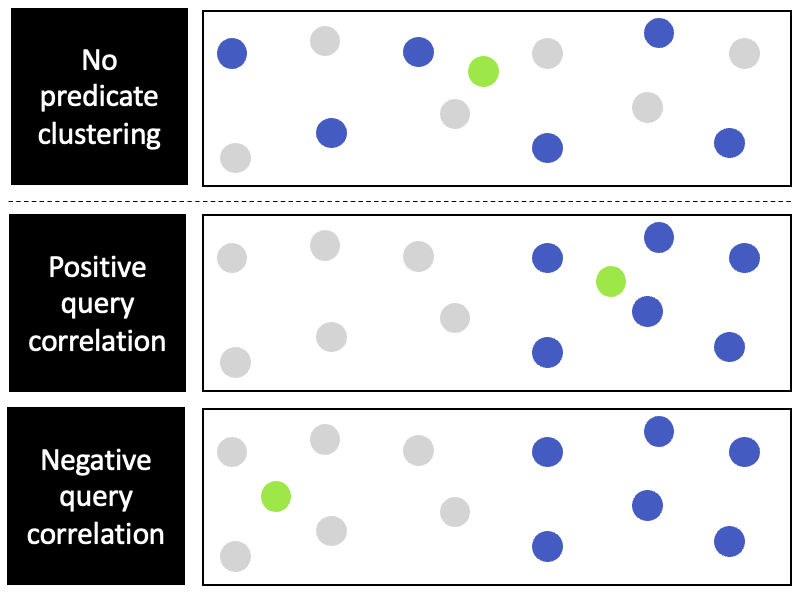
- 设计一种系统,在高选择性或向量相似性与结构化谓词之间相关性较低的情况下,仍能保持高搜索效率和低构建开销。
- 通过最小的工程投入,同时支持高吞吐量生产工作负载(ACORN-γ)和资源受限环境(ACORN-1)。
- 提供一种实用的、与 HNSW 兼容的扩展,实现与谓词无关的搜索,同时不牺牲最先进近似最近邻索引的性能特性。
提出的方法
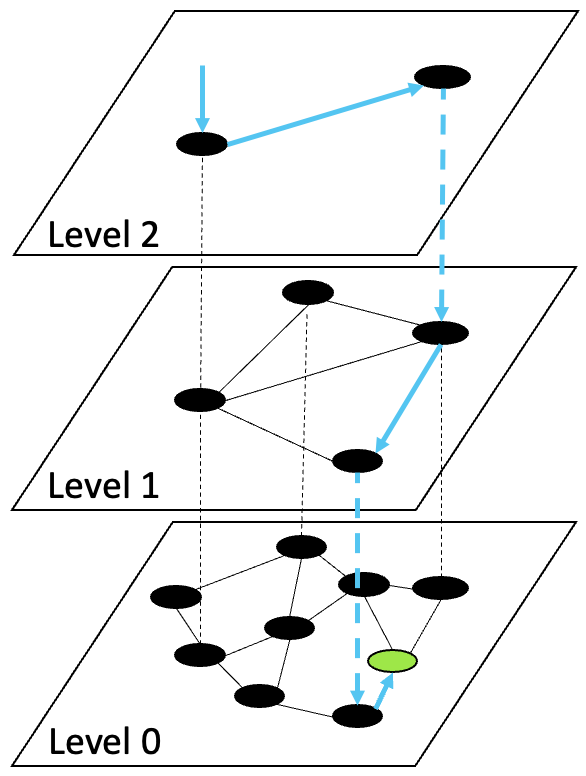
- ACORN 引入谓词子图遍历策略,动态探索由满足查询中结构化谓词的节点所诱导的 HNSW 索引子图。
- 它通过一种与谓词无关的构建过程扩展了 HNSW 索引算法,通过剪枝和重加权边来在存在谓词约束时保持图结构和搜索效率。
- ACORN-γ 在索引构建期间采用参数化的边剪枝与扩展策略,以优化搜索性能,模拟理想的子图质量指标,如低强连通分量数量、最优高度和平衡出度。
- ACORN-1 采用轻量级构建方法,通过限制边扩展来减少索引大小和构建时间,代价是略微降低搜索性能。
- 该系统可无缝集成至现有 HNSW 库中,实现无需重大架构变更的部署。
- 它利用 HNSW 的分层结构,在保持对数时间复杂度的同时,通过子图遍历而非暴力或全图探索实现高效过滤。
实验结果
研究问题
- RQ1混合搜索系统是否能在无先验查询工作负载知识的前提下,对多样化且高基数的谓词集实现高性能?
- RQ2在吞吐量和召回率方面,基于修改后的 HNSW 索引的谓词子图遍历是否优于传统的预过滤和后过滤策略?
- RQ3与谓词无关的索引构建方法是否能在支持任意结构化谓词的同时,保持 HNSW 的结构特性(如图高度和连通性)?
- RQ4ACORN 在不同选择性、属性相关性和数据规模的数据库上与现有系统相比如何扩展?
- RQ5轻量级变体(ACORN-1)在减少构建时间和内存开销的同时,能在多大程度上保持高性能搜索?
主要发现
- ACORN-γ 在基准数据集和复杂多模态数据集上,与先前方法相比,在 0.9 召回率下实现了 2–1,000× 的更高查询吞吐量。
- 在 TripClick 数据集上,ACORN-γ 维持了较高的子图质量,每层平均仅有 1.2 个强连通分量,表明谓词子图具有稳健的连通性。
- ACORN-γ 的谓词子图在未压缩层级上表现出 12.5 的图高度和平均 14.3 的出度,紧密逼近 HNSW 的最优结构特性。
- ACORN-1 相较于 ACORN-γ 将首次响应时间(TTI)减少了 9–53 倍,使其适用于资源受限的部署场景。
- ACORN 在低基数和高基数谓词工作负载下均优于 Milvus、Weaviate 和 FAISS-IVF,尤其在低相关性或高选择性条件下表现更优。
- 与谓词无关的构建方法支持无界且多样的谓词集,包括范围、相等和正则表达式过滤,且性能无下降。
阅读本论文
在 Nubint 阅读器中打开原文,边读边就任意段落提问。
在 Nubint 中阅读本论文本解读由 AI 根据论文原文生成,引用前请核对原文。