
[论文解读] Active flow control for three-dimensional cylinders through deep reinforcement learning
本文通过多智能体深度强化学习(MARL)控制在圆柱表面的多个零净质量流量合成射流,并通过与 CFD 求解器的 PPO 耦合,在三维圆柱上实现阻力降低的成功案例。
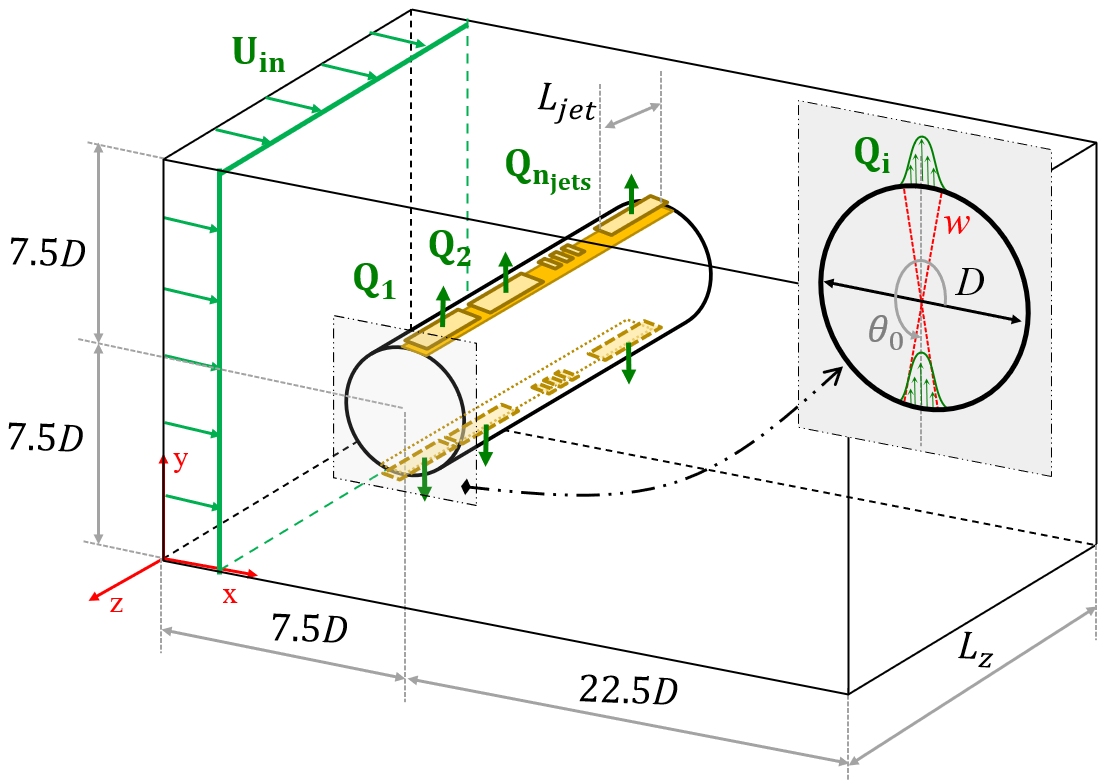
This paper presents for the first time successful results of active flow control with multiple independently controlled zero-net-mass-flux synthetic jets. The jets are placed on a three-dimensional cylinder along its span with the aim of reducing the drag coefficient. The method is based on a deep-reinforcement-learning framework that couples a computational-fluid-dynamics solver with an agent using the proximal-policy-optimization algorithm. We implement a multi-agent reinforcement-learning framework which offers numerous advantages: it exploits local invariants, makes the control adaptable to different geometries, facilitates transfer learning and cross-application of agents and results in significant training speedup. In this contribution we report significant drag reduction after applying the DRL-based control in three different configurations of the problem.
研究动机与目标
- 将基于 DRL 的主动流动控制从 2D 扩展到具有多个表面致动器的 3D 圆柱。
- 利用多智能体局部观测来管理高维射流控制,避免高昂的训练成本。
- 在一系列雷诺数和几何配置下评估阻力降低性能。
- 提供一个针对 3D 尾迹控制的 MARL 基准,并给出致动器放置和观测选择的见解。
提出的方法
- 将 Alya CFD 求解器(有限元 Navier–Stokes)与 multi-agent PPO 框架耦合。
- 部署若干独立代理,共享神经网络权重,以 Q 来控制展向射流的质量流量。
- 基于阻力降低和升力惩罚定义局部与全局奖励,由 β=0.8 的参数进行平衡。
- 使用伪环境中 85 个探针的切片来观测尾迹状态,提供可选的邻近探针以形成 255 探针观测。
- 使用 Q 缩放,其中 Q_max3D = 2 * Q_max2D,将策略输出映射到射流致动,并强制执行相对的射流动作以确保每个环境的零净质量流量。
实验结果
研究问题
- RQ1在局部运行的代理下,MARL 是否能够控制 3D 圆柱上多个表面射流,在一系列雷诺数下实现阻力降低?
- RQ2如何将邻近尾迹观测和不同跨展向域大小纳入学习,如何影响学习与性能?
- RQ3在三维相较于二维基准下,可以实现怎样的阻力降低性能,以及尾迹动力学如何影响策略选择?
主要发现
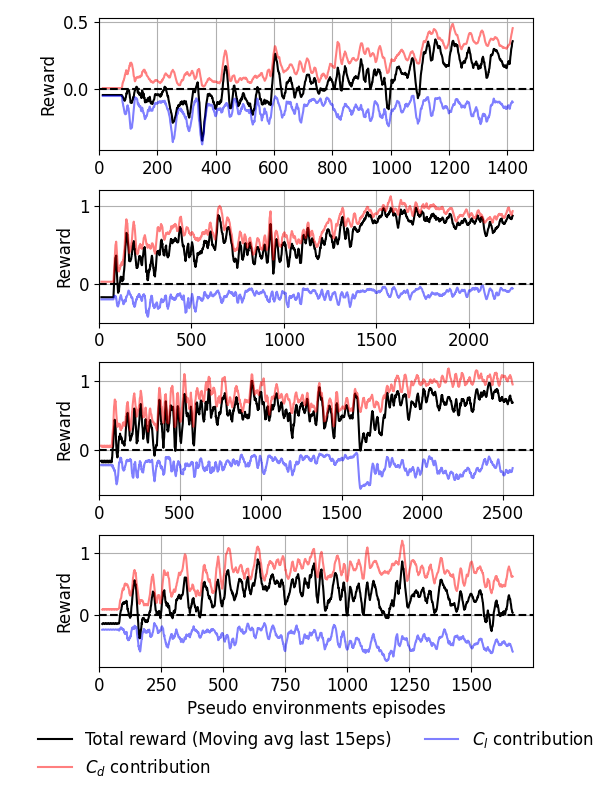
- MARL 在 Re = 100、200、300、400 的 3D 圆柱案例中实现显著的阻力降低,分别为 9.4%、17.2%、6.7%、9.9%(Ljet/D = 1)。
- 使用较短的射流(Ljet/D = 0.4),阻力降低为 4.3%、11.0%、10.8%、15.0%(局部观测)和 8.0%、12.7%、15.2%、11.0%(观测邻近尾迹)。
- 3D 结果在较高 Re 时显示出比其 2D 对应结果更一致的阻力降低性能,尽管存在一些与 Re 相关的变化。
- DRL 控制降低涡脱落强度并延迟尾迹再附着,表明驱动具有尾迹稳定作用。
- 策略呈现跨展向的挤压式、同步射流策略,较高 Re 可能受益于改变射流长度和观测粒度。
- MARL 框架支持在具有共享权重的伪环境中训练,加速学习并在概念上实现对不同圆柱几何的迁移。
阅读本论文
在 Nubint 阅读器中打开原文,边读边就任意段落提问。
在 Nubint 中阅读本论文本解读由 AI 根据论文原文生成,引用前请核对原文。