
[论文解读] Active Learning in Symbolic Regression with Physical Constraints
本文提出了一种用于符号回归的主动学习框架,结合查询委员会(QBC)与物理约束,以减少数据需求并提升方程发现能力。通过利用候选方程的帕累托前沿指导数据选择,并将软性物理约束(尤其是对称性)作为正则化项,该方法在使用远少于先前方法(如AI Feynman)的数据点情况下,实现了已知方程的最先进复现性能。
Evolutionary symbolic regression (SR) fits a symbolic equation to data, which gives a concise interpretable model. We explore using SR as a method to propose which data to gather in an active learning setting with physical constraints. SR with active learning proposes which experiments to do next. Active learning is done with query by committee, where the Pareto frontier of equations is the committee. The physical constraints improve proposed equations in very low data settings. These approaches reduce the data required for SR and achieves state of the art results in data required to rediscover known equations.
研究动机与目标
- 减少符号回归为复现已知科学方程所需的数据点数量。
- 在低数据量和噪声环境下,通过主动学习提升符号回归性能。
- 将物理约束作为正则化手段,引导搜索过程朝向物理解释性强的方程。
- 评估不同类型物理约束对符号回归性能的影响。
- 在Feynman数据集上与最先进方法(如AI Feynman)进行基准对比。
提出的方法
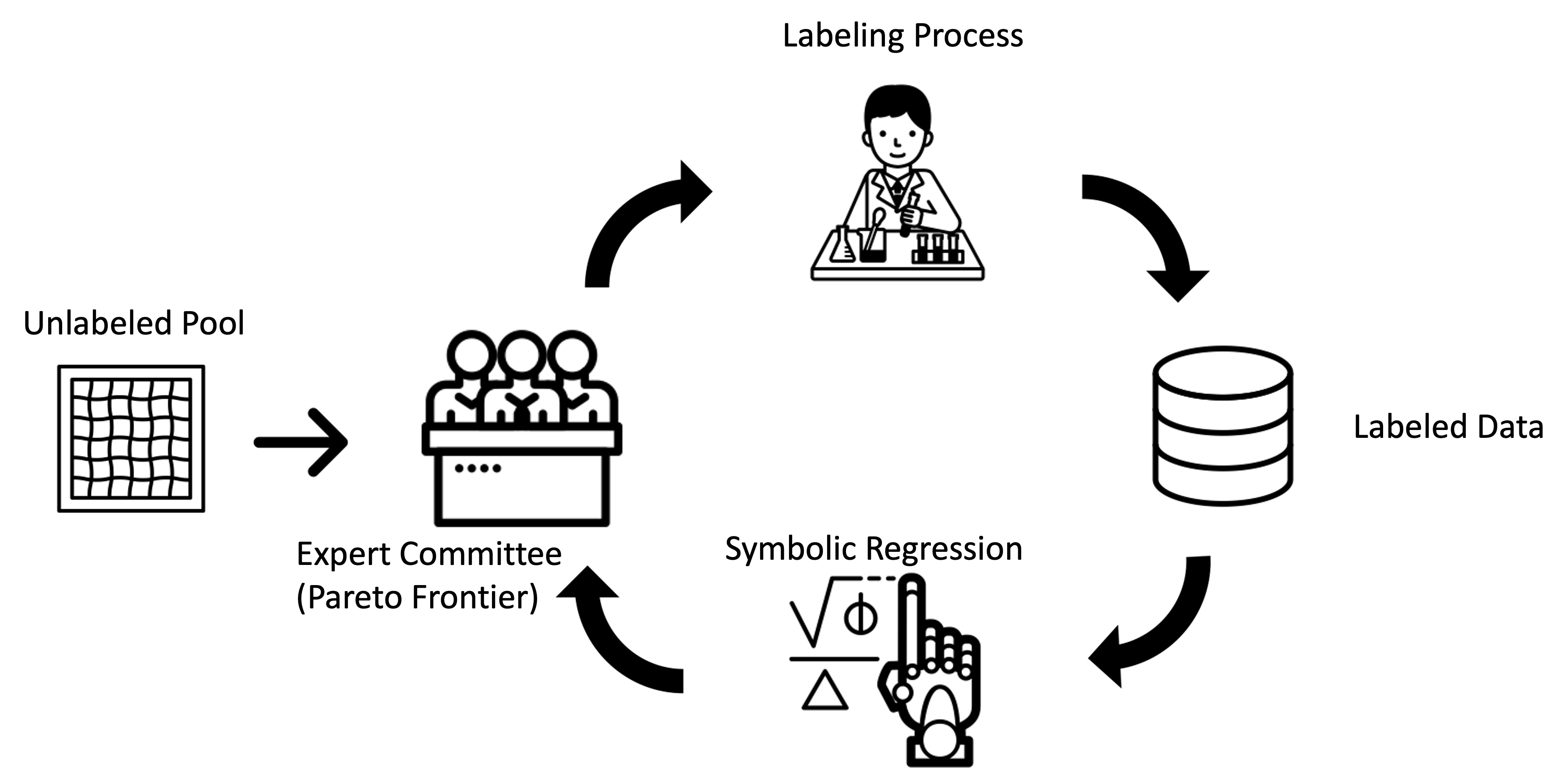
- 采用查询委员会(QBC)方法,以进化出的方程的帕累托前沿作为委员会,选择最具信息量的下一个数据点。
- 使用遗传算法与二叉树表示法演化候选符号方程。
- 将软性物理约束(发散性、渐近线、单调性、正性与对称性)作为正则化项整合进损失函数。
- 应用对称性与单位正确性等约束,引导搜索过程朝向物理解释合理的解。
- 使用Feynman数据集作为基准,评估在不同数据量与噪声条件下的方程复现性能。
- 通过消融研究比较在多个方程与噪声水平下,约束优化与无约束优化的性能差异。
实验结果
研究问题
- RQ1基于QBC的主动学习能否减少符号回归复现已知方程所需的数据点数量?
- RQ2在低数据量环境下,不同类型的物理约束(如对称性、发散性)如何影响符号回归的性能?
- RQ3引入软性物理约束是否能提升符号回归在噪声环境下的鲁棒性?
- RQ4与最先进方法(如AI Feynman)相比,该方法在数据效率与方程复现率方面表现如何?
- RQ5在何种情况下,物理约束反而会阻碍而非促进符号回归过程?
主要发现
- 在引入发散性约束的情况下,引力公式复现率提升了10%,优于无约束回归方法。
- 对称性约束提升了距离公式的复现性能,在无噪声情况下p值为0.061,表明存在统计上边缘显著但具有实际意义的改进。
- 在高噪声条件(噪声水平0.1)下,约束优化在139次运行中成功复现了距离公式,而无约束优化则完全失败。
- 出乎意料的是,渐近线与单调性约束降低了性能,表明并非所有物理约束都有益,可能误导搜索过程。
- 该方法在噪声环境下表现出强鲁棒性,即使在噪声条件下,约束优化也优于无约束方法,尤其在复杂方程上表现更优。
- QBC与物理约束的结合实现了最先进水平的数据效率,其复现已知方程所需的数据点数量少于AI Feynman。
阅读本论文
在 Nubint 阅读器中打开原文,边读边就任意段落提问。
在 Nubint 中阅读本论文本解读由 AI 根据论文原文生成,引用前请核对原文。