
[论文解读] Adapted Large Language Models Can Outperform Medical Experts in Clinical Text Summarization
研究表明,适应化的大型语言模型(LLMs)在多项临床摘要任务中能达到甚至超过医学专家摘要,使用上下文学习和微调方法,含有安全分析。
Analyzing vast textual data and summarizing key information from electronic health records imposes a substantial burden on how clinicians allocate their time. Although large language models (LLMs) have shown promise in natural language processing (NLP), their effectiveness on a diverse range of clinical summarization tasks remains unproven. In this study, we apply adaptation methods to eight LLMs, spanning four distinct clinical summarization tasks: radiology reports, patient questions, progress notes, and doctor-patient dialogue. Quantitative assessments with syntactic, semantic, and conceptual NLP metrics reveal trade-offs between models and adaptation methods. A clinical reader study with ten physicians evaluates summary completeness, correctness, and conciseness; in a majority of cases, summaries from our best adapted LLMs are either equivalent (45%) or superior (36%) compared to summaries from medical experts. The ensuing safety analysis highlights challenges faced by both LLMs and medical experts, as we connect errors to potential medical harm and categorize types of fabricated information. Our research provides evidence of LLMs outperforming medical experts in clinical text summarization across multiple tasks. This suggests that integrating LLMs into clinical workflows could alleviate documentation burden, allowing clinicians to focus more on patient care.
研究动机与目标
- 通过评估适应化的LLMs是否能生成高质量的临床摘要来减少临床医生的文书工作负担。
- 评估模型类型、适应方法和任务之间的性能权衡。
- 确定LLM生成的摘要是否不劣于或优于医学专家摘要。
- 探讨在临床使用中可能造成伤害的安全隐患和错误类型。
提出的方法
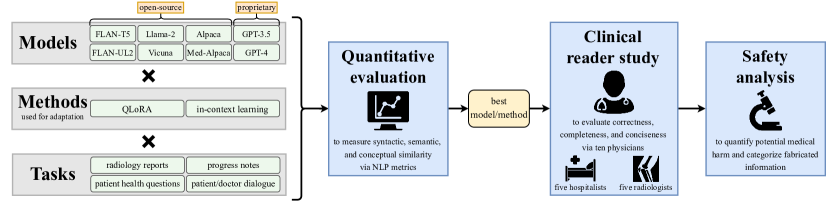
- 评估八个LLMs(开源的Seq2Seq和自回归模型,以及专有模型)在四个临床摘要任务上,使用六个数据集。
- 应用两种适应方法:带最近邻检索示例的上下文学习(ICL)和量化低秩适应(QLoRA)微调。
- 调整提示以包含任务相关的专业知识和长度约束;将模型温度设为0.1。
- 使用NLP度量(BLEU、ROUGE-L、BERTScore、MEDCON)以及基于QuickUMLS的概念检查进行评估。
- 进行一项临床读者研究,邀请十位医生,将最佳模型摘要与医学专家摘要进行对比。
- 进行安全性分析,将错误与潜在伤害相关联,并对虚构信息进行分类。
实验结果
研究问题
- RQ1适应化的LLMs是否能够在多项临床任务中生成不劣于或优于医学专家的临床摘要?
- RQ2在放射学、患者提问、病历进展记录和对话摘要方面,哪种模型类型与适应方法的组合能带来最佳性能?
- RQ3NLP度量分数与临床读者在各任务中的偏好之间有何相关性?
- RQ4与LLM生成的临床摘要相关的安全考虑和错误类型(包括潜在伤害和虚假信息)有哪些?
主要发现
- 表现最佳的设置:GPT-4 结合上下文学习在完整性和正确性方面通常优于医学专家摘要。
- 适应方法的选择显示出权衡;在上下文学习中,如果有足够的上下文示例,可以达到或超过微调模型。
- 开源模型配合QLoRA可以胜过一些基线,但专有模型(GPT-3.5、GPT-4)在有足够的上下文示例时通常取得更强的结果。
- 临床读者研究:在放射学、患者提问和病历进展记录方面,与医学专家相比,模型摘要在81%的案例中被偏好或不劣(45% 不劣,36% 偏好)。
- 安全性分析揭示了LLMs和医学专家的共同挑战;错误与潜在医疗危害相关,且对虚构信息的类型进行了分类。

阅读本论文
在 Nubint 阅读器中打开原文,边读边就任意段落提问。
在 Nubint 中阅读本论文本解读由 AI 根据论文原文生成,引用前请核对原文。