
[论文解读] Adaptive Policy Learning for Offline-to-Online Reinforcement Learning
本文提出自适应策略学习(APL)框架,通过在离线数据上应用悲观更新、在在线数据上应用乐观/贪婪更新,自适应地结合离线与在线强化学习。该方法实现了高样本效率,即使从低质量的离线数据集中也能学习到专家策略——仅使用20%的在线交互,其样本效率已超越先前的离线到在线方法。
Conventional reinforcement learning (RL) needs an environment to collect fresh data, which is impractical when online interactions are costly. Offline RL provides an alternative solution by directly learning from the previously collected dataset. However, it will yield unsatisfactory performance if the quality of the offline datasets is poor. In this paper, we consider an offline-to-online setting where the agent is first learned from the offline dataset and then trained online, and propose a framework called Adaptive Policy Learning for effectively taking advantage of offline and online data. Specifically, we explicitly consider the difference between the online and offline data and apply an adaptive update scheme accordingly, that is, a pessimistic update strategy for the offline dataset and an optimistic/greedy update scheme for the online dataset. Such a simple and effective method provides a way to mix the offline and online RL and achieve the best of both worlds. We further provide two detailed algorithms for implementing the framework through embedding value or policy-based RL algorithms into it. Finally, we conduct extensive experiments on popular continuous control tasks, and results show that our algorithm can learn the expert policy with high sample efficiency even when the quality of offline dataset is poor, e.g., random dataset.
研究动机与目标
- 解决当数据集质量较差或缺乏最优动作覆盖时,离线强化学习的局限性。
- 通过利用离线与在线数据的互补优势,提升离线到在线强化学习的样本效率。
- 设计一种统一框架,根据数据来源(离线与在线)自适应调整更新策略,且无需大量超参数调优。
- 证明结合离线数据多样性与在线策略改进,可在连续控制任务中实现更优性能。
提出的方法
- APL框架采用两级回放缓冲区,以区分离线与在线数据,支持基于数据来源的特定更新策略。
- 对离线数据应用悲观更新策略,以缓解分布偏移问题,并避免对分布外动作的过拟合。
- 对在线数据采用乐观或贪婪更新策略,以加速收敛并提升策略性能。
- 该框架通过两种算法实现:基于值函数的方法(GCQL)与基于策略的方法(GCQL-i2e5),两者均融合了当前最先进的离线与在线强化学习技术。
- 引入在线-离线回放缓冲区(OORB),以动态管理数据流,其中阈值 $ p $ 依据策略相似性决定数据选择。
- 自适应更新机制使用一个基于数据来源变化的加权因子 $ \mathcal{W} $,实现离线与在线学习之间的动态平衡。
实验结果
研究问题
- RQ1能否通过根据数据来源自适应调整更新策略,设计一个统一框架,有效结合离线与在线强化学习?
- RQ2离线到在线强化学习的性能在多大程度上依赖于离线数据集的质量?该框架是否能在随机或次优数据下仍保持高样本效率?
- RQ3在线缓冲区与贪婪更新策略在稳定学习与提升性能方面分别起到多大作用?
- RQ4该框架对超参数(如初始训练步数、离线更新频率及OORB阈值)的敏感性如何?
主要发现
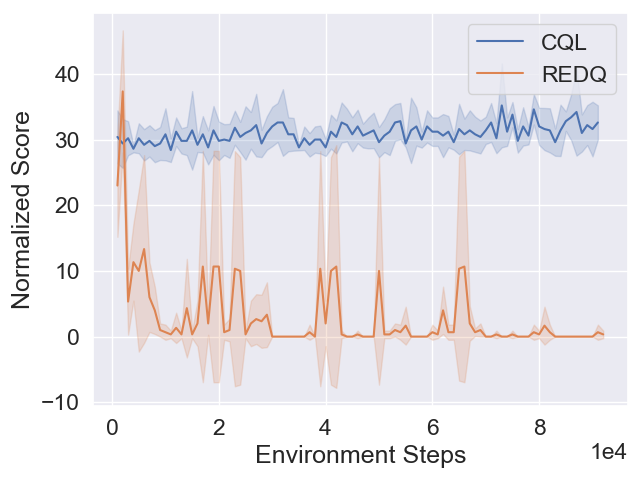
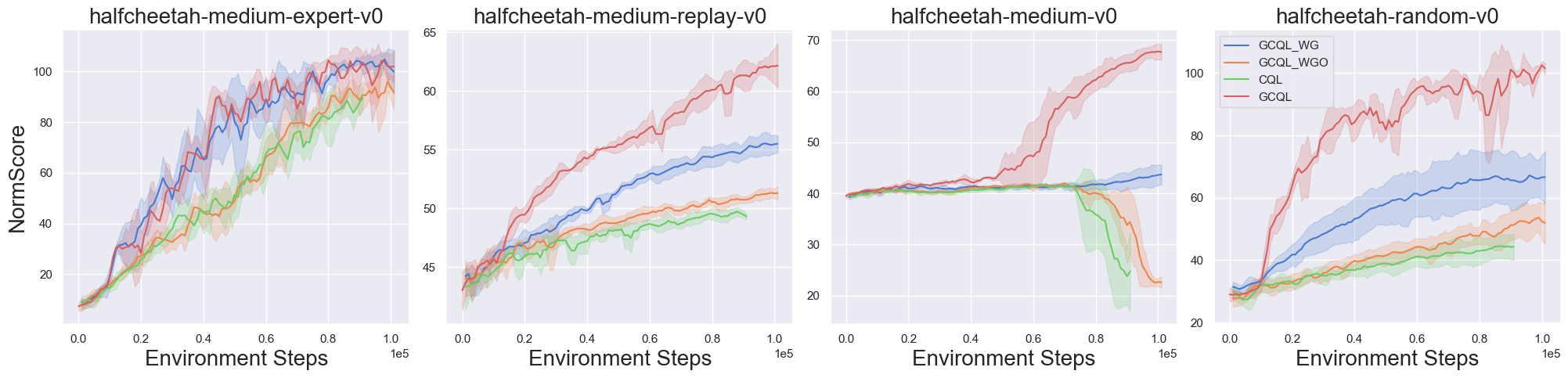
- 即使离线数据集为随机数据,APL框架在MuJoCo连续控制任务中仍能达到专家级性能,展现出对低质量数据的强鲁棒性。
- 仅使用20%的在线交互,该方法在样本效率上已超越先前最先进方法(Nair et al., 2020)。
- 消融实验表明,在线缓冲区与贪婪更新策略均至关重要:移除任一组件均导致性能显著下降,尤其在中等与随机数据集上更为明显。
- OORB阈值 $ p $ 对性能有显著影响,$ p = 0.5 $ 在各类数据集上均取得最佳整体表现,表明在线与离线数据的均衡利用为最优策略。
- 该方法对 $ T_{\text{initial}} $ 与 $ T_{\text{off}} $ 相对不敏感,表明在大多数场景下对默认超参数设置具有鲁棒性。
- GCQL(基于值函数)与GCQL-i2e5(基于策略)两种实现方式均表现出色,证实该框架可兼容多种强化学习算法。
阅读本论文
在 Nubint 阅读器中打开原文,边读边就任意段落提问。
在 Nubint 中阅读本论文本解读由 AI 根据论文原文生成,引用前请核对原文。