
[论文解读] Adaptive-TMLE for the Average Treatment Effect based on Randomized Controlled Trial Augmented with Real-World Data
本文提出自适应TMLE(A-TMLE),一种基于目标损失的估计框架,整合随机对照试验(RCT)和真实世界数据(RWD),以更高效地估计平均治疗效应(ATE)。通过从RWD中自适应学习偏差函数并利用双重稳健性,A-TMLE实现$√n$-一致性与渐近正态性,其有限样本效率与一个已知最优的估计器相当,在模拟中表现出更低的均方误差和更窄的置信区间,优于现有方法。
We consider the problem of estimating the average treatment effect (ATE) when both randomized control trial (RCT) data and external real-world data (RWD) are available. We decompose the ATE estimand as the difference between a pooled-ATE estimand that integrates RCT and RWD and a bias estimand that captures the conditional effect of RCT enrollment on the outcome. We introduce an adaptive targeted maximum likelihood estimation (A-TMLE) framework to estimate them. We prove that the A-TMLE estimator is root-n-consistent and asymptotically normal. Moreover, in finite sample, it achieves the super-efficiency one would obtain had one known the oracle model for the conditional effect of the RCT enrollment on the outcome. Consequently, the smaller and more parsimonious the working model of the bias induced by the RWD is, the greater our estimator's efficiency, while our estimator will always be at least as efficient as an efficient estimator that uses the RCT data only. A-TMLE outperforms existing methods in simulations by having smaller mean-squared-error and 95% confidence intervals. We apply A-TMLE to augment the DEVOTE trial with external data from the Optum Clinformatics Data Mart, demonstrating its potential to establish treatment superiority in noninferiority trials. A-TMLE could utilize external RWD to help improve the power of randomized trials without biasing the estimates of intervention effects. This approach could allow for smaller, faster trials, decreasing the time until patients can receive effective treatments.
研究动机与目标
- 解决在结合RCT与真实世界数据(RWD)时,因人群特征差异及可能违反正性或可交换性假设而导致的平均治疗效应(ATE)估计效率低下问题。
- 开发一种方法,利用RWD提升估计精度,同时不引入偏差,尤其在RCT入组状态影响结果的效应超出可观测协变量时。
- 构建一个在渐近正态性与有限样本中均表现优异的估计器,使其在真实偏差模型下达到已知最优估计器的效率水平。
- 提供一种数据自适应框架,通过偏差-方差权衡实现正则化,确保稳健性的同时最大化来自RWD的效率增益。
提出的方法
- 该方法将ATE分解为一个合并的ATE目标参数(结合RCT与RWD)和一个捕捉RCT入组对结果条件效应的偏差目标参数。
- 提出一种自适应目标最小损失估计(A-TMLE)框架,通过交叉验证或类似模型选择方法,自适应地选择偏差函数的工作模型。
- A-TMLE利用来自影响函数的巧妙协变量,对结果回归的初始估计量($\bar{Q}$)进行目标调整,确保双重稳健性与渐近正态性。
- 估计量基于有效影响函数的经验均值进行一步更新,无需迭代更新,从而得到闭式解。
- 该方法确保在真实偏差模型下,A-TMLE的影响函数等于有效影响函数,从而在有限样本中实现超效率。
- 通过保持标准TMLE的稳健性,即使工作模型设定错误,只要模型选择合理,仍能保证渐近正态性与一致性。
实验结果
研究问题
- RQ1是否可以利用真实世界数据在不引入偏差的前提下提升RCT中ATE估计的效率?
- RQ2如何建模并估计RCT入组对结果的条件效应,以校正数据融合中的选择偏差?
- RQ3一种自适应地从RWD中学习偏差函数、同时保持双重稳健性的估计器,在有限样本中的表现如何?
- RQ4A-TMLE是否相对于已知真实偏差函数的最优模型展现出超效率?
- RQ5A-TMLE能否在提升效率的同时,保持渐近正态性与一致性,超越仅基于RCT的估计器?
主要发现
- A-TMLE具有$\sqrt{n}$-一致性与渐近正态性,在标准正则性条件下可保证有效推断。
- 在有限样本中,A-TMLE实现的超效率与已知真实偏差模型的最优估计器相当,即达到在已知偏差函数下可实现的最佳效率水平。
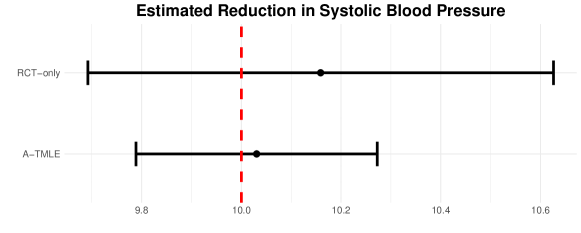
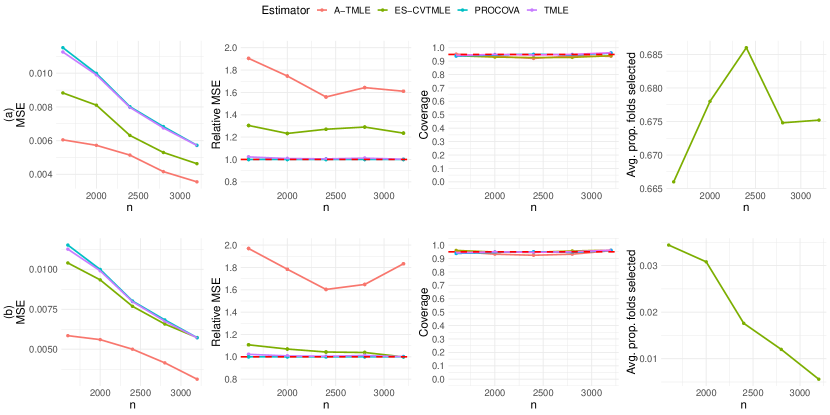
- 在模拟中,该方法优于现有方法,表现出更低的均方误差与更窄的95%置信区间。
- 效率增益与真实偏差函数的复杂度成正比:RCT入组对结果的影响越复杂,效率提升越显著。
- 即使偏差较大,但若其可被协变量与治疗的函数较好近似,A-TMLE仍能实现显著的效率增益。
- A-TMLE的效率始终不低于仅基于RCT的高效估计器,且能充分利用RWD提升精度,同时不损害稳健性。
阅读本论文
在 Nubint 阅读器中打开原文,边读边就任意段落提问。
在 Nubint 中阅读本论文本解读由 AI 根据论文原文生成,引用前请核对原文。