
[论文解读] Advancing LLM Reasoning Generalists with Preference Trees
Eurus 是一套开源大语言模型,通过 UltraInteract 微调,在开源模型中实现最先进的推理性能,并在具有挑战性的基准测试中对 GPT-3.5 Turbo 也具竞争力,方法是利用树状偏好数据方法和新颖的奖励建模。
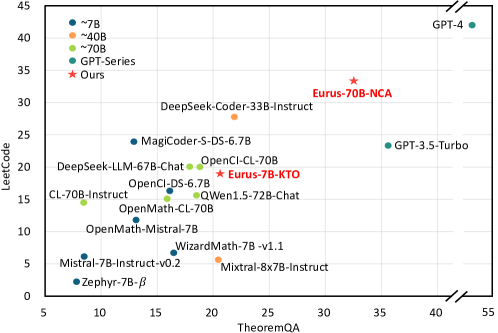
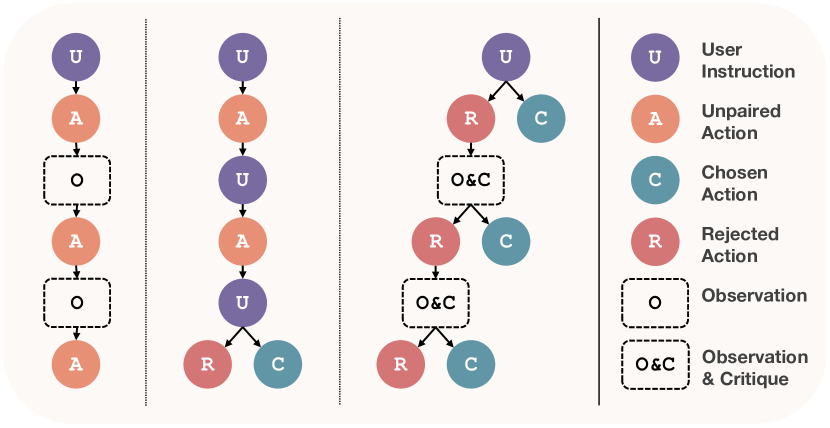
We introduce Eurus, a suite of large language models (LLMs) optimized for reasoning. Finetuned from Mistral-7B and CodeLlama-70B, Eurus models achieve state-of-the-art results among open-source models on a diverse set of benchmarks covering mathematics, code generation, and logical reasoning problems. Notably, Eurus-70B beats GPT-3.5 Turbo in reasoning through a comprehensive benchmarking across 12 tests covering five tasks, and achieves a 33.3% pass@1 accuracy on LeetCode and 32.6% on TheoremQA, two challenging benchmarks, substantially outperforming existing open-source models by margins more than 13.3%. The strong performance of Eurus can be primarily attributed to UltraInteract, our newly-curated large-scale, high-quality alignment dataset specifically designed for complex reasoning tasks. UltraInteract can be used in both supervised fine-tuning and preference learning. For each instruction, it includes a preference tree consisting of (1) reasoning chains with diverse planning strategies in a unified format, (2) multi-turn interaction trajectories with the environment and the critique, and (3) pairwise data to facilitate preference learning. UltraInteract allows us to conduct an in-depth exploration of preference learning for reasoning tasks. Our investigation reveals that some well-established preference learning algorithms may be less suitable for reasoning tasks compared to their effectiveness in general conversations. Inspired by this, we derive a novel reward modeling objective which, together with UltraInteract, leads to a strong reward model.
研究动机与目标
- 通过改进对齐数据质量和偏好学习,缩小开源模型与专有模型在复杂推理方面的差距。
- 通过使用 UltraInteract 对齐数据对 Mistral-7B 和 CodeLlama-70B 进行微调来开发 Eurus 模型。
- 研究偏好学习算法(DPO、KTO、NCA)在推理任务中的有效性并推导奖励建模目标。
- 提供高质量、树状结构的对齐数据集(UltraInteract),用于有监督微调和偏好学习。
提出的方法
- 创建 UltraInteract:86K 条指令和 220K 对行动对,组织为多轮推理的偏好树。
- 将问题分解为子任务;以文本或代码生成逐步行动;与环境(Python 解释器)和评审模型交互。
- 使用仅叶子节点正确行动的训练数据以及数据混合(UltraChat、ShareGPT2、OpenOrca)来训练 Eurus-7B-SFT 和 Eurus-70B-SFT。
- 使用多轮轨迹对探索三种偏好学习算法(DPO、KTO、NCA);在 Bradley-Terry 目标上加入数据奖励正则化项。
- 开发 Eurus-RM-7B 奖励模型,采用修改后的目标,使选定行动的奖励增加、被拒绝行动的奖励降低;在 RM 基准上进行评估。
实验结果
研究问题
- RQ1UltraInteract 的树状结构、多轮对齐数据是否能比传统的单轮数据更有效提升开源 LLM 的推理能力?
- RQ2哪些偏好学习算法在推理任务中最有效,以及奖励强调(绝对奖励 vs 相对奖励)如何影响性能?
- RQ3将 UltraInteract 与其他对齐数据混合是否能在提升推理和工具使用能力的同时保留指令遵循能力?
- RQ4专用奖励模型(Eurus-RM-7B)在提升基于推理的评估指标和重新排序任务方面有多高的效果?
主要发现
- Eurus-7B 和 Eurus-70B 在同等规模的开源模型中,在多样化的推理基准上实现了最佳整体性能。
- Eurus-70B-SFT 在若干基准上达到与 GPT-3.5 Turbo 相当的性能;加入 KTO/NCA 提升了数学和多轮评估。
- DPO 在许多基准上可能降低推理性能,而 KTO 和 NCA 始终改善结果;对所选解给出更高的绝对奖励与更好性能相关。
- Eurus-RM-7B 提供强大的基于奖励模型的重新排序,通常超越更大基线,与人类对推理任务的判断相关性高。
- UltraInteract 数据设计(多样化推理模式、工具使用、多轮评审)在与标准 SFT 数据集混合时,对推理能力提升至关重要。
阅读本论文
在 Nubint 阅读器中打开原文,边读边就任意段落提问。
在 Nubint 中阅读本论文本解读由 AI 根据论文原文生成,引用前请核对原文。