
[论文解读] Advancing Pose-Guided Image Synthesis with Progressive Conditional Diffusion Models
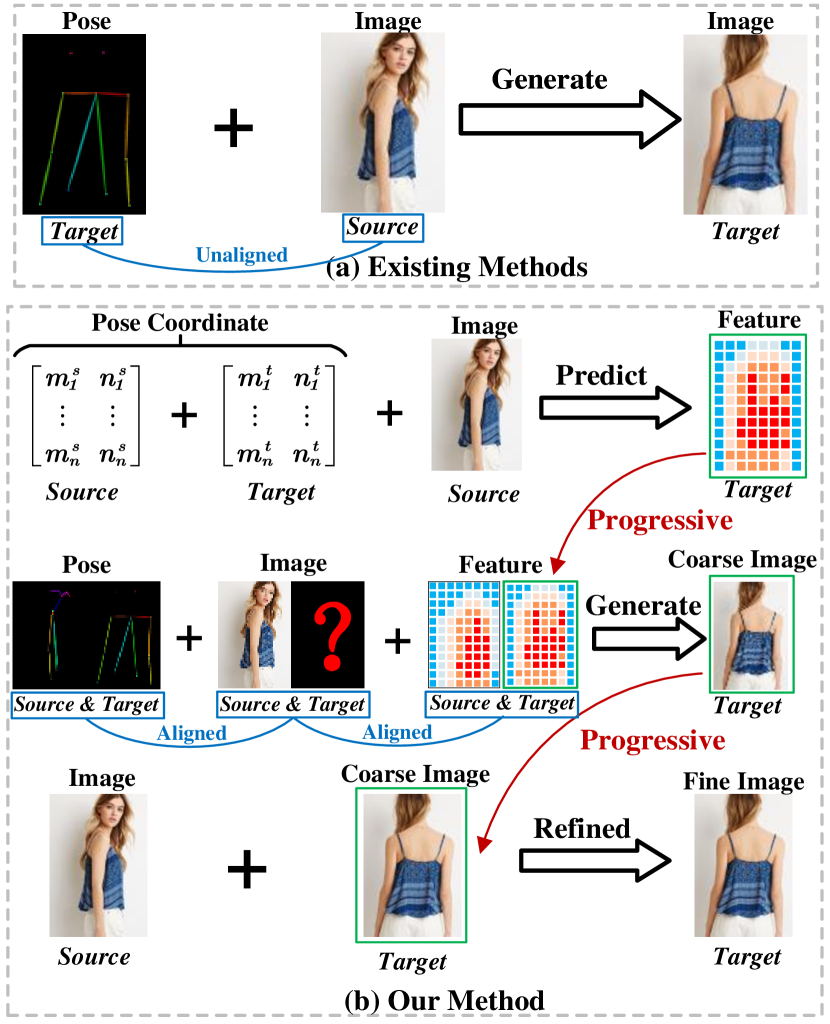
PCDMs 引入三阶段渐进扩散框架,用于桥接源姿势与目标姿势以实现姿态引导的人物图像合成,提升真实感与一致性。
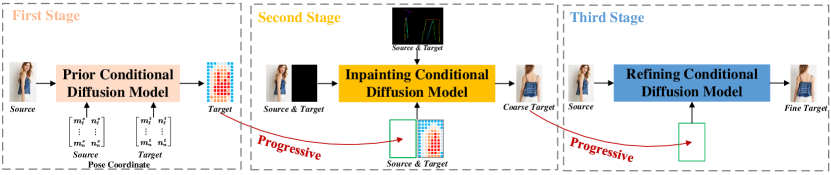
Recent work has showcased the significant potential of diffusion models in pose-guided person image synthesis. However, owing to the inconsistency in pose between the source and target images, synthesizing an image with a distinct pose, relying exclusively on the source image and target pose information, remains a formidable challenge. This paper presents Progressive Conditional Diffusion Models (PCDMs) that incrementally bridge the gap between person images under the target and source poses through three stages. Specifically, in the first stage, we design a simple prior conditional diffusion model that predicts the global features of the target image by mining the global alignment relationship between pose coordinates and image appearance. Then, the second stage establishes a dense correspondence between the source and target images using the global features from the previous stage, and an inpainting conditional diffusion model is proposed to further align and enhance the contextual features, generating a coarse-grained person image. In the third stage, we propose a refining conditional diffusion model to utilize the coarsely generated image from the previous stage as a condition, achieving texture restoration and enhancing fine-detail consistency. The three-stage PCDMs work progressively to generate the final high-quality and high-fidelity synthesized image. Both qualitative and quantitative results demonstrate the consistency and photorealism of our proposed PCDMs under challenging scenarios.The code and model will be available at https://github.com/tencent-ailab/PCDMs.
研究动机与目标
- 当源姿势与目标姿势不同寻求改进姿态引导的人物图像合成的动机。
- 提出一个三阶段扩散框架,逐步对齐外观、姿态与纹理。
- 利用全局特征、密集对应和纹理细化来提升照片真实感。
- 在公开数据集上展示更优的定量和定性结果,并评估下游应用。
提出的方法
- 阶段1:先验条件扩散模型通过变换器和基于CLIP的嵌入,利用姿态坐标和源图像预测目标图像的全局特征。
- 阶段2:修复条件扩散模型使用全局目标特征来建立密集的源目标对应关系并生成粗骨架图像。
- 阶段3:细化条件扩散模型利用粗图像通过纹理引导扩散与交叉注意力来还原纹理和细节。
- 进行分类器无引导引导以平衡保真度和多样性;利用潜在扩散和基于CLIP的嵌入。
- 三阶段推进将非对齐输入生成转化为对齐的高质量合成。
实验结果
研究问题
- RQ1三阶段渐进扩散框架能否有效弥合源与目标姿势之间的差距,以实现人物图像合成?
- RQ2全局特征预测、密集对应和纹理细化是否比单阶段方法带来改进?
- RQ3PCDMs 在标准基准和下游任务如人物重新识别中的表现如何?
主要发现
- PCDMs 在 DeepFashion 与 Market-1501 上实现更高的 SSIM、以及更低的 LPIPS,相较若干 SOTA 方法。
- 在 DeepFashion 256x176 上,PCDMs 达到 SSIM 0.7444,LPIPS 0.1365,FID 7.4734,优于许多基线。
- 在 DeepFashion 512x352 上,PCDMs 达到 SSIM 0.7601,LPIPS 0.1475,FID 7.5519,超越若干对手。
- 在 Market-1501 上,PCDMs 达到 SSIM 0.3169,LPIPS 0.2238,FID 13.897,超越多种方法。
- 用户研究表明对真实图像误判率较好,并偏好 PCDMs。
- 精细化扩散在其他SOTA方法上也有改进,显示普适性。
阅读本论文
在 Nubint 阅读器中打开原文,边读边就任意段落提问。
在 Nubint 中阅读本论文本解读由 AI 根据论文原文生成,引用前请核对原文。