
[论文解读] AfriSenti: A Twitter Sentiment Analysis Benchmark for African Languages
AfriSenti 提供了覆盖 14 种非洲语言的最大规模多语言 Twitter 情感数据集,并评估基线多语言和以非洲为中心的语言模型,支持跨语言与零-shot 迁移研究。
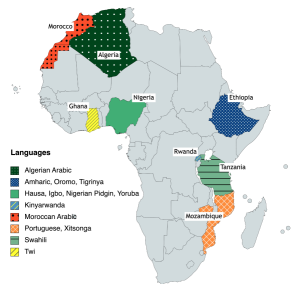
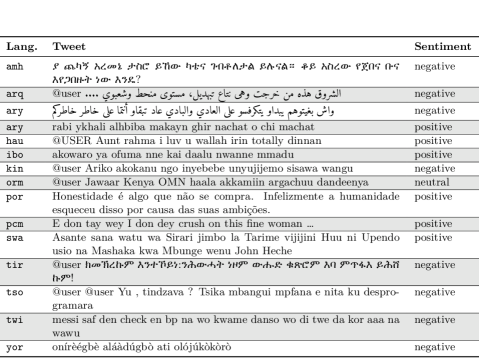
Africa is home to over 2,000 languages from more than six language families and has the highest linguistic diversity among all continents. These include 75 languages with at least one million speakers each. Yet, there is little NLP research conducted on African languages. Crucial to enabling such research is the availability of high-quality annotated datasets. In this paper, we introduce AfriSenti, a sentiment analysis benchmark that contains a total of >110,000 tweets in 14 African languages (Amharic, Algerian Arabic, Hausa, Igbo, Kinyarwanda, Moroccan Arabic, Mozambican Portuguese, Nigerian Pidgin, Oromo, Swahili, Tigrinya, Twi, Xitsonga, and Yorùbá) from four language families. The tweets were annotated by native speakers and used in the AfriSenti-SemEval shared task (The AfriSenti Shared Task had over 200 participants. See website at https://afrisenti-semeval.github.io). We describe the data collection methodology, annotation process, and the challenges we dealt with when curating each dataset. We further report baseline experiments conducted on the different datasets and discuss their usefulness.
研究动机与目标
- 突出在代表性不足的非洲语言中情感分析资源的需求,并跨 14 种语言创建一个大规模、带注释的 Twitter 数据集。
- 描述多语言非洲语言情感数据在数据收集、标注和质量控制方面的挑战。
- 提供使用多语言与以非洲为中心的语言模型(PLMs)的基线实验,以建立性能基准。
- 发布数据集、情感词典和资源,以促进非洲语言自然语言处理领域的进一步研究。
提出的方法
- 由于对非洲语言的 Twitter 语言标注有限,使用基于地点和基于词汇的启发式方法收集 Twitter 数据。
- 使用多数表决将推文标注为三类情感标签(积极、消极、中性);为埃塞俄比亚语言提供单独标签。
- 使用大规模多语言的 PLMs(XLM-R、mDeBERTaV3)和以非洲为中心的模型(AfriBERTa、AfroXLMR、XLM-T)评估单语言基线。
- 对组合数据集进行多语言训练,并评估从源语言对阿沃罗语(Oromo)和提格里尼亚语(Tigrinya)的零-shot 迁移。
- 发布数据集和词汇表;讨论数据收集、标注挑战以及伦理考量。
实验结果
研究问题
- RQ1现有的非洲语言情感分析资源有哪些,如何跨 14 种语言创建一个大型、带注释的 Twitter 数据集?
- RQ2单语、 多语和跨语言迁移模型在 AfriSenti 语言上的表现如何?
- RQ3在收集、标注及对齐多样化的非洲语言情感数据时面临哪些挑战,包括双脚本写作(digraphia)和话语切换?
- RQ4在相关语言之间的跨语言迁移对像 Oromo 和 Tigrinya 这样的零-shot 目标,其效果如何(例如豪萨语 Hausa、阿姆哈拉语 Amharic)?
主要发现
- AfriSenti 包含跨越 Afro-Asiatic、Niger-Congo、英语克里奥尔语和印欧语系的 14 种非洲语言的 110k+ 推文。
- AfroXLMR-large 在所评估模型中取得最佳整体表现,联合测试集的平均 F1 约为 71.2。
- 研究中,多语言的以非洲为中心的模型通常优于基线 XLM-R 变体,凸显了语言/领域特定预训练和模型规模的优势。
- 对 Oromo 和 Tigrinya 的零-shot 迁移在以 Hausa 语或 Amharic 作为 Oromo 的源语言,以及 Yoruba 或 Hausa 作为 Tigrinya 的源语言时最强,反映出语言相关性和数据规模效应。
- 单语基线因语言而异;AfroXLMR-base 和 AfroXLMR-large 对若干 AfriSenti 语言表现强劲,对某些阿拉伯语和葡萄牙语方言语言有显著提升。
阅读本论文
在 Nubint 阅读器中打开原文,边读边就任意段落提问。
在 Nubint 中阅读本论文本解读由 AI 根据论文原文生成,引用前请核对原文。