
[论文解读] Agent AI: Surveying the Horizons of Multimodal Interaction
对 Agent AI 的全面综述——基于大型基础模型(LLMs/VLMs)构建的多模态、具身的代理,能够在物理与虚拟环境中感知、推理和行动,并讨论学习范式、伦理和应用。
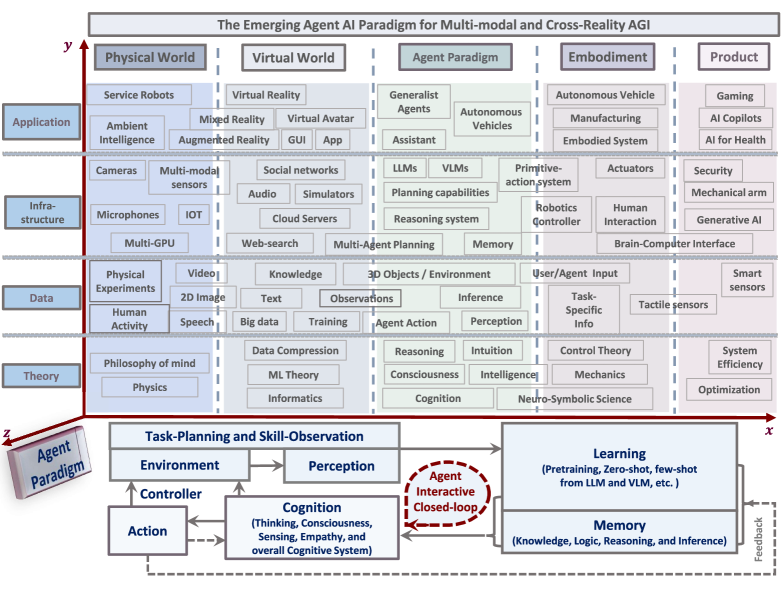
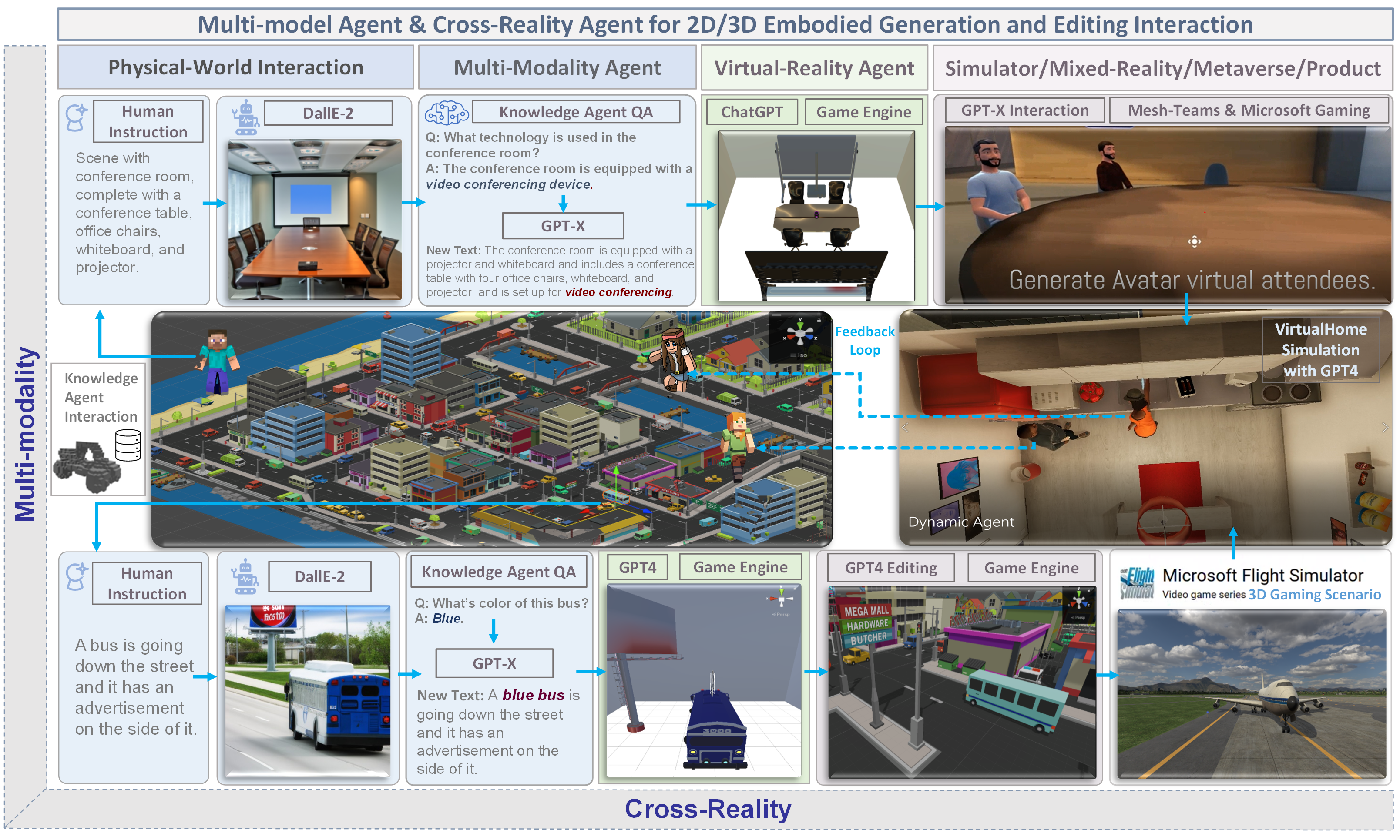
Multi-modal AI systems will likely become a ubiquitous presence in our everyday lives. A promising approach to making these systems more interactive is to embody them as agents within physical and virtual environments. At present, systems leverage existing foundation models as the basic building blocks for the creation of embodied agents. Embedding agents within such environments facilitates the ability of models to process and interpret visual and contextual data, which is critical for the creation of more sophisticated and context-aware AI systems. For example, a system that can perceive user actions, human behavior, environmental objects, audio expressions, and the collective sentiment of a scene can be used to inform and direct agent responses within the given environment. To accelerate research on agent-based multimodal intelligence, we define "Agent AI" as a class of interactive systems that can perceive visual stimuli, language inputs, and other environmentally-grounded data, and can produce meaningful embodied actions. In particular, we explore systems that aim to improve agents based on next-embodied action prediction by incorporating external knowledge, multi-sensory inputs, and human feedback. We argue that by developing agentic AI systems in grounded environments, one can also mitigate the hallucinations of large foundation models and their tendency to generate environmentally incorrect outputs. The emerging field of Agent AI subsumes the broader embodied and agentic aspects of multimodal interactions. Beyond agents acting and interacting in the physical world, we envision a future where people can easily create any virtual reality or simulated scene and interact with agents embodied within the virtual environment.
研究动机与目标
- 将 Agent AI 定义为一类交互系统,这些系统感知可视、语言和环境数据并产生具身行动。
- 综述将大型基础模型(LLMs 和 VLMs)与主体能力相结合,以在跨现实环境中运行的集成。
- 对代理的类型及在游戏、机器人技术和医疗等领域的应用进行分类。
- 讨论学习策略(强化学习 RL、模仿学习、情景内学习)以及用于零-shot/少样本情景的代理基础设施。
- 讨论基于代理的 AI 的伦理、隐私、偏见、可解释性与治理等考量。
提出的方法
- 提出一个框架,用于训练和评估将 LLMs/VLMs 与具身行动整合的 Agent AI 系统。
- 分析以基础模型驱动的代理中的幻觉与偏见挑战,并讨论接地与检索增强方法。
- 概述一个 Agent Transformer 范式及多领域代理的构建过程。
- 描述学习策略(RL、IL、在情境内学习)以及它们如何在跨任务的零-shot与少样本泛化中起作用。
- 提出一份关于代理类型、模态、以及现实/虚拟环境的组织化分类法,并附带评价基准和数据集。
实验结果
研究问题
- RQ1如何利用 LLMs 和 VLMs 来创建在物理与虚拟环境中都能有效运行的具身多模态代理?
- RQ2哪些学习范式与架构最能支持 Agent AI 在跨域中的泛化、接地与鲁棒性?
- RQ3应如何按能力、模态和环境对 Agent AI 进行分类,以指导研究与评估?
- RQ4基于代理的系统会带来哪些伦理、隐私和包容性方面的考量,以及如何缓解?
- RQ5为推进多模态 Agent AI 研究,需要哪些数据集和基准?
主要发现
- 将 Agent AI 框定为走向更具互动性、具身的多模态智能的途径,横跨物理和虚拟现实。
- 提供了关于 Agent AI 类别和应用的全面分类法,包括通用型、具身、仿真、生成、知识和神经符号代理。
- 关于与基础模型的整合的讨论,强调了收益与风险,包括幻觉、偏见、数据隐私和可解释性等考量。
- 本文概述了学习策略(RL、IL、在情境内学习)和实现零-shot与少-shot 泛化的代理基础设施。
- 分析了伦理、社会与治理方面,并提出用于基准评估 Agent AI 进展的数据集和领导委员会。
阅读本论文
在 Nubint 阅读器中打开原文,边读边就任意段落提问。
在 Nubint 中阅读本论文本解读由 AI 根据论文原文生成,引用前请核对原文。