
[论文解读] AI for Low-Code for AI
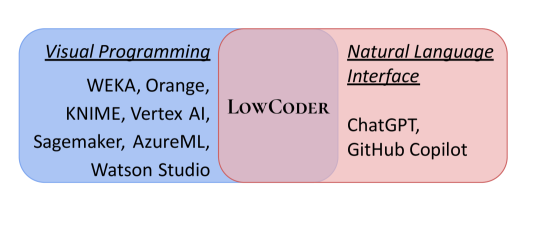
本文介绍了LowCoder,一种创新的低代码平台,结合了可视化编程(LowCoder VP)与基于人工智能的自然语言接口(LowCoder NL),帮助开发人员以最少的编码构建机器学习流水线。该系统显著提升了操作符的可发现性与流水线组合效率,在用户研究中,75%的任务得益于AI驱动的发现,而仅32.5%的任务通过关键词搜索完成;同时实现了85%的任务成功率和72.5%的迭代优化。
Low-code programming allows citizen developers to create programs with minimal coding effort, typically via visual (e.g. drag-and-drop) interfaces. In parallel, recent AI-powered tools such as Copilot and ChatGPT generate programs from natural language instructions. We argue that these modalities are complementary: tools like ChatGPT greatly reduce the need to memorize large APIs but still require their users to read (and modify) programs, whereas visual tools abstract away most or all programming but struggle to provide easy access to large APIs. At their intersection, we propose LowCoder, the first low-code tool for developing AI pipelines that supports both a visual programming interface (LowCoder_VP) and an AI-powered natural language interface (LowCoder_NL). We leverage this tool to provide some of the first insights into whether and how these two modalities help programmers by conducting a user study. We task 20 developers with varying levels of AI expertise with implementing four ML pipelines using LowCoder, replacing the LowCoder_NL component with a simple keyword search in half the tasks. Overall, we find that LowCoder is especially useful for (i) Discoverability: using LowCoder_NL, participants discovered new operators in 75% of the tasks, compared to just 32.5% and 27.5% using web search or scrolling through options respectively in the keyword-search condition, and (ii) Iterative Composition: 82.5% of tasks were successfully completed and many initial pipelines were further successfully improved. Qualitative analysis shows that AI helps users discover how to implement constructs when they know what to do, but still fails to support novices when they lack clarity on what they want to accomplish. Overall, our work highlights the benefits of combining the power of AI with low-code programming.
研究动机与目标
- 解决AI库中的语法复杂性与可视化低代码工具在机器学习流水线中可发现性有限的双重挑战。
- 探究将可视化编程与基于人工智能的自然语言接口相结合,如何提升开发人员的生产力与流水线组合效率。
- 评估AI在辅助可发现性与实现方面的作用,尤其针对已明确需求但缺乏编码能力的用户。
- 识别当前AI助手在支持目标不明确的初学者用户方面的局限性。
- 探索未来低代码ML工具的设计改进,如上下文模板与数据感知建议。
提出的方法
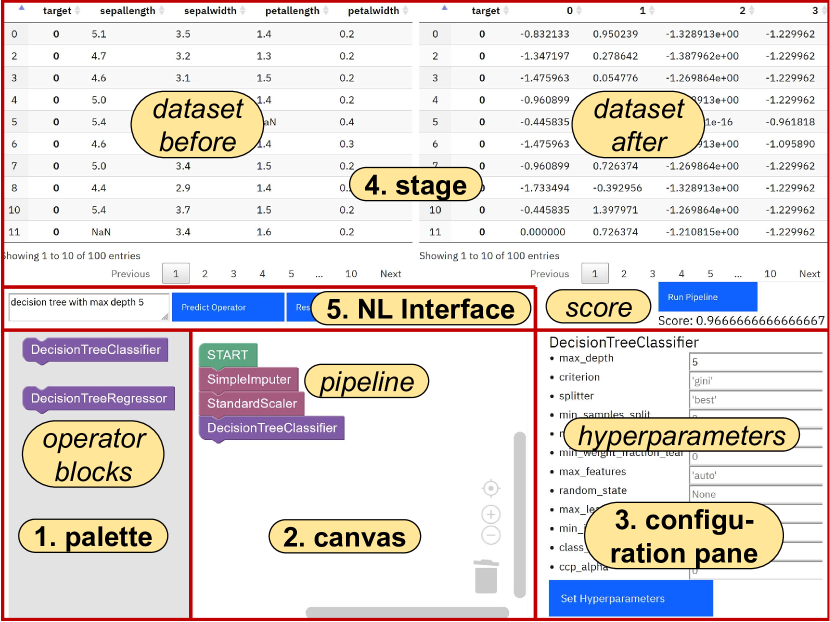
- LowCoder整合了一个基于Blockly的可视化编程界面(LowCoder VP),允许用户通过拖拽代表AI操作符的模块来构建流水线。
- 系统还包含一个自然语言接口(LowCoder NL),利用微调后的CodeT5模型,从自然语言提示中预测相关的机器学习操作符与超参数。
- 提出了一种新颖的任务表述方法,以处理用户查询中部分提及的超参数,从而提升模型在真实低代码使用场景下的性能。
- 通过一项包含20名不同AI技能水平参与者的被试内用户研究,对系统进行了评估,将LowCoder NL与关键词搜索及网页搜索在操作符发现方面进行了对比。
- 研究评估了任务成功率、迭代次数,并收集了关于用户挑战的定性见解,特别是与机器学习开发中的概念设计障碍相关的问题。
- 研究数据(包括匿名化的定性与定量结果)已通过Zenodo公开发布。
实验结果
研究问题
- RQ1将可视化编程与基于人工智能的自然语言接口结合,如何提升低代码机器学习开发中AI操作符的可发现性?
- RQ2LowCoder NL在多大程度上支持初学者与经验丰富的开发人员构建与优化机器学习流水线?
- RQ3当用户明确其目标但难以实现时,PBNL在哪些方面提供帮助,又在哪些方面失效?
- RQ4设计障碍(尤其是不确定性与概念不清晰)如何影响初学者在机器学习流水线开发中的表现?
- RQ5上下文建议、模板或数据感知推荐在引导用户实现有效流水线设计方面发挥何种作用?
主要发现
- LowCoder NL显著提升了操作符的可发现性:75%的任务通过AI发现新操作符,而关键词搜索仅支持32.5%,滚动浏览选项仅支持27.5%。
- 使用LowCoder NL时,85%的任务成功完成,表明该系统在不同用户技能水平下均有效支持流水线构建。
- 72.5%的任务涉及迭代优化,表明用户能有效借助AI界面改进初始流水线。
- 尽管有AI辅助,当初学者缺乏明确目标时仍面临困难,表明PBNL本身无法克服机器学习开发中的概念设计障碍。
- 为LowCoder NL微调的CodeT5模型在真实用户查询上表现出良好泛化能力,即使在不同数据集上训练,也显示出实际应用中的稳健性。
- 定性反馈表明,上下文建议(如模板、数据可视化与特征感知推荐)可进一步提升公民开发者用户的可用性。
阅读本论文
在 Nubint 阅读器中打开原文,边读边就任意段落提问。
在 Nubint 中阅读本论文本解读由 AI 根据论文原文生成,引用前请核对原文。