
[论文解读] Alchemical diastereomers from antisymmetric alchemical perturbations
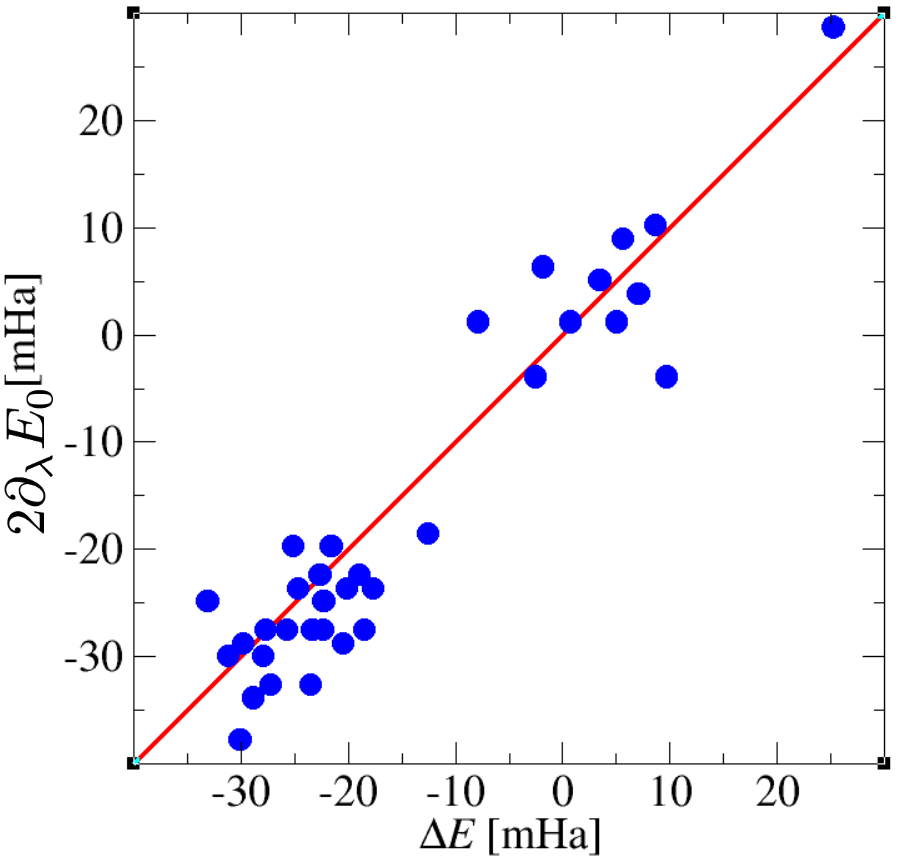
本文通过反称性杂化扰动引入了杂化对映体,表明在使用平均电子参考哈密顿量时,偶数阶能量贡献会消失。主导项——在平均参考点处的两倍Hellmann-Feynman导数——能以平均绝对误差4.3 mHa准确预测35种硼氮共掺杂甲苯异构体的相对能量,从而实现对多维化学空间的高效探索。
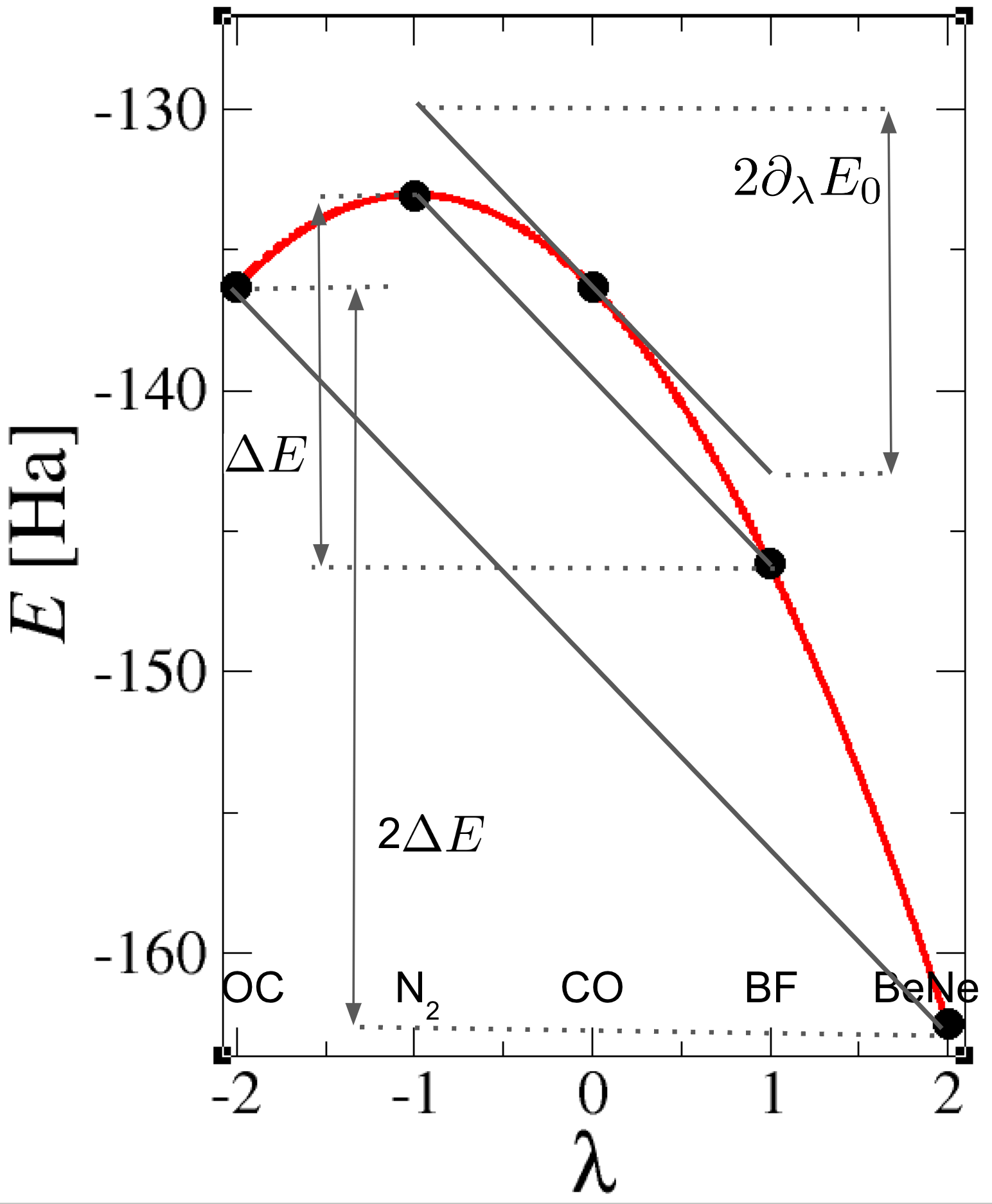
The energy difference between two iso-electronic systems can be accurately approximated by the alchemical first order Hellmann-Feynmann derivative for the averaged Hamiltonian. This approximation is exact up to third order because even-order contributions cancel out. This finding holds for any iso-electronic compound pair (dubbed `alchemical diastereomers'), regardless of differences in configuration, composition, or energy, and consequently, relative energy estimates for all possible iso-electronic alchemical diastereomer pairs, require only O(1) self-consistent field cycles for any given averaging reference Hamiltonian. We discuss the relation to the Verlet algorithm, alchemical harmonic approximation (AHA) [J. Chem. Phys. 162, 044101 (2025)], relative properties such as forces, ionization potential or electron affinities, and Levy's formula for relative energies among iso-electronic systems that uses the averaged electron density of the two systems [J. Chem. Phys. 70, 1573 (1979)]. Numerical estimates accurately reflect trends in the charge-neutral iso-electronic diatomic molecule series with 14 protons (N$_2$, CO, BF, BeNe, LiNa, HeMg, HAl), with systematically increasing errors. Using alchemical Hellmann-Feynman derivatives for toluene, we demonstrate the concept's broader applicability by estimating relative energies for all 36 possible alchemical diastereomer pairs from vertical iso-electronic charge-neutral antisymmetric BN doping of toluene's aromatic ring, with mean absolute errors of a few milli-Hartrees.
研究动机与目标
- 通过放宽对等电子参考体系的对称性约束,推广杂化手性概念。
- 研究在等电子化合物中,反称性杂化扰动下能量差的变化行为。
- 评估微扰理论中主导项在相对能量估算中的预测能力。
- 展示该框架在使用单一参考电子密度探索高维化学空间时的可扩展性。
- 在反称性扰动背景下解释Mel Levy公式,并识别其对高阶奇数贡献的高估。
提出的方法
- 对等电子化合物应用微扰理论,使用线性耦合参数λ,哈密顿量定义为H(λ) = H₀ + λH′,其中H₀为平均参考哈密顿量。
- 将能量差ΔE按λ的幂级数展开,并解析证明在反称性扰动下所有偶数阶贡献均消失。
- 推导出主导项为2∂λE₀,对应于在平均参考哈密顿量处计算的两倍Hellmann-Feynman导数。
- 采用PBE0泛函和pcX-2基组的密度泛函理论(DFT)计算电子结构和Hellmann-Feynman导数。
- 该方法应用于14种质子等电子系列(N₂, CO, BF等)以及35种硼氮共掺杂甲苯异构体,采用固定的甲苯几何构型。
- 利用相同的电子密度从Hellmann-Feynman导数计算能量差,最大限度降低计算开销。
实验结果
研究问题
- RQ1当对等电子化合物施加反称性杂化扰动时,偶数阶能量贡献会发生什么变化?
- RQ2微扰展开中的主导项与Mel Levy公式在相对能量估算中相比如何?
- RQ3在平均参考哈密顿量处的一阶Hellmann-Feynman导数能否准确预测杂化对映体之间的相对能量?
- RQ4单一电子密度在杂化微扰理论中能在多大程度上实现对多维化学空间的高效探索?
- RQ5主导项近似精度如何随扰动大小和体系复杂度变化?
主要发现
- 当使用平均电子参考哈密顿量时,所有反称性杂化扰动下,相对能量的偶数阶贡献均消失。
- 主导项对应于在平均参考哈密顿量处计算的两倍Hellmann-Feynman导数。
- Mel Levy公式包含了第一阶贡献,但其对更高阶奇数贡献的估计值会随阶数线性增加而被高估。
- 对于14种质子等电子系列,主导项以极低计算成本提供了相对能量的准确估计。
- 在35种硼氮共掺杂甲苯杂化对映体的情况下,预测势能差的平均绝对误差(MAE)为4.3 mHa,已接近化学精度。
- 该框架仅需一个参考电子密度即可同时探索多个化学空间维度,显著降低计算开销。
阅读本论文
在 Nubint 阅读器中打开原文,边读边就任意段落提问。
在 Nubint 中阅读本论文本解读由 AI 根据论文原文生成,引用前请核对原文。