
[论文解读] Align and Distill: Unifying and Improving Domain Adaptive Object Detection
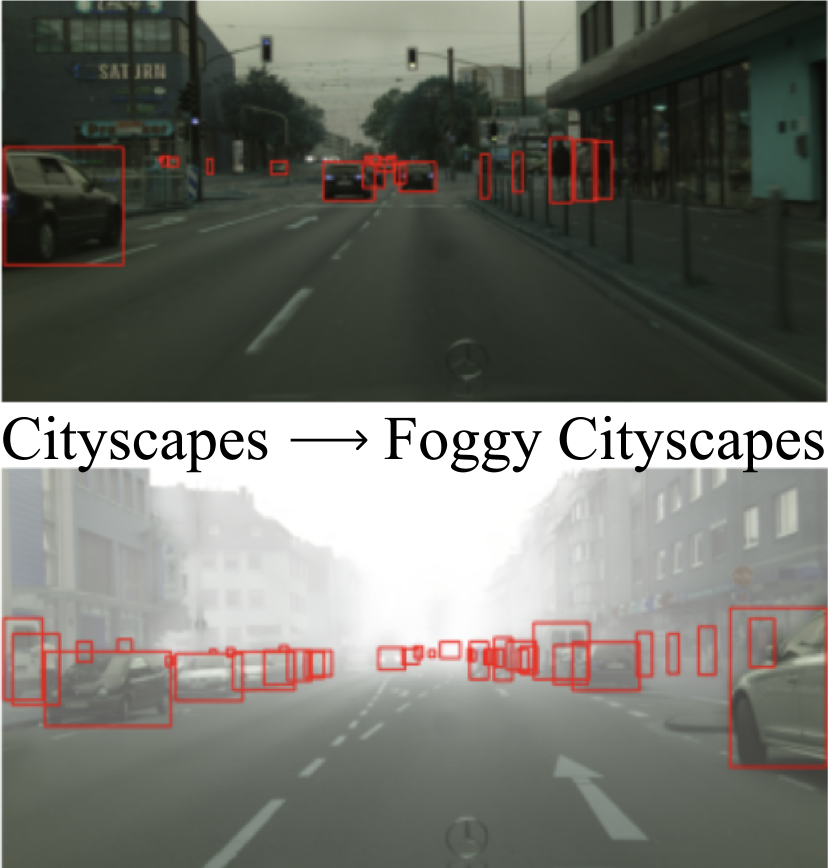
本文提出 ALDI,一个统一的领域自适应目标检测(DAOD)基准测试与训练框架,解决了先前评估实践中的系统性缺陷。通过标准化实现、引入 CFC-DAOD 基准,并提出 ALDI++,该方法在 Cityscapes→Foggy Cityscapes 上实现 +3.5 AP50、在 Sim10k→Cityscapes 上实现 +5.7 AP50 的最先进性能,超越此前 SOTA 水平,同时揭示了由于基线不一致和超参数选择不当,先前结果存在高估现象。
Object detectors often perform poorly on data that differs from their training set. Domain adaptive object detection (DAOD) methods have recently demonstrated strong results on addressing this challenge. Unfortunately, we identify systemic benchmarking pitfalls that call past results into question and hamper further progress: (a) Overestimation of performance due to underpowered baselines, (b) Inconsistent implementation practices preventing transparent comparisons of methods, and (c) Lack of generality due to outdated backbones and lack of diversity in benchmarks. We address these problems by introducing: (1) A unified benchmarking and implementation framework, Align and Distill (ALDI), enabling comparison of DAOD methods and supporting future development, (2) A fair and modern training and evaluation protocol for DAOD that addresses benchmarking pitfalls, (3) A new DAOD benchmark dataset, CFC-DAOD, enabling evaluation on diverse real-world data, and (4) A new method, ALDI++, that achieves state-of-the-art results by a large margin. ALDI++ outperforms the previous state-of-the-art by +3.5 AP50 on Cityscapes to Foggy Cityscapes, +5.7 AP50 on Sim10k to Cityscapes (where ours is the only method to outperform a fair baseline), and +0.6 AP50 on CFC Kenai to Channel. ALDI and ALDI++ are architecture-agnostic, setting a new state-of-the-art for YOLO and DETR-based DAOD as well without additional hyperparameter tuning. Our framework, dataset, and state-of-the-art method offer a critical reset for DAOD and provide a strong foundation for future research. Code and data are available: https://github.com/justinkay/aldi and https://github.com/visipedia/caltech-fish-counting.
研究动机与目标
- 解决 DAOD 研究中的系统性基准问题,包括基线能力不足、实现不一致以及过时或狭窄的基准。
- 建立公平透明的评估协议,将领域自适应性能与网络架构及超参数改进相隔离。
- 开发一个全新、多样化且真实世界场景的基准数据集 CFC-DAOD,以提升 DAOD 方法的泛化能力和适用性。
- 提出 ALDI++,一种新型 DAOD 方法,在多个基准上实现最先进性能,证明了统一对齐与蒸馏策略的有效性。
- 提供公开代码库与标准化框架,以支持未来 DAOD 研究的可复现性、透明性与可比性。
提出的方法
- 提出 ALDI,一个统一框架,标准化不同目标检测主干网络与深度学习库在 DAOD 方法中的训练、评估与实现。
- 实施公平的训练与评估协议,对所有方法(包括仅源域和理想基线)使用一致的网络结构、超参数与数据增强策略。
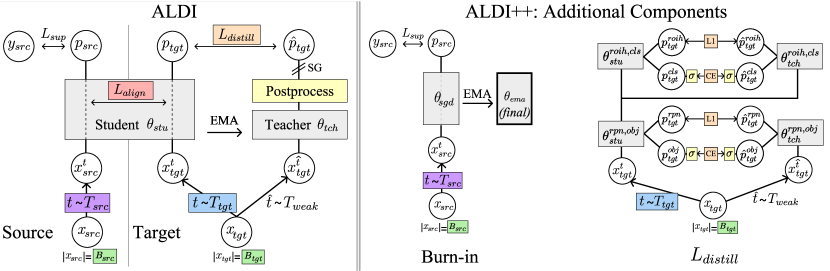
- 通过结合特征对齐与自训练蒸馏设计 ALDI++,其中教师模型的预测通过一致性正则化指导学生模型。
- 采用两阶段训练流程:首先在源域数据上预训练学生模型,然后通过动量平均的教师模型进行迭代自训练,以优化无标签目标域数据的预测。
- 通过源域与目标域特征之间的对比损失实现特征层级对齐,以减少领域偏移,同时保持检测头的一致性。
- 在训练中集成强数据增强与网络权重的指数移动平均(EMA),以提升泛化能力,且无需依赖目标域标签。
实验结果
研究问题
- RQ1由于基线不一致或能力不足,以及超参数选择不当,先前的 DAOD 结果在多大程度上高估了性能?
- RQ2当在公平、标准化的协议下评估时,DAOD 方法的性能如何变化,该协议能有效隔离领域自适应性能与架构及训练改进的影响?
- RQ3统一框架与基准是否能提升 DAOD 研究的可复现性、透明度与泛化能力?
- RQ4在 DAOD 中,特征对齐与自训练的相对贡献是什么?二者结合时如何相互作用?
- RQ5像 CFC-DAOD 这样的新基准是否更能反映真实世界中的领域偏移挑战,并支持更稳健的方法评估?
主要发现
- 在公平协议下评估时,没有任何现有 DAOD 方法能超越理想基线模型,且许多方法甚至未能超过仅源域训练的基线,与先前报告的性能增益相矛盾。
- ALDI++ 在 Cityscapes→Foggy Cityscapes 上实现 +3.5 AP50,在 Sim10k→Cityscapes 上实现 +5.7 AP50,显著优于先前最先进方法。
- 仅使用特征对齐可将性能提升最高达 2.6 AP50,但当与自训练结合时,其增益降至 ≤0.2 AP50,表明自训练是性能提升的主要驱动力。
- 更强的主干网络(如 VitDet)与改进的训练策略(如 EMA、强数据增强)显著提升了仅源域训练的性能,通常超过先前的 DAOD 方法。
- DAOD 方法与理想基线之间的性能差距依然较大,尤其在 VitDet 等先进架构上,表明未来仍有巨大改进空间。
- 在评估中使用目标域验证集违反了 DAOD 的无监督假设,限制了其在真实场景中的适用性,提示需要采用无监督验证流程。
阅读本论文
在 Nubint 阅读器中打开原文,边读边就任意段落提问。
在 Nubint 中阅读本论文本解读由 AI 根据论文原文生成,引用前请核对原文。