
[论文解读] Align-DETR: Enhancing End-to-end Object Detection with Aligned Loss
Align-DETR 引入一个 IoU 感知的 BCE 损失 (IA-BCE),通过混合匹配和 prime sample weighting 来纠正分类置信度与定位之间的错位,在基于 DETR 的检测器上实现 COCO 的 AP 提升。
DETR has set up a simple end-to-end pipeline for object detection by formulating this task as a set prediction problem, showing promising potential. Despite its notable advancements, this paper identifies two key forms of misalignment within the model: classification-regression misalignment and cross-layer target misalignment. Both issues impede DETR's convergence and degrade its overall performance. To tackle both issues simultaneously, we introduce a novel loss function, termed as Align Loss, designed to resolve the discrepancy between the two tasks. Align Loss guides the optimization of DETR through a joint quality metric, strengthening the connection between classification and regression. Furthermore, it incorporates an exponential down-weighting term to facilitate a smooth transition from positive to negative samples. Align-DETR also employs many-to-one matching for supervision of intermediate layers, akin to the design of H-DETR, which enhances robustness against instability. We conducted extensive experiments, yielding highly competitive results. Notably, our method achieves a 49.3% (+0.6) AP on the H-DETR baseline with the ResNet-50 backbone. It also sets a new state-of-the-art performance, reaching 50.5% AP in the 1x setting and 51.7% AP in the 2x setting, surpassing several strong competitors. Our code is available at https://github.com/FelixCaae/AlignDETR.
研究动机与目标
- 识别并量化 DETR 基检测器中分类置信度与定位精度之间的错配。
- 提出一个简单且有效的 IA-BCE 损失,在不改变后处理的前提下对齐分类与定位。
- 通过混合多对一与一对一匹配策略提升训练效率。
- 通过主样本加权减轻稀疏查询的负面影响。
- 在强基线下展示对 COCO 的最先进结果。
提出的方法
- 定义一个质量目标 t = s^α · u^(1−α),以同时捕捉 IoU 与置信度(IA-BCE 目标)。
- 使用不对称的 IA-BCE 损失:对前景的 BCE 使用 IA-BCE 目标,对负样本采用类似 focal 的加权。
- 采用混合匹配策略:在浅层解码器层使用多对一匹配,在顶层使用一对一匹配。
- 引入主样本加权:基于组内样本序列 rank,使用权重 w_i = exp(−r_i/τ) 对次要正样本进行下采样权重。
- 用相同的 w_i 对回归损失进行下采样权重,以保持训练重点的一致性。
- 采用一种损失形式,将 L_m2o 与中间层混合,将 L_o2o 应用于最终层(Eq. 8)。
实验结果
研究问题
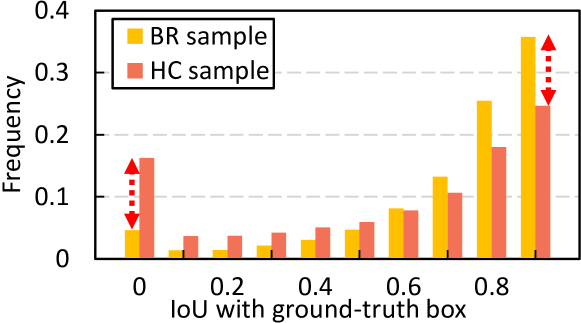
- RQ1DETR 的一对一匹配是否会导致分类置信度与定位质量之间的错配?
- RQ2一个 IoU 感知的损失是否能改善 DETR 中置信分数与定位精度之间的相关性?
- RQ3混合匹配是否在不牺牲端到端优化的情况下加速训练?
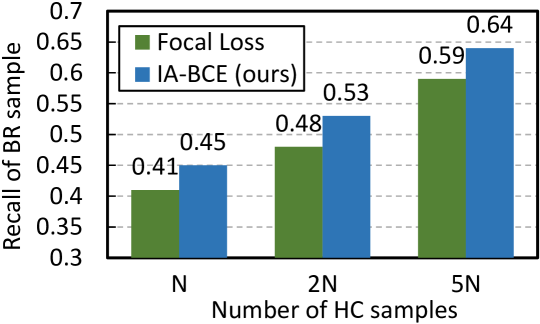
- RQ4主样本与对次要正样本的下采样是否提升 BR(best-regressed)样本召回率和整体 AP?
主要发现
- IA-BCE 提升了置信度与 IoU 之间的对齐,相对于基线提高 AP 与 AP75。
- 与 IA-BCE + 混合匹配的 Align-DETR 在 DAB-DETR-R50 基线(50 轮)上达到 +3.8 AP。
- 在以 DINO 为基线的 1x COCO 下,Align-DETR 在 val 上达到 50.2 AP;1x 和 2x 计划相对于强基线表现出改进。
- Align-DETR 在使用相似或更少查询数和训练量的同时,优于若干 DETR 变体和基于 CNN 的检测器。
- 主样本加权与混合匹配均有助于性能提升;IA-BCE 提供主要改进。
- 消融实验表明 α 取约 0.25 可获得最佳稳定性与性能;k 与 τ 具有中等影响。
阅读本论文
在 Nubint 阅读器中打开原文,边读边就任意段落提问。
在 Nubint 中阅读本论文本解读由 AI 根据论文原文生成,引用前请核对原文。