
[论文解读] Aligning Language Models to Explicitly Handle Ambiguity
本文提出了一种新颖的对齐方法,使大语言模型(LLMs)能够通过利用其内在知识来自我消歧,显式处理模糊查询。通过引入一个代理任务和基于信息增益的度量(Infogain),从模型视角识别模糊性,该方法在不降低清晰问题性能的前提下,提升了模型在模糊输入上的鲁棒性,已在多个问答基准上得到验证。
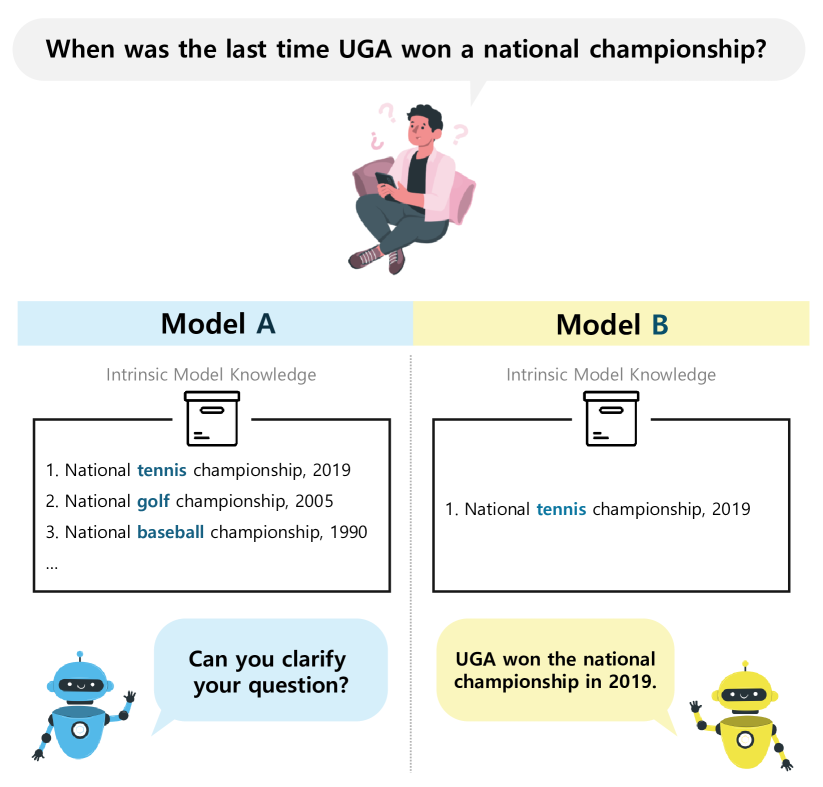
In interactions between users and language model agents, user utterances frequently exhibit ellipsis (omission of words or phrases) or imprecision (lack of exactness) to prioritize efficiency. This can lead to varying interpretations of the same input based on different assumptions or background knowledge. It is thus crucial for agents to adeptly handle the inherent ambiguity in queries to ensure reliability. However, even state-of-the-art large language models (LLMs) still face challenges in such scenarios, primarily due to the following hurdles: (1) LLMs are not explicitly trained to deal with ambiguous utterances; (2) the degree of ambiguity perceived by the LLMs may vary depending on the possessed knowledge. To address these issues, we propose Alignment with Perceived Ambiguity (APA), a novel pipeline that aligns LLMs to manage ambiguous queries by leveraging their own assessment of ambiguity (i.e., perceived ambiguity). Experimental results on question-answering datasets demonstrate that APA empowers LLMs to explicitly detect and manage ambiguous queries while retaining the ability to answer clear questions. Furthermore, our finding proves that APA excels beyond training with gold-standard labels, especially in out-of-distribution scenarios. The data and code are available at https://github.com/heyjoonkim/APA.
研究动机与目标
- 解决LLMs因缺乏显式模糊性处理训练而无法识别或适当地响应模糊用户查询的挑战。
- 克服从模型视角测量模糊性的困难,因为其模糊性感知会随内在知识而变化。
- 基于模型感知的模糊性,开发一种数据选择策略,实现针对性对齐以提升鲁棒性。
- 在保持对清晰查询强性能的同时,评估该对齐方法在模糊输入上的有效性。
- 贡献一个新的数据集AmbigTriviaQA,以支持LLMs模糊性鲁棒性的更广泛评估。
提出的方法
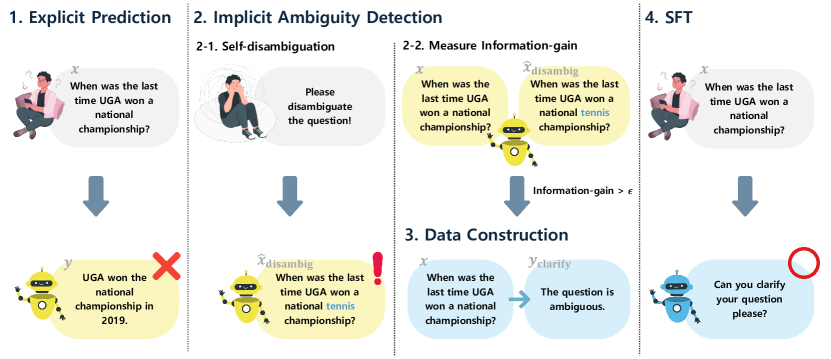
- 引入一个代理任务,让LLM通过其内在知识自我消歧给定查询。
- 将Infogain定义为消歧带来的信息增益度量,作为感知模糊性的隐式指标。
- 使用Infogain分数从模型视角筛选出被认为模糊的样本,用于下游对齐。
- 使用监督微调(SFT)在选定的模糊样本上微调LLM,重点在于生成澄清请求。
- 使用Valid Alignment Rate (VAR)、Misaligned Clarification Rate (MCR)和Overall Alignment Performance (OAP)等指标评估对齐性能。
- 构建一个新的基准数据集AmbigTriviaQA,以支持对LLMs模糊性处理能力的全面评估。
实验结果
研究问题
- RQ1仅依靠内在知识,LLMs能否被有效对齐以识别并显式响应模糊查询?
- RQ2如何从模型视角定量测量模糊性,而无需依赖人工标注标签?
- RQ3使用Infogain作为数据选择线索,是否能提升模型处理模糊查询的能力,同时不损害其在清晰查询上的性能?
- RQ4模型的感知模糊性如何随其知识库变化?这一特性能否用于实现更优的对齐?
- RQ5所提出的对齐方法在分布外的模糊输入上具有多大程度的泛化能力?
主要发现
- 所提出的对齐方法显著提升了模型生成模糊查询澄清请求的能力,在AmbigQA上的Valid Alignment Rate (VAR)相比基线方法提高了12.5%。
- 该方法在F1分数上相比随机采样提升了5个百分点,并优于隐式基线方法,验证了Infogain作为数据选择线索的有效性。
- 所提方法在Llama2 7B上的Overall Alignment Performance (OAP)达到0.84,优于Honesty-tuned (0.71)和Full-set (0.78),表明其在处理模糊性与保持清晰输入正确响应之间取得了更优平衡。
- 模型在分布外模糊查询上表现出鲁棒性,在AmbigQA和TriviaQA等多个数据集上均保持一致的性能提升。
- 案例研究证实,当模型缺乏足够知识时,能够正确识别模糊性;在查询明确时可避免误报,尽管由于对多个媒体标题的知识过度关联,仍存在少数误分类。
- 新构建的AmbigTriviaQA数据集支持对模糊性鲁棒性的更全面评估,并为该领域未来研究提供支持。
阅读本论文
在 Nubint 阅读器中打开原文,边读边就任意段落提问。
在 Nubint 中阅读本论文本解读由 AI 根据论文原文生成,引用前请核对原文。