
QUICK REVIEW
[论文解读] ALOHA 2: An Enhanced Low-Cost Hardware for Bimanual Teleoperation
ALOHA Team, Jorge Aldaco|arXiv (Cornell University)|Feb 7, 2024
一句话总结
ALOHA 2 通过改进抓手、重力补偿、框架、摄像头以及 MuJoCo 仿真模型,增强低成本双手远程操控系统;实现用于精细操控任务的大规模数据采集。
ABSTRACT
Diverse demonstration datasets have powered significant advances in robot learning, but the dexterity and scale of such data can be limited by the hardware cost, the hardware robustness, and the ease of teleoperation. We introduce ALOHA 2, an enhanced version of ALOHA that has greater performance, ergonomics, and robustness compared to the original design. To accelerate research in large-scale bimanual manipulation, we open source all hardware designs of ALOHA 2 with a detailed tutorial, together with a MuJoCo model of ALOHA 2 with system identification. See the project website at aloha-2.github.io.
研究动机与目标
- 提升双手远程操控系统的性能和任务范围。
- 改善用户人机工效学,降低操作员在大规模数据收集中的疲劳。
- 增强鲁棒性和可维护性,以支持研究环境中的一组机器人。
- 提供开源硬件设计和详细的仿真模型,以加速研究。
提出的方法
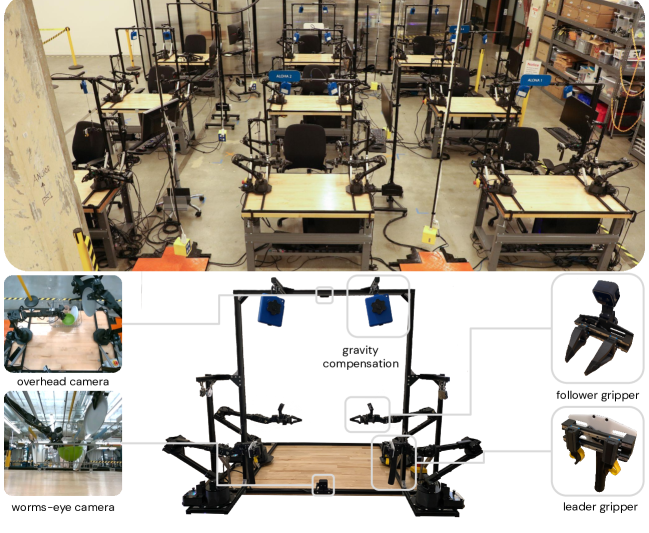
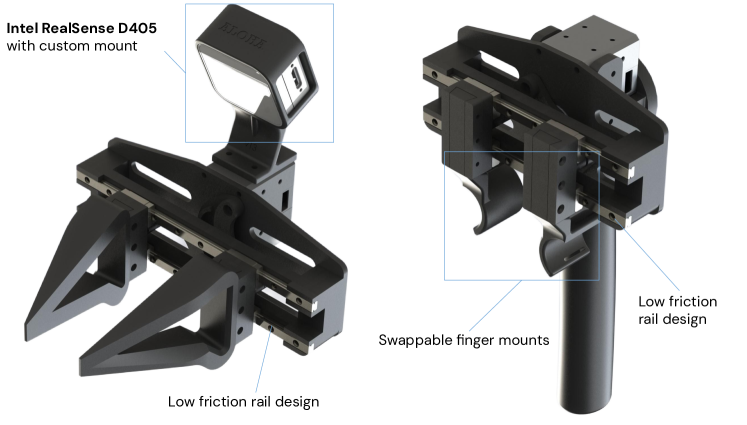
- 用低摩擦线性导轨设计和低摩擦电机替换 leader gripper,以降低张开力并提高手部工效学。
- 将 follower grippers 升级为低摩擦、高力的指尖,使用 3D 打印的碳纤维尼龙材料和聚氨酯握把带。
- 使用现成组件实现被动重力补偿系统,以降低操作员负担。
- 重新设计框架以简化结构并为数据收集与协作释放空间。
- 采用四个 Intel RealSense D405 摄像头,配备自定义支架以减小占用空间并增大视场。
- 提供带系统辨识的 MuJoCo Menagerie 模型的 ALOHA 2,以实现准确的基于仿真的学习。
实验结果
研究问题
- RQ1改进抓手、重力补偿、框架和传感硬件是否能提升远程操作性能和任务多样性?
- RQ2就被动重力补偿而言,是否比主动、基于软件的方法在远程操作性能和安全性方面表现更好?
- RQ3开源硬件并提供准确的仿真模型在大规模数据收集和操作任务的策略学习方面有何影响?
主要发现
- The leader gripper uses a low-friction linear rail design, requiring about 10x less force to open (0.84 N) than the previous design and allowing greater closing force at the follower tip (27.9 N vs. 12.8 N).
- Follower grippers achieve about 2x the grasping force of the old design and exhibit reduced latency due to lower friction.
- Passive gravity compensation outperformed the active inverse-dynamics approach in a 6-user task study, with shapes inserted per minute improving from 0.97 to 1.38 on average and offering safer operation when software faults occur.
- Frame redesign provides space for human-robot collaboration and props, while maintaining camera mounting rigidity.
- Smaller, higher-FOV RealSense D405 cameras with custom mounts reduce footprint and collision states, enabling more versatile manipulation.
- MuJoCo-based simulation model with system identification enables high-fidelity simulation data collection for policy learning.
阅读本论文
在 Nubint 阅读器中打开原文,边读边就任意段落提问。
在 Nubint 中阅读本论文本解读由 AI 根据论文原文生成,引用前请核对原文。