
[论文解读] AlphaBlock: Embodied Finetuning for Vision-Language Reasoning in Robot Manipulation
AlphaBlock 引入 AlphaBlock 数据集和 CogLoop,这是一个闭环、vision-language 的机器人规划框架,使用带视觉适配器和 Q-former 的大语言模型生成并更新面向操作任务的高层子任务计划,从而在成功率上优于现有方法。
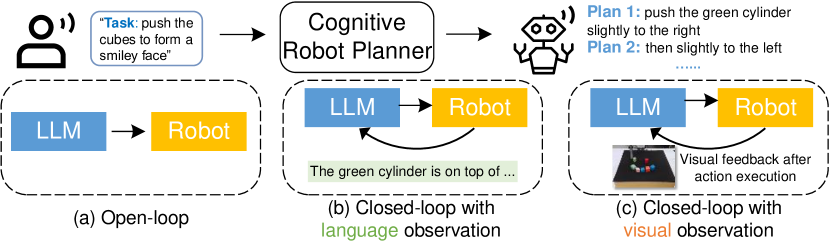
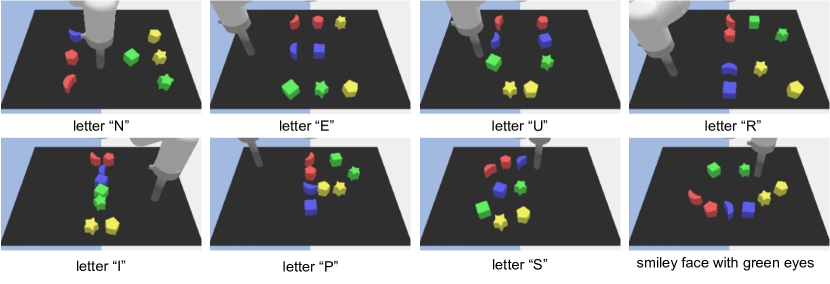
We propose a novel framework for learning high-level cognitive capabilities in robot manipulation tasks, such as making a smiley face using building blocks. These tasks often involve complex multi-step reasoning, presenting significant challenges due to the limited paired data connecting human instructions (e.g., making a smiley face) and robot actions (e.g., end-effector movement). Existing approaches relieve this challenge by adopting an open-loop paradigm decomposing high-level instructions into simple sub-task plans, and executing them step-by-step using low-level control models. However, these approaches are short of instant observations in multi-step reasoning, leading to sub-optimal results. To address this issue, we propose to automatically collect a cognitive robot dataset by Large Language Models (LLMs). The resulting dataset AlphaBlock consists of 35 comprehensive high-level tasks of multi-step text plans and paired observation sequences. To enable efficient data acquisition, we employ elaborated multi-round prompt designs that effectively reduce the burden of extensive human involvement. We further propose a closed-loop multi-modal embodied planning model that autoregressively generates plans by taking image observations as input. To facilitate effective learning, we leverage MiniGPT-4 with a frozen visual encoder and LLM, and finetune additional vision adapter and Q-former to enable fine-grained spatial perception for manipulation tasks. We conduct experiments to verify the superiority over existing open and closed-loop methods, and achieve a significant increase in success rate by 21.4% and 14.5% over ChatGPT and GPT-4 based robot tasks. Real-world demos are shown in https://www.youtube.com/watch?v=ayAzID1_qQk .
研究动机与目标
- 通过语言指令引导的多步推理,激励机器人操作的高层认知能力学习。
- 通过使用大语言模型(LLM)和执行模型自动生成认知机器人数据集,降低数据收集负担。
- 开发一个融合视觉特征与语言的多模态规划模型,以输出子任务计划。
- 在机器人任务中实现冻结的 LLM 与视觉编码器,加上轻量级适配器,实现端到端训练。
提出的方法
- 通过多轮提示向 GPT-4 采集 AlphaBlock 数据集,生成高层任务、子任务计划与观测-动作序列;使用 LAVA 作为执行模型来创建实时规划数据。
- 提出 CogLoop:一种解码器架构,将基于 ViT 的视觉特征与冻结语言解码器(通过 LLaMA 的 Vicuna)对齐,利用 Vision Adapter 与 Vision Tokenizer(Q-former + 投影仪)实现细粒度的空间感知。
- 训练 CogLoop 在保持 LLM 与视觉编码器冻结的前提下,使用交叉熵损失生成自回归的子任务计划,并在需要时仅对适配器与 Q-former 进行调优。
- 使用类似回溯的提示与自我验证策略,确保数据质量并降低数据收集过程中的人工工作量。
- 在基于模拟的 LAVA 控制器上评估 CogLoop 相对于开放回路与闭环基线的表现,并对步骤数、再规划频率与模态组件进行消融分析。
实验结果
研究问题
- RQ1AlphaBlock 数据是否能提升机器人操作的高层认知规划,相较于现有的开放回路和闭环方法?
- RQ2相较于仅语言观测,闭环的视觉-语言规划方法是否更擅长实时更新子任务计划?
- RQ3视觉适配器与基于 Q-former 的模态对齐如何影响规划性能与机器人空间推理?
- RQ4在有效认知中,规划/更新频率与计算成本之间的权衡如何?
主要发现
- 基于视觉的闭环规划 CogLoop 的成功率为 23.5%,超越基线包括 ChatGPT(16.4%)和带语言观测的 GPT-4。
- 使用视觉信息更新计划时,AlphaBlock 能显著优于 ChatGPT(+21.4%)和 GPT-4(+7.1%)。
- 视觉适配器与调优 Vision Q-former 能显著提升性能;最佳结果来自两者同时调优。
- 总步数增加可提升成功率直到约 150 步收敛;更频繁的重规划(每 10 步一次)提高成功率但增加时间成本;每 10 步重规划是一个实际平衡点。
- 在 Franka Emika 手臂与 Kinect 传感的真实环境部署,展示了从仿真到物理环境的迁移能力。
阅读本论文
在 Nubint 阅读器中打开原文,边读边就任意段落提问。
在 Nubint 中阅读本论文本解读由 AI 根据论文原文生成,引用前请核对原文。