
[论文解读] Ambient Diffusion: Learning Clean Distributions from Corrupted Data
基于扩 diffusion 的框架通过在扩 diffusion 过程中注入额外的测量失真,仅使用高度损坏的样本来学习干净数据的分布,从而在没有干净数据的情况下实现从真实分布进行采样。
We present the first diffusion-based framework that can learn an unknown distribution using only highly-corrupted samples. This problem arises in scientific applications where access to uncorrupted samples is impossible or expensive to acquire. Another benefit of our approach is the ability to train generative models that are less likely to memorize individual training samples since they never observe clean training data. Our main idea is to introduce additional measurement distortion during the diffusion process and require the model to predict the original corrupted image from the further corrupted image. We prove that our method leads to models that learn the conditional expectation of the full uncorrupted image given this additional measurement corruption. This holds for any corruption process that satisfies some technical conditions (and in particular includes inpainting and compressed sensing). We train models on standard benchmarks (CelebA, CIFAR-10 and AFHQ) and show that we can learn the distribution even when all the training samples have $90\%$ of their pixels missing. We also show that we can finetune foundation models on small corrupted datasets (e.g. MRI scans with block corruptions) and learn the clean distribution without memorizing the training set.
研究动机与目标
- 在未获得或成本高昂的情况下,激励学习数据分布。
- 开发一个利用损坏数据来学习干净数据条件期望的扩散框架。
- 在一般污染过程下,为从受损测量中学习提供理论保障。
- 在标准基准和现实世界的受损数据集上展示实际效果。
- 展示在较小的受损数据集上对基础扩散模型进行微调,同时减轻记忆效应。
提出的方法
- 在扩散过程中引入额外的测量失真,并训练以从进一步污染的图像预测原始被污染图像。
- 训练一个评分网络 h_theta,在给定进一步污染的输入与 A 的情况下,估计 E[x0 | Ãx_t, Ã]。
- 使用一个训练目标 J_corr(theta),对 (x0, x_t, A, Ã),使 ||A(h_theta(Ã, Ãx_t, t) - x0)||^2 最小。
- 应用理论,证明在广义污染设置下,最优模型在给定 Ã 的条件下,能够恢复 E[x0 | Ãx_t, Ã],前提是 A^T A 的秩为满秩。
- 通过在所选的 A 与 Ã 及 Ã 下,用 E[x0 | Ãx_t, Ã] 来近似 E[x0 | x_t],进行采样,从而实现实用生成。
- 通过 Reconstruction Guidance 来增强采样,在扩散过程中强制不同掩模之间的一致性。
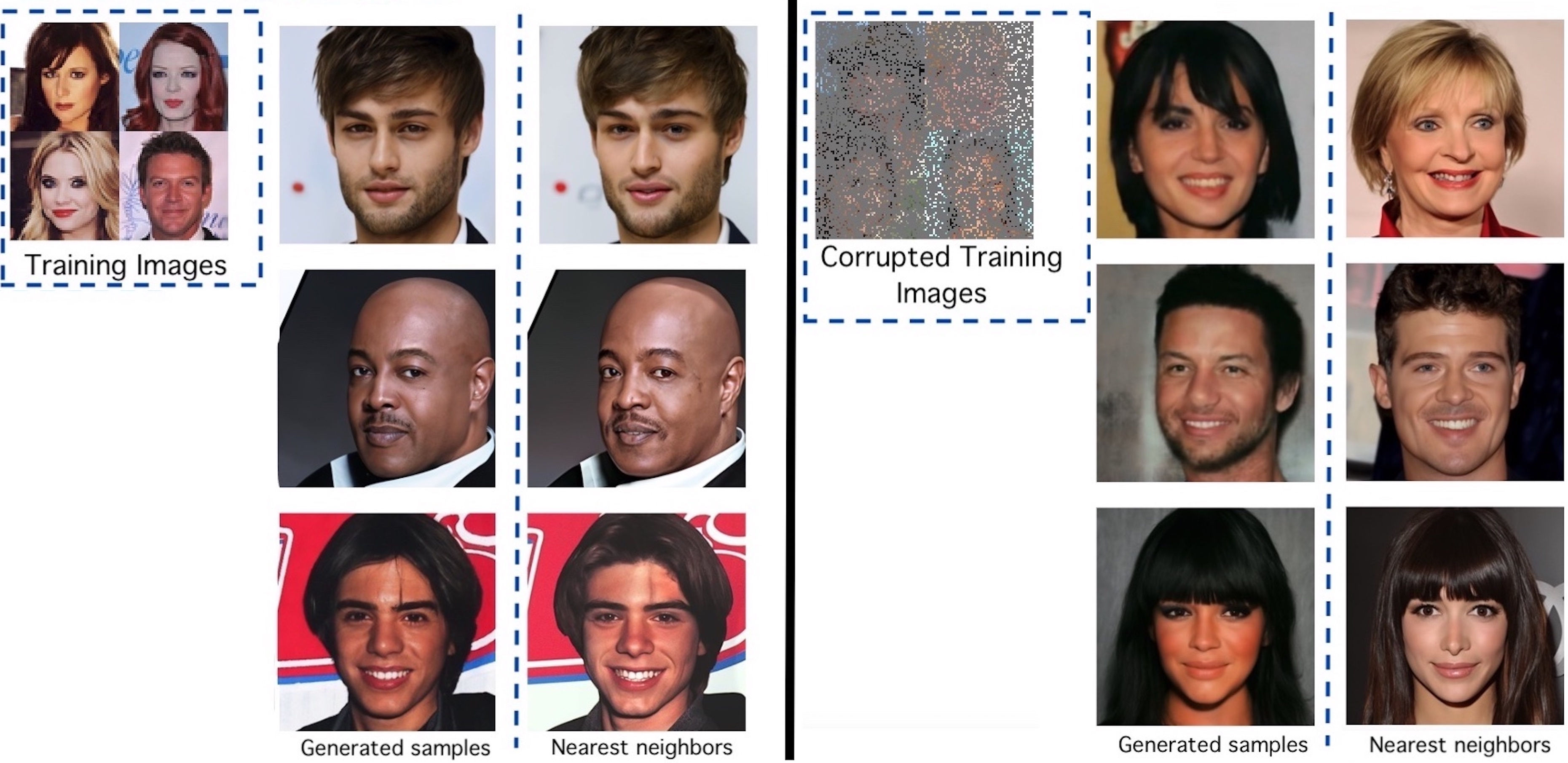
实验结果
研究问题
- RQ1在仅有损坏测量 y0 = Ax0 可用的情况下,我们能否学习条件期望 E[x0 | y_t, A]?
- RQ2如果可以,我们是否能使用学到的恢复来近似 E[x0 | x_t] 并在没有干净数据的情况下从真实分布采样?
- RQ3在训练期间引入少量额外的污染 Ã 如何影响学习到的分布以及微调模型中的记忆效应?
- RQ4在标准基准上,污染水平与生成器质量之间的权衡是什么?
- RQ5该方法是否能够在较小的受损数据集上对基础扩散模型进行微调(例如医学图像),同时避免记忆化?
主要发现
- 该方法在一般污染 A 和 Ã 下学习条件期望 E[x0 | Ãx_t, Ã],并且额外失真很小(delta 可以很小但为正值)。
- 在损坏数据上训练的扩散模型能够生成接近干净分布的样本,在许多设置中优于 AmbientGAN 和基线方法。
- 在 CelebA-HQ、AFHQ 和 CIFAR-10 的实验中,该方法在缺失像素高达 90% 时仍能产生合理的生成质量(以 FID 和 Inception Scores 衡量)。
- 学到的恢复能力使逆问题的性能具有竞争力或更优,且所需采样步数远少于需要数百步的基线。
- 在高度受损数据上微调预训练的扩散模型可降低记忆化,通过降低生成样本与训练图像的相似度来证明,同时实现领域迁移(如脑 MRI)。
- 代码与模型已开源(论文中提供了 GitHub 链接)。

阅读本论文
在 Nubint 阅读器中打开原文,边读边就任意段落提问。
在 Nubint 中阅读本论文本解读由 AI 根据论文原文生成,引用前请核对原文。