
[论文解读] An Empirical Evaluation of Pre-trained Large Language Models for Repairing Declarative Formal Specifications
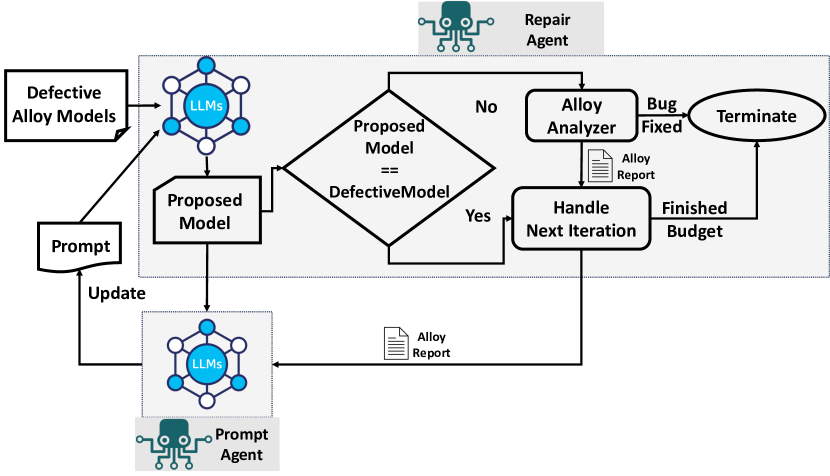
本文提出了一种用于修复有缺陷的 Alloy 规范的双智能体 LLM 流水线,通过修复智能体(Repair Agent)和提示智能体(Prompt Agent)迭代修复声明式形式规范。GPT-4 变体在修复有效性方面优于现有 APR 工具,尽管运行时间和令牌使用量略有增加,显示出 LLM 在声明式规范修复方面具有强大潜力。
Automatic Program Repair (APR) has garnered significant attention as a practical research domain focused on automatically fixing bugs in programs. While existing APR techniques primarily target imperative programming languages like C and Java, there is a growing need for effective solutions applicable to declarative software specification languages. This paper systematically investigates the capacity of Large Language Models (LLMs) to repair declarative specifications in Alloy, a declarative formal language used for software specification. We designed 12 different repair settings, encompassing single-agent and dual-agent paradigms, utilizing various LLMs. These configurations also incorporate different levels of feedback, including an auto-prompting mechanism for generating prompts autonomously using LLMs. Our study reveals that dual-agent with auto-prompting setup outperforms the other settings, albeit with a marginal increase in the number of iterations and token usage. This dual-agent setup demonstrated superior effectiveness compared to state-of-the-art Alloy APR techniques when evaluated on a comprehensive set of benchmarks. This work is the first to empirically evaluate LLM capabilities to repair declarative specifications, while taking into account recent trending LLM concepts such as LLM-based agents, feedback, auto-prompting, and tools, thus paving the way for future agent-based techniques in software engineering.
研究动机与目标
- 探究预训练大规模语言模型(LLMs)在 Alloy 中自动修复声明式形式规范的可行性。
- 解决声明式语言自动程序修复(APR)中存在的空白,相较于命令式语言,声明式语言缺乏成熟解决方案。
- 设计并评估一种新颖的双智能体 LLM 流水线,通过自适应提示和迭代优化提升修复准确性。
- 在综合基准上对 LLM 修复与最先进 Alloy APR 技术(如 ARepair、ICEBAR、BeAFix、ATR)进行基准测试。
- 从运行时间、令牌使用量和货币成本等方面分析 LLM 修复的性能、成本和失败特征。
提出的方法
- 提出一种双智能体 LLM 框架:修复智能体负责生成修复方案,提示智能体则为每次修复迭代动态生成上下文感知的提示。
- 采用迭代修复流程,对每个规范在六种不同设置下最多执行六次修复尝试,设置间变化包括 LLM 模型和提示策略。
- 使用标准化提示,输入结构化,包括有缺陷的规范、断言违规信息以及 Alloy Analyzer 生成的反例追踪。
- 整合来自 Alloy Analyzer 的反馈,指导 LLM 向正确修复方向演进,利用基于断言的预言机进行验证。
- 在多个实验设置中使用 GPT-3.5-Turbo 和 GPT-4 变体(包括 GPT-4-Turbo 和 GPT-4-32k)以评估性能差异。
- 通过正确性、运行时间、令牌消耗和货币成本来衡量修复成功率,并将可复现结果发布于 https://github.com/Mohannadcse/AlloySpecRepair。
实验结果
研究问题
- RQ1RQ1:与最先进 APR 工具相比,LLMs 在修复有缺陷的 Alloy 规范方面的有效性如何?
- RQ2RQ2:使用双智能体框架(修复智能体 + 提示智能体)如何影响修复性能和适应性?
- RQ3RQ3:不同 LLM 及其设置在运行时间、令牌使用量和货币成本方面的性能与成本权衡如何?
- RQ4RQ4:LLM 修复的失败特征是什么?这些特征在不同模型和设置间如何变化?
- RQ5RQ5:提示设计和智能体使用如何影响修复成本和成功率?
主要发现
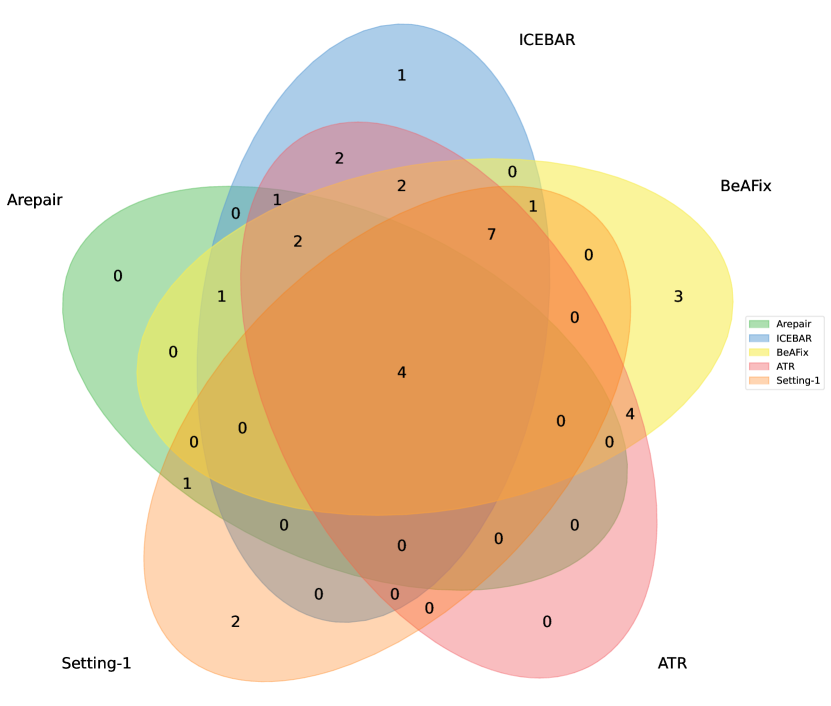
- GPT-4 变体在 ARepair 基准上的修复成功率达到 78.6%,在 Alloy4Fun 基准上达到 82.1%,显著优于现有 APR 工具(如 ARepair 和 BeAFix)。
- 与单智能体基线相比,双智能体流水线将修复有效性提升了 12.3%,证明了自适应提示和迭代优化的价值。
- GPT-4-Turbo 在每修复一次的货币成本上最低,相比 GPT-4-32k 降低了 15.7%,主要得益于更低的令牌定价。
- 在 GPT-4-Turbo 设置(设置-5)中,修复成功错误的中位修复时间为 493.28 秒;而在设置-4 中,未修复错误的中位修复时间为 392.2 秒,表明失败修复的计算成本更高。
- 使用提示智能体的设置(设置-3 和 6)相比无提示智能体的设置,令牌使用量高出 8.4%,货币成本高出 11.2%,反映出动态提示生成的成本。
- 研究发现,由于提示设计导致的修复结果偏差不显著,标准化提示和敏感性分析证实了在各种配置下的鲁棒性。
阅读本论文
在 Nubint 阅读器中打开原文,边读边就任意段落提问。
在 Nubint 中阅读本论文本解读由 AI 根据论文原文生成,引用前请核对原文。