
[论文解读] An Empirical Study of Training End-to-End Vision-and-Language Transformers
该论文提出 Meter,一种使用视觉变换器(ViTs)作为图像编码器的视觉-语言变换器端到端训练框架。通过在视觉编码器、文本编码器、融合模块和预训练目标方面进行系统性消融实验,Meter 仅使用 400 万张图像即在 VQAv2 上实现了 77.64% 的准确率——比当前最优的基于区域特征的模型高出 1.04%,比之前的完全基于变换器的模型高出 1.6%。
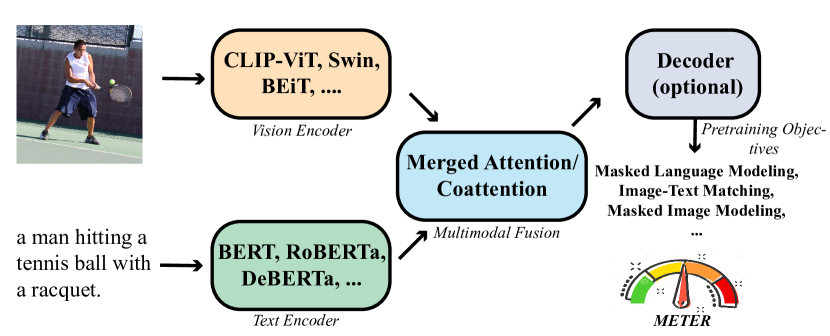
Vision-and-language (VL) pre-training has proven to be highly effective on various VL downstream tasks. While recent work has shown that fully transformer-based VL models can be more efficient than previous region-feature-based methods, their performance on downstream tasks often degrades significantly. In this paper, we present METER, a Multimodal End-to-end TransformER framework, through which we investigate how to design and pre-train a fully transformer-based VL model in an end-to-end manner. Specifically, we dissect the model designs along multiple dimensions: vision encoders (e.g., CLIP-ViT, Swin transformer), text encoders (e.g., RoBERTa, DeBERTa), multimodal fusion module (e.g., merged attention vs. co-attention), architectural design (e.g., encoder-only vs. encoder-decoder), and pre-training objectives (e.g., masked image modeling). We conduct comprehensive experiments and provide insights on how to train a performant VL transformer. METER achieves an accuracy of 77.64% on the VQAv2 test-std set using only 4M images for pre-training, surpassing the state-of-the-art region-feature-based model by 1.04%, and outperforming the previous best fully transformer-based model by 1.6%. Notably, when further scaled up, our best VQA model achieves an accuracy of 80.54%. Code and pre-trained models are released at https://github.com/zdou0830/METER.
研究动机与目标
- 弥合基于区域特征的模型与完全基于变换器的视觉-语言预训练模型之间的性能差距。
- 探究如何有效设计并预训练以视觉变换器(ViTs)作为图像编码器的端到端视觉-语言变换器。
- 识别高性能端到端 VL 模型的最优架构组件与预训练目标。
- 证明当设计与预训练得当时,基于 ViT 的模型可超越基于区域的方法。
提出的方法
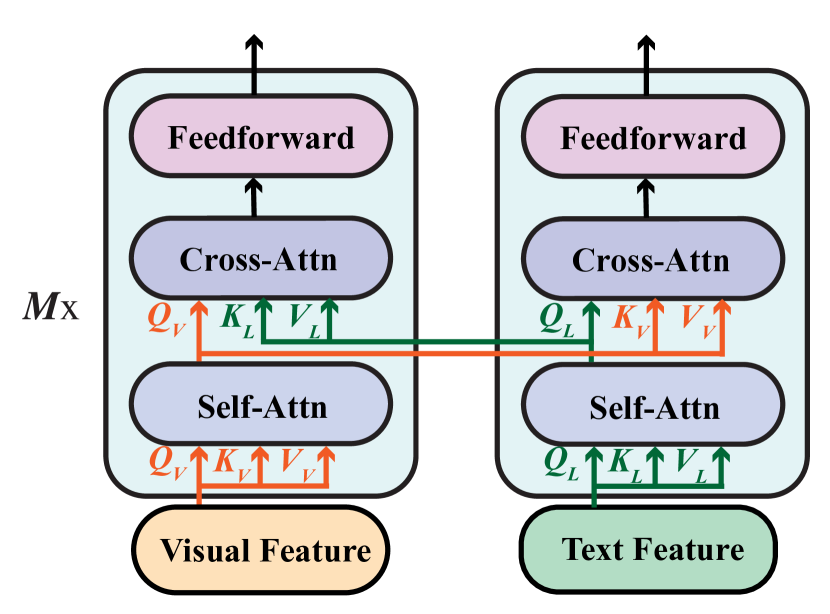
- 提出 Meter,一个统一的框架,用于系统性消融视觉编码器(如 CLIP-ViT、Swin Transformer)、文本编码器(如 RoBERTa、DeBERTa)以及多模态融合模块(融合注意力与协同注意力)。
- 采用仅编码器与编码器-解码器架构进行对比分析,重点关注在 VQA、检索与视觉推理任务上的下游性能。
- 在四个大规模数据集(COCO、Conceptual Captions、SBU Captions 和 Visual Genome)上进行预训练,结合掩码语言建模(MLM)、图文匹配(ITM)与掩码图像建模(MIM)。
- 使用协同注意力机制增强多模态融合,结果表明其在性能上持续优于仅使用自注意力的方案。
- 在不同模型变体之间采用公平的比较协议,确保超参数与训练调度一致。
- 将性能最佳的配置扩展至 1400 万张图像,使用 CoSwin-Huge 与 RoBERTa-base,在 VQAv2 上实现最先进性能。
实验结果
研究问题
- RQ1视觉变换器(ViTs)能否作为端到端视觉-语言预训练中的有效图像编码器,超越基于区域的方法?
- RQ2不同视觉与文本编码器(如 CLIP-ViT、RoBERTa)如何影响端到端 VL 模型的下游性能?
- RQ3在多模态融合模块中引入交叉注意力是否优于仅使用自注意力的机制?
- RQ4在 VQA 与零样本图像-文本检索等判别性任务中,仅编码器架构是否比编码器-解码器架构更有效?
- RQ5掩码图像建模(MIM)是否能提升基于 ViT 的 VL 模型的下游性能,还是会引入冲突的监督信号?
主要发现
- 视觉变换器(ViTs)在视觉-语言预训练中的作用比语言变换器更为关键,且单模态任务上的表现不能可靠预测 VL 任务的性能。
- 在多模态融合模块中引入交叉注意力可显著提升下游性能,优于仅使用自注意力的机制。
- 在公平比较条件下,仅编码器架构在 VQA 与零样本图像-文本检索任务上优于编码器-解码器架构。
- 掩码图像建模(MIM)在 VQAv2 与 Flickr30k 检索任务上均导致性能下降,表明其可能引入冲突目标或噪声的 patch 级监督。
- Meter 仅使用 400 万张图像即在 VQAv2 测试-std 集上达到 77.64% 的准确率——比之前的最先进区域特征模型(VinVL)高出 1.04%,比之前的最优完全基于变换器的模型(ALBEF)高出 1.6%。
- 将最佳模型扩展至 1400 万张图像,使用 CoSwin-Huge 与 RoBERTa-base,在 VQAv2 上达到 80.54% 的准确率,创下新 SOTA 记录,并超越在 18 亿张图像上预训练的模型。
阅读本论文
在 Nubint 阅读器中打开原文,边读边就任意段落提问。
在 Nubint 中阅读本论文本解读由 AI 根据论文原文生成,引用前请核对原文。