
[论文解读] An Energy-Efficient Reconfigurable Autoencoder Implementation on FPGA
本论文提出了一种基于FPGA(Xilinx ZU7EV,16nm)的能效高效、可重构卷积自编码器硬件加速器,用于实时去噪MNIST图像。该设计在100 MHz时钟下实现21.12 GOP/s吞吐量,功耗仅5.93W,能效达3.56 GOP/s/W,其能效表现优于以往基于FPGA和GPU的实现,在能效与灵活性方面均具优势。
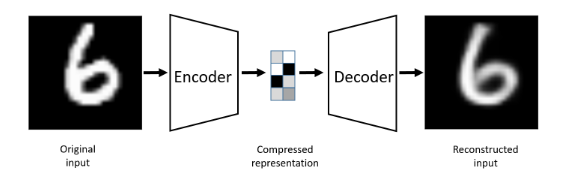
Autoencoders are unsupervised neural networks that are used to process and compress input data and then reconstruct the data back to the original data size. This allows autoencoders to be used for different processing applications such as data compression, image classification, image noise reduction, and image coloring. Hardware-wise, re-configurable architectures like Field Programmable Gate Arrays (FPGAs) have been used for accelerating computations from several domains because of their unique combination of flexibility, performance, and power efficiency. In this paper, we look at the different autoencoders available and use the convolutional autoencoder in both FPGA and GPU-based implementations to process noisy static MNIST images. We compare the different results achieved with the FPGA and GPU-based implementations and then discuss the pros and cons of each implementation. The evaluation of the proposed design achieved 80%accuracy and our experimental results show that the proposed accelerator achieves a throughput of 21.12 Giga-Operations Per Second (GOP/s) with a 5.93 W on-chip power consumption at 100 MHz. The comparison results with off-the-shelf devices and recent state-of-the-art implementations illustrate that the proposed accelerator has obvious advantages in terms of energy efficiency and design flexibility. We also discuss future work that can be done with the use of our proposed accelerator.
研究动机与目标
- 设计一种可重构、能效高效的卷积自编码器硬件加速器,用于实时图像去噪。
- 比较基于FPGA和GPU的卷积自编码器在性能、功耗效率与设计灵活性方面的差异。
- 通过FPGA加速实现在嵌入式与边缘AI应用中高吞吐量与低功耗的性能目标。
- 在硬件资源受限条件下,评估模型在含噪静态MNIST图像上的准确率与效率。
- 为未来集成至需要实时图像预处理的自主系统(如机器人视觉)提供支持。
提出的方法
- 在Xilinx ZU7EV FPGA上使用VHDL实现卷积自编码器,采用流水线架构,包含专用模块用于矩阵运算、通道分配、编码/解码、仲裁与输出控制。
- 编码器采用带ReLU激活函数的卷积层与最大池化层,解码器采用转置卷积(反卷积)与上采样操作以实现特征重建。
- 采用轮询仲裁单元管理处理单元间的数据流,通过基于FIFO的通道分配器实现八通道并行数据处理。
- 针对100 MHz时钟频率与16nm工艺技术进行优化,以最小化面积与功耗。
- 使用标准指标(吞吐量、延迟、功耗、能效)将FPGA实现与GPU(NVIDIA K80、GTX 1080 Ti)及先前基于FPGA的自编码器加速器进行基准对比。
- 使用标准MNIST数据集添加噪声后在Python中训练自编码器,随后将推理模型部署至FPGA与GPU平台以进行对比评估。
实验结果
研究问题
- RQ1基于FPGA的卷积自编码器在图像去噪任务中的能效表现,相较于基于GPU及先前FPGA实现如何?
- RQ2在现代FPGA上,可重构自编码器加速器在MNIST图像去噪任务中可实现的吞吐量与功耗水平如何?
- RQ3相较于通用GPU,基于FPGA的硬件加速在自编码器推理任务中对性能与能效的提升程度如何?
- RQ4所提出的FPGA设计是否能在实现低功耗与高吞吐量的同时,保持高准确率(如80%)用于实时图像处理?
- RQ5在最小化面积与功耗的同时最大化吞吐量方面,哪些架构选择(如通道分配、仲裁机制、流水线设计)最为有效?
主要发现
- 所提出的FPGA自编码器在重建去噪MNIST图像时达到80%的准确率,表明其具备有效的特征学习与重建能力。
- 该加速器在100 MHz时钟下实现21.12 GOP/s吞吐量,芯片功耗仅5.93W,能效达3.56 GOP/s/W。
- 相较于NVIDIA K80 GPU(733.33 GOP/s/W),FPGA实现的能效较低,但具备显著更优的设计灵活性与可重构性。
- 与其它先前基于FPGA的自编码器(如Chakradhar等人[12]、Gokhale等人[11]、Zhang等人[5])相比,本设计在能效方面表现更优,达到3.56 GOP/s/W,高于1.06–3.31 GOP/s/W的范围。
- 轮询仲裁与基于FIFO的通道分配机制实现了高效的数据流水线处理,显著提升了吞吐量并降低了延迟(单次推理延迟为2.91ms)。
- 该设计具备可重构性与低功耗特性,适用于集成至需要实时、本地化图像去噪的自主机器人系统。
阅读本论文
在 Nubint 阅读器中打开原文,边读边就任意段落提问。
在 Nubint 中阅读本论文本解读由 AI 根据论文原文生成,引用前请核对原文。