
[论文解读] An Investigation into Pre-Training Object-Centric Representations for Reinforcement Learning
该论文评估无监督的面向对象表征(OCR)作为图像基础强化学习的预训练,使用一个新的简单2D面向对象基准和一个3D机器人任务来研究何时OCR预训练有用、其样本效率以及泛化能力。
Unsupervised object-centric representation (OCR) learning has recently drawn attention as a new paradigm of visual representation. This is because of its potential of being an effective pre-training technique for various downstream tasks in terms of sample efficiency, systematic generalization, and reasoning. Although image-based reinforcement learning (RL) is one of the most important and thus frequently mentioned such downstream tasks, the benefit in RL has surprisingly not been investigated systematically thus far. Instead, most of the evaluations have focused on rather indirect metrics such as segmentation quality and object property prediction accuracy. In this paper, we investigate the effectiveness of OCR pre-training for image-based reinforcement learning via empirical experiments. For systematic evaluation, we introduce a simple object-centric visual RL benchmark and conduct experiments to answer questions such as ``Does OCR pre-training improve performance on object-centric tasks?'' and ``Can OCR pre-training help with out-of-distribution generalization?''. Our results provide empirical evidence for valuable insights into the effectiveness of OCR pre-training for RL and the potential limitations of its use in certain scenarios. Additionally, this study also examines the critical aspects of incorporating OCR pre-training in RL, including performance in a visually complex environment and the appropriate pooling layer to aggregate the object representations.
研究动机与目标
- 评估OCR预训练是否能提高对象中心任务的RL性能。
- 研究哪些任务类型(交互、关系推理)最受益于OCR。
- 在样本效率和对分布外场景的泛化方面评估OCR预训练。
- 考察视觉复杂性和池化选择对基于OCR的RL性能的影响。
- 提供基准、代码和在何时对RL有利的OCR预训练见解。
提出的方法
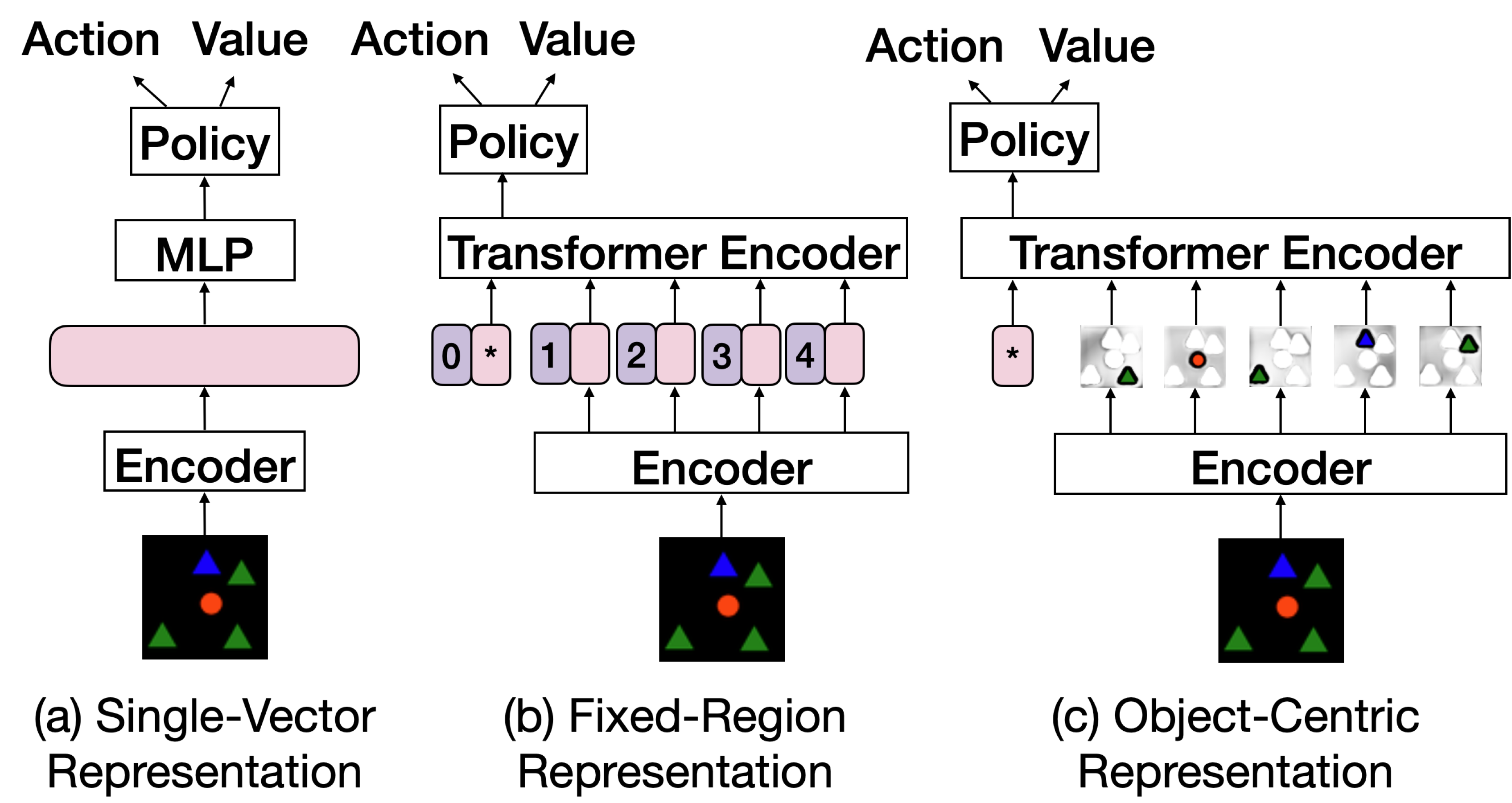
- 在端到端学习和OCR预训练方案下,比较多种表征类型(单向量、固定区域、对象中心)
- 使用PPO作为所有实验的RL算法,配合一个简单的2D对象中心基准和一个3D到达任务进行评估
- 评估多种OCR模型(IODINE、Slot-Attention、SLATE、SLATE-Large)和池化层(Transformer vs MLP),研究它们对RL性能的影响
- 实现基于2D Spriteworld的数据集进行预训练,以及用于测试复杂环境的3D CausalWorld机器人任务
- 分析对象目标、对象交互、对象比较和属性比较任务中的结果以评估关系推理能力
实验结果
研究问题
- RQ1OCR预训练是否提高对象中心强化学习任务的性能,哪些任务类型收益最大?
- RQ2OCR预训练对对象中心RL场景的样本效率有何影响?
- RQ3OCR预训练是否能提升对分布外数量或颜色的泛化?
- RQ4在分割困难的视觉复杂环境中,OCR的表现如何,哪种池化层最有利于RL?
- RQ5哪种OCR模型和结构选择(如变换器池化)能带来最佳RL性能?
主要发现
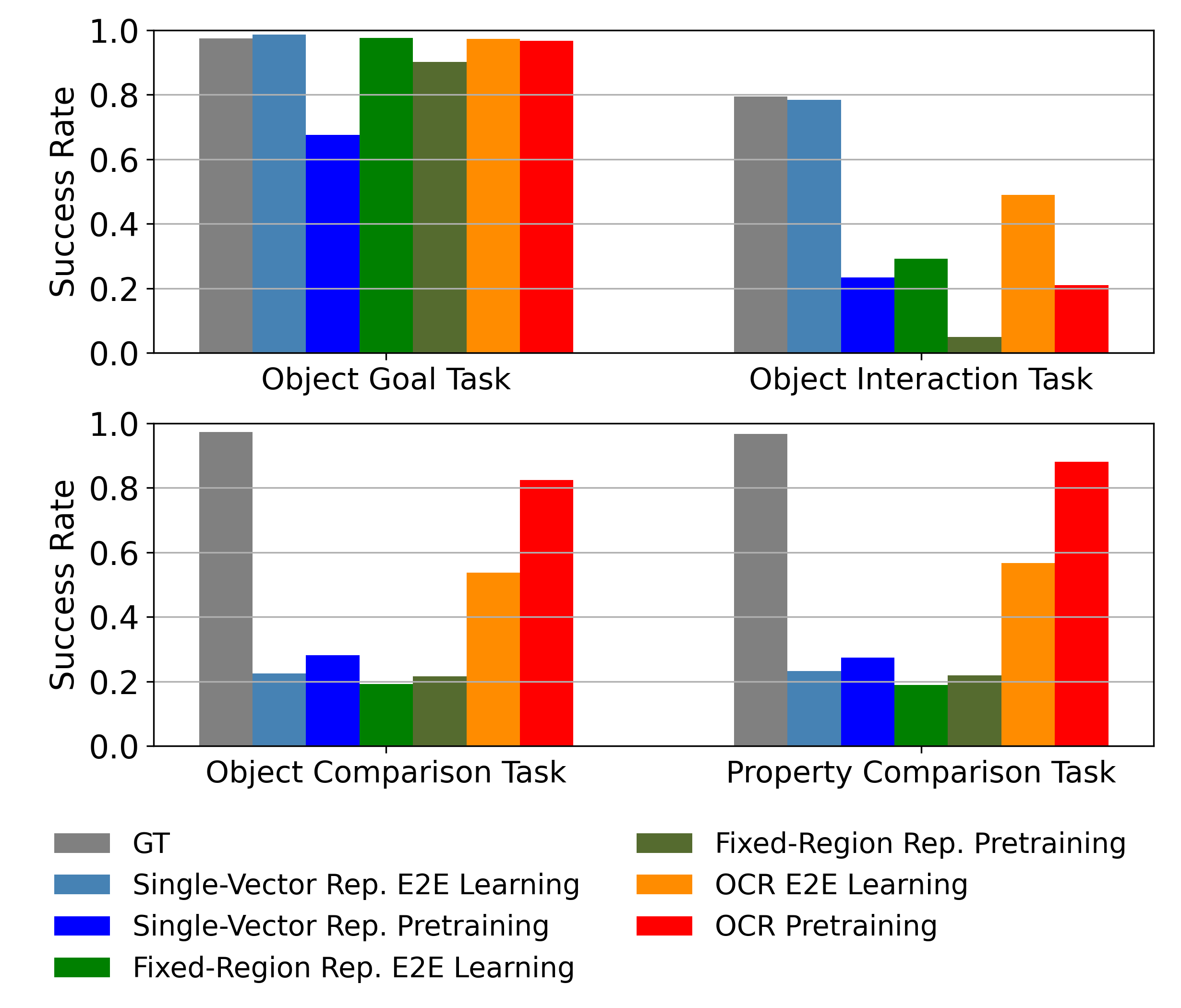
- 在关系推理任务中,OCR预训练可以提高性能,但并不在所有对象中心任务上都显著优于其他表示。
- 在Object Goal任务中,大多数模型达到80%以上的成功率,除了预训练的单向量表示,后者难以提取每个对象的信息。
- 只有SLATE和端到端CNN基线在Object Interaction任务上达到约80%的成功;其他OCR模型常失败,表明解码器架构重要。
- 在Object Comparison和Property Comparison任务上,OCR预训练的表现接近真值状态,IO DINE在OCR方法中表现较差。
- 相较于其他预训练基线,OCR预训练通常提高样本效率,特别是对关系聚焦任务;非SLATE的OCR方法可能在Object Interaction上失败。
- SLATE在各方面持续表现强劲,包括视觉复杂场景(Object Reaching),而IODINE则更慢且性能较弱。
阅读本论文
在 Nubint 阅读器中打开原文,边读边就任意段落提问。
在 Nubint 中阅读本论文本解读由 AI 根据论文原文生成,引用前请核对原文。