
[论文解读] Anatomy of Thermally Interplayed Spin-Orbit Torque Driven Antiferromagnetic Switching
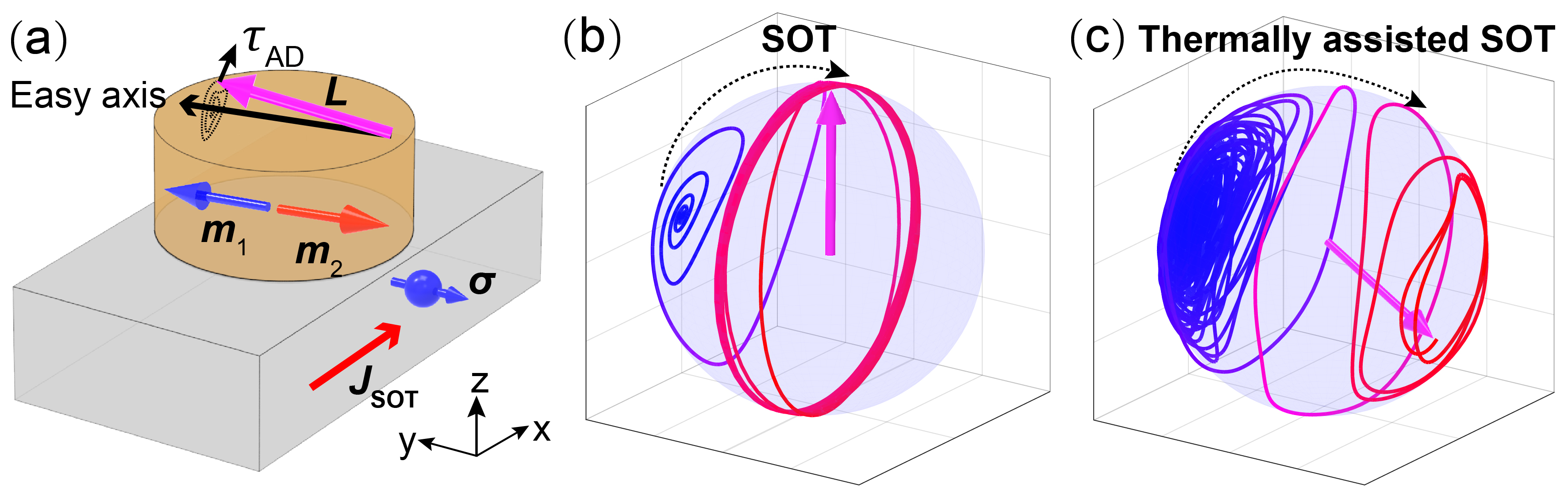
本研究通过将朗之万随机场整合到朗道-李福希茨-吉尔伯特方程中,建立了一个热耦合自旋-轨道力矩(SOT)驱动的反铁磁(AFM)切换模型,实验验证了焦耳热与SOT共同主导AFM切换。关键发现是,在Pt/IrMn-MTJs中,AFM切换的阈值SOT电流密度为338 MA cm⁻²,而由于铜基器件中自旋-轨道耦合较弱,热效应占主导地位。
Current-induced antiferromagnetic (AFM) switching remains critical in spintronics, yet the interplay between thermal effects and spin torques still lacks clear clarification. Here we experimentally investigate the thermally interplayed spin-orbit torque induced AFM switching in magnetic tunnel junctions via pulse-width dependent reversal and time-resolved measurements. By introducing the Langevin random field into the AFM precession equation, we establish a novel AFM switching model that anatomically explains the experimental observations. Our findings elucidate the currentinduced AFM switching mechanism and offer significant promise for advancements in spintronics.
研究动机与目标
- 澄清先前研究中尚未明确理解的热效应与自旋-轨道力矩(SOT)在电流驱动反铁磁(AFM)切换中的相互作用机制。
- 通过改变脉冲宽度,实验分离并量化焦耳热与SOT在磁隧道结(MTJs)中对AFM切换的贡献。
- 开发并验证一个宏观物理模型,该模型同时包含SOT和热涨落,用于描述AFM切换动力学。
- 通过温度分辨测量解耦热效应与自旋力矩效应,确定AFM切换的本征SOT阈值电流密度。
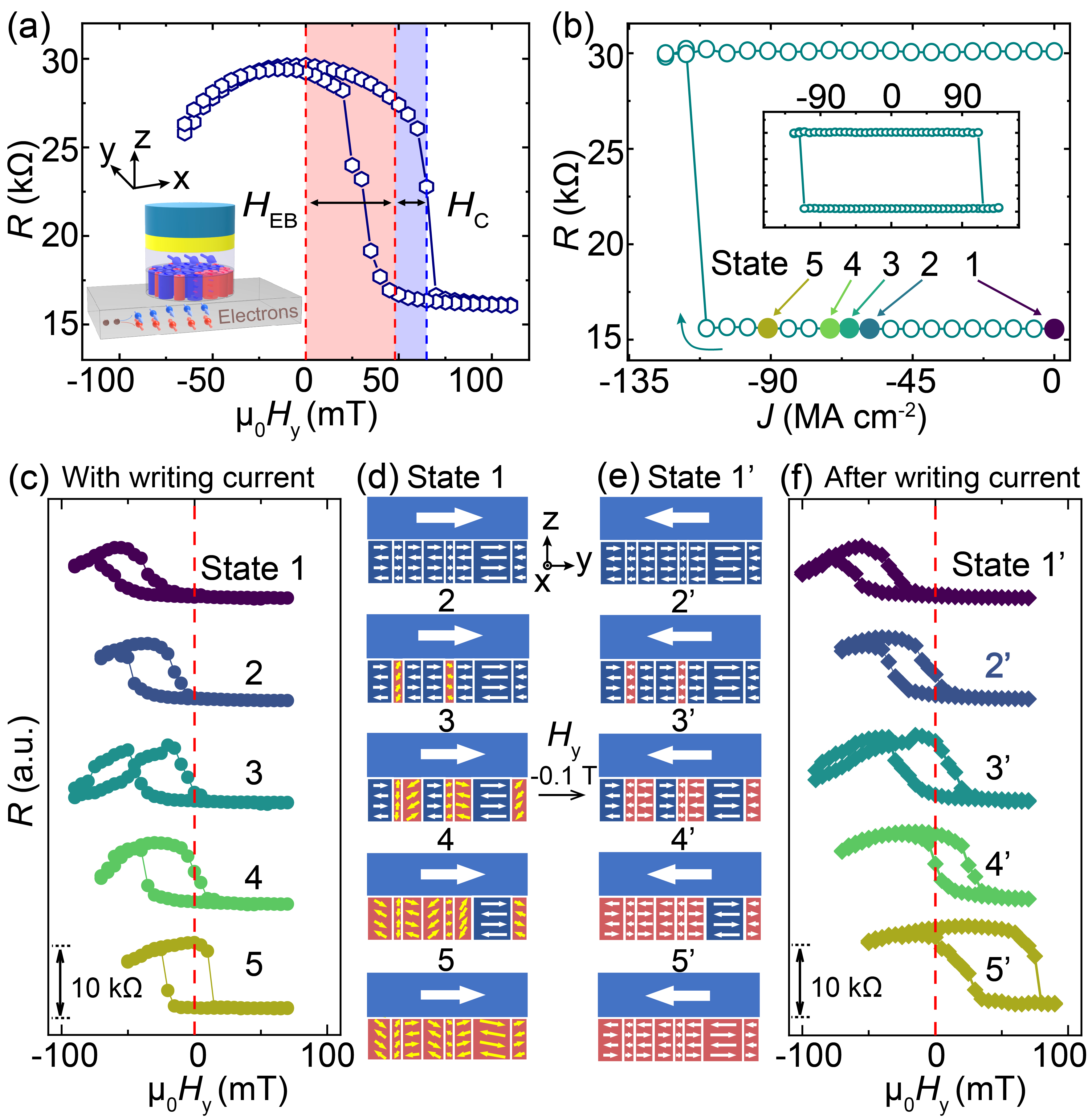
- 在交换偏置磁隧道结(EB-MTJs)中实现FM层与AFM层的异步切换,以实现AFM态的精确读出与表征。
提出的方法
- 将朗之万随机场引入朗道-李福希茨-吉尔伯特(LLG)方程,以在有限温度下建模热涨落,从而实现对AFM动力学的宏观描述。
- 利用示波器进行时间分辨电压测量,实时追踪EB-MTJs中的电阻变化,从而直接估算电流脉冲期间的器件温升。
- 采用谐波测量校准铂(Pt)中的自旋霍尔角(ξ_DL = 0.15(1)),以实现SOT强度的精确估计。
- 制备了具有700 nm纳米柱和100% TMR比的Pt/IrMn-MTJ与Cu/IrMn-MTJ器件,以实现AFM态的高保真度读出。
- 施加脉冲宽度依赖的电流扫描,以提取切换概率并估算不同时间尺度下的有效切换温度(T_switching)。
- 将实验数据拟合至热激活模型,以确定阻塞温度(T_b),并与T_switching比较,以区分热驱动与SOT驱动的切换机制。
实验结果
研究问题
- RQ1热涨落与自旋-轨道力矩(SOT)如何共同决定磁隧道结中反铁磁(AFM)序的切换动力学?
- RQ2在具有相同IrMn/CoFeB结构的Pt基与Cu基MTJs中,焦耳热与SOT对AFM切换的相对贡献是什么?
- RQ3能否独立于热效应量化AFM切换的SOT阈值电流密度?其本征值是多少?
- RQ4脉冲宽度如何影响AFM切换过程中的有效温度?这揭示了热-SOT相互作用的何种机制?
- RQ5在EB-MTJs中观测到的切换行为在多大程度上与包含朗之万噪声和SOT的LLG框架中的宏观模型一致?
主要发现
- 在Cu/IrMn-MTJs中,估算的切换温度(T_switching)与阻塞温度(T_b)非常接近,表明由于铜中自旋-轨道耦合较弱,AFM切换主要由焦耳热驱动。
- 在Pt/IrMn-MTJs中,T_switching显著低于T_b,证明SOT在切换中起主导作用,尤其在短脉冲宽度下更为明显。
- Pt/IrMn-MTJs中AFM切换的SOT阈值电流密度被量化为338 MA cm⁻²,约为FM切换阈值的十倍。
- 观测到归一化SOT阈值电流密度与温度校正后脉冲宽度的倒数之间存在线性关系,验证了热耦合SOT切换模型。
- 时间分辨测量显示,当脉冲宽度低于1 µs时,器件温度未达饱和,证实了在超快切换研究中实时温度估算的必要性。
- 在EB-MTJs中,FM层与AFM层的异步切换实现了对AFM态转变的精确检测,有助于精确表征切换机制。
阅读本论文
在 Nubint 阅读器中打开原文,边读边就任意段落提问。
在 Nubint 中阅读本论文本解读由 AI 根据论文原文生成,引用前请核对原文。