
[论文解读] Andes: Defining and Enhancing Quality-of-Experience in LLM-Based Text Streaming Services
Andes 提出一个 QoE 感知的 LLM 服务系统,通过动态、抢先调度和客户端令牌缓冲区来优化令牌流式传输,在高峰波动负载下相比基线如 vLLM,QoE 提升最高可达 3.2x,吞吐量提高最多 1.6x。
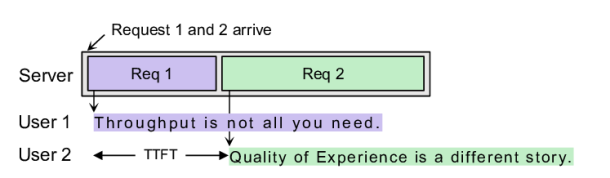
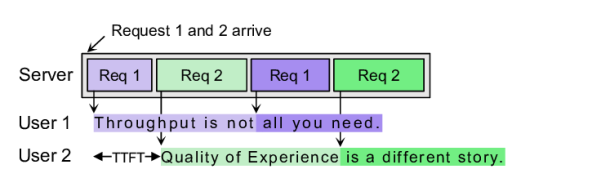
Large language models (LLMs) are now at the core of conversational AI services such as real-time translation and chatbots, which provide live user interaction by incrementally streaming text to the user. However, existing LLM serving systems fail to provide good user experience because their optimization metrics are not always aligned with user experience. In this paper, we first introduce and define the notion of Quality-of-Experience (QoE) for text streaming services by considering each user's end-to-end interaction timeline. Based on this, we propose Andes, a QoE-aware LLM serving system that enhances user experience by ensuring that users receive the first token promptly and subsequent tokens at a smooth, digestible pace, even during surge periods. This is enabled by Andes's preemptive request scheduler that dynamically prioritizes requests at the token granularity based on each request's expected QoE gain and GPU resource usage. Our evaluations demonstrate that, compared to state-of-the-art LLM serving systems, Andes improves the average QoE by up to $4.7 imes$ given the same GPU resource, or saves up to 61% GPU resources while maintaining the same high QoE.
研究动机与目标
- 为增量交付令牌的文本流服务定义一个正式的 QoE(体验质量)度量。
- 设计 Andes,通过动态、逐令牌的调度与抢占来优化 QoE。
- 共同设计一个客户端令牌缓冲区,以在服务器波动中统一用户体验。
- 在 OPT 模型(13B–175B)上评估 Andes,并与最先进的基线(如 vLLM)进行比较。
- 证明 Andes 在不增加额外资源的情况下提升 QoE和/或吞吐量。
提出的方法
- 将实际令牌交付时间线与由 TTFT 和 TDS 定义的期望时间线进行比较的正式 QoE 度量。
- 面向 QoE 的在线抢占式调度器,按令牌粒度在时间量 Δt 内最大化 QoE。
- 一种背包问题式的公式化,其中批量大小和 GPU 内存约束定义了要服务的请求的优化问题。
- 一种贪心打包算法,带有平衡 QoE 增益、内存使用和避免饥饿的优先函数(方程式5)。
- 两种抢占机制(交换和重新计算)在需要时用于在抢占期间移动或重新计算 KV 缓存。
- 客户端令牌缓冲区,平滑令牌交付以匹配用户期望的 TDS,而不受服务器端 pacing 的影响。
实验结果
研究问题
- RQ1如何为增量式、流式的 LLM 交互正式定义 QoE?
- RQ2在请求速率压力下,QoE 感知调度器是否能在不超额配置资源的情况下改善用户体验?
- RQ3在遵守内存约束的前提下,哪种调度算法和批量大小策略能够最大化平均 QoE?
- RQ4抢占开销对令牌交付延迟和整体 QoE 的影响是什么?
- RQ5Andes 在不同模型规模(13B–175B OPT)上的表现如何,并与基线如 vLLM 相比?
主要发现
- 与基线相比,在高负载/波动下,Andes 将平均 QoE 提高最多 3.2x。
- 在不增加额外资源的前提下,Andes 能处理高达 1.6x 的请求速率,同时保持高 QoE。
- 吞吐量与基线相近,负载上升时吞吐量下降最多约 10%。
- TTFT 显著提升,同时保持 TDS 高于用户期望的速度。
- 一种基于贪心背包的调度解,复杂度 O(N log N),实现与 DP 解相当的性能,但开销更低。
- 客户端令牌缓冲区平滑令牌交付,使用户体验与服务器端调度和网络波动解耦。
阅读本论文
在 Nubint 阅读器中打开原文,边读边就任意段落提问。
在 Nubint 中阅读本论文本解读由 AI 根据论文原文生成,引用前请核对原文。