
[论文解读] AnyLoc: Towards Universal Visual Place Recognition
AnyLoc 通过从自监督基础模型(DINO/DINOv2 ViTs)提取逐像素特征,并结合无监督方法(VLAD/GeM)进行聚合,构建通用的 VPR 解决方案,在 12 个多样化数据集上无需 VPR 特定训练即达到最前沿或具有竞争力的结果。
Visual Place Recognition (VPR) is vital for robot localization. To date, the most performant VPR approaches are environment- and task-specific: while they exhibit strong performance in structured environments (predominantly urban driving), their performance degrades severely in unstructured environments, rendering most approaches brittle to robust real-world deployment. In this work, we develop a universal solution to VPR -- a technique that works across a broad range of structured and unstructured environments (urban, outdoors, indoors, aerial, underwater, and subterranean environments) without any re-training or fine-tuning. We demonstrate that general-purpose feature representations derived from off-the-shelf self-supervised models with no VPR-specific training are the right substrate upon which to build such a universal VPR solution. Combining these derived features with unsupervised feature aggregation enables our suite of methods, AnyLoc, to achieve up to 4X significantly higher performance than existing approaches. We further obtain a 6% improvement in performance by characterizing the semantic properties of these features, uncovering unique domains which encapsulate datasets from similar environments. Our detailed experiments and analysis lay a foundation for building VPR solutions that may be deployed anywhere, anytime, and across anyview. We encourage the readers to explore our project page and interactive demos: https://anyloc.github.io/.
研究动机与目标
- 动机:需要一个在结构化和非结构化环境中均可工作的通用视觉地点识别(VPR)解决方案。
- 探索通用的、自监督的基础模型特征是否能在无需针对任务的再训练的前提下,作为 VPR 的通用底层基础。
- 确定有效的逐像素特征提取、聚合和词汇表策略,以最大化跨域 VPR 的性能。
- 展示 AnyLoc 在城市、室内、空中的、水下和地下等数据集上的多样性与鲁棒性。
- 提供关于聚合特征的语义属性如何影响 VPR 性能和词汇表设计的见解。
提出的方法
- 评估三大基础模型家族(DINO、DINOv2、CLIP),并比较用于 VPR 的逐图像特征与逐像素特征提取。
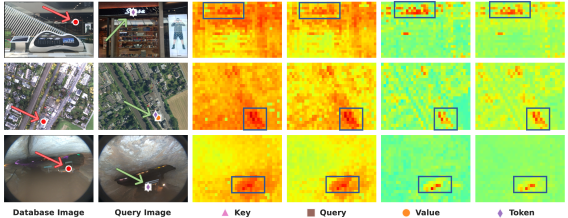
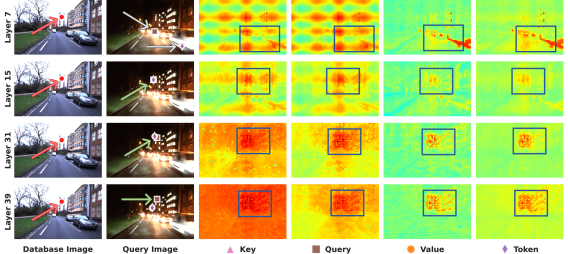
- 从中间 ViT 层提取逐像素特征,并丢弃 CLS 令牌以保持细粒度的局部性。
- 将无监督聚合方法(GAP、GMP、GeM、hard/soft VLAD)应用于逐像素特征。
- 使用 PCA 投影的全局描述符构建领域感知的 VLAD 词汇表,以捕捉语义域(Urban、Indoor、Aerial、SubT、Degraded、Underwater)。
- 在结构化和非结构化数据集上评估 AnyLoc 的变体(AnyLoc-GeM-DINOv2、AnyLoc-VLAD-DINO、AnyLoc-VLAD-DINOv2),包括日夜和视点变化场景。
- 与 VPR 基线(NetVLAD、CosPlace、MixVPR)和 CLS-token 基线(CLIP、DINO、DINOv2)进行对比。
- 研究 ViT 大小、层/面选择和词汇表类型对性能和描述符尺寸的影响。
实验结果
研究问题
- RQ1是否可以通过利用自监督基础模型特征,在不进行任何 VPR 专用训练的情况下实现通用 VPR?
- RQ2哪种基础模型、逐像素特征提取策略、聚合方法和词汇设计的组合,在多样环境和视点变化下能实现稳健性能?
- RQ3领域感知词汇构建如何影响跨数据集迁移与 Recall@1?
- RQ4在与无监督聚合结合用于通用 VPR 时,自监督 ViT 是否优于为 VPR 特定训练的 ViT?
- RQ5在不同环境中描述符维度与检索精度之间存在哪些权衡?
主要发现
- AnyLoc 变体在非结构化环境(如 Nardo-Air、VP-Air)上显著超过最先进基线,并在所有 12 个数据集上表现强劲。
- 来自自监督 ViTs 的逐像素特征配合无监督聚合(GeM、VLAD)在 VPR 上的表现超过逐图像 CLS 基于描述符。
- 通过 PCA 投影全局描述符构建领域感知词汇在 Recall@1 上有改进,尤其是在空中和城市域。
- 硬分配 VLAD 通常在无监督聚合中提供最佳性 能,GeM 则在描述符尺寸/准确性上提供有利权衡。
- 自监督 ViTs(DINO、DINOv2)与 AnyLoc-VLAD 在结构化和非结构化环境中达到比 VPR 训练的 ViTs(CosPlace)更高的 Recall@1,通常描述符尺寸更小或相当。
- 纵向和跨域实验表明 AnyLoc 对时间(日夜、季节)和视点变化(anyview)的鲁棒性。
阅读本论文
在 Nubint 阅读器中打开原文,边读边就任意段落提问。
在 Nubint 中阅读本论文本解读由 AI 根据论文原文生成,引用前请核对原文。