
[论文解读] Approximating Online Human Evaluation of Social Chatbots with Prompting
本文提出 DEP,一种基于提示工程的框架,利用大语言模型(LLMs)自动近似在线人类对社交聊天机器人的评估。通过让 LLM 扮演特定社交角色并应用指令微调提示,DEP 生成合成对话日志和评估分数,与人类判断的皮尔逊相关系数最高达 0.95,从而实现在真实交互场景中可扩展、低成本且准确的聊天机器人评估。
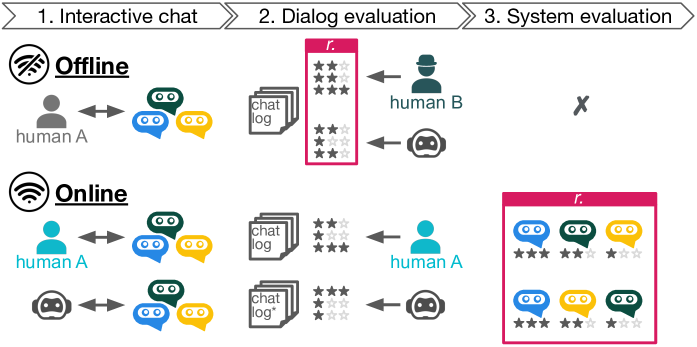
As conversational models become increasingly available to the general public, users are engaging with this technology in social interactions. Such unprecedented interaction experiences may pose considerable social and psychological risks to the users unless the technology is properly controlled. This highlights the need for scalable and robust evaluation metrics for conversational chatbots. Existing evaluation metrics aim to automate offline user evaluation and approximate human judgment of pre-curated dialogs. However, they are limited in their ability to capture subjective perceptions of users who actually interact with the bots and might not generalize to real-world settings. To address this limitation, we propose an approach to approximate online human evaluation leveraging large language models (LLMs) from the GPT family. We introduce a new Dialog system Evaluation framework based on Prompting (DEP), which enables a fully automatic evaluation pipeline that replicates live user studies and achieves an impressive correlation with human judgment (up to Pearson r=0.95 on a system level). The DEP approach involves collecting synthetic chat logs of evaluated bots with an LLM in the other-play setting, where the LLM is carefully conditioned to follow a specific scenario. We further explore different prompting approaches to produce evaluation scores with the same LLM. The best performing prompts, which contain few-shot demonstrations and instructions, show outstanding performance on the tested dataset and demonstrate the ability to generalize to other dialog corpora.
研究动机与目标
- 解决现有评估指标无法捕捉真实用户在与社交聊天机器人实时互动中主观感受的差距。
- 开发一种自动化、可扩展且成本低廉的在线人类评估替代方案,以复现真实用户研究的动态。
- 探究 LLM 是否可通过有效提示模拟对话系统中的人类社交角色和评估行为。
- 在共情和开放域对话设置中,实现自动化评估分数与人类判断之间的高相关性。
- 实现评估在不同对话语料和社交现象(超越基础质量指标)上的泛化能力。
提出的方法
- 使用 GPT 系列 LLM 作为合成对话伙伴,在‘他人扮演’设置中生成与被评估聊天机器人互动的真实对话日志。
- 通过特定角色的提示对 LLM 进行条件设定,以在对话生成过程中模拟特定社交角色(如共情倾听者、情绪表达者)。
- 应用少样本提示并结合标注示例,引导 LLM 根据对话质量维度分配细粒度评估分数。
- 设计明确将细粒度属性(如共情、连贯性)与整体对话评分关联的指令提示,以提升与人类判断的一致性。
- 通过聚合多个对话会话的评估分数,计算系统级别的排名以进行对比分析。
- 使用基准数据集(iEval、FED、DSTC9)验证该框架,并测量其与人工标注真实值的相关性。
实验结果
研究问题
- RQ1LLM 是否能通过有效提示在对话交互中模拟类人社交角色,从而生成逼真的合成对话日志?
- RQ2指令微调提示在多大程度上能生成与在线评估场景中人类判断高度相关的评估分数?
- RQ3DEP 框架在不同对话语料和社交互动现象(如共情、毒性)上的泛化能力如何?
- RQ4哪些提示策略(如少样本示范、详细指令)能实现与人类评估最高的相关性?
- RQ5该框架能否适应评估超越基本响应质量的复杂社交行为,如情感支持或幽默感?
主要发现
- 在 iEval 数据集上,DEP 框架在系统层面与人类判断的皮尔逊相关系数最高达 0.95,表明其与人类评估具有极强的一致性。
- 结合详细指令的少样本提示显著提升了评估分数的准确性,优于零样本或通用提示方法。
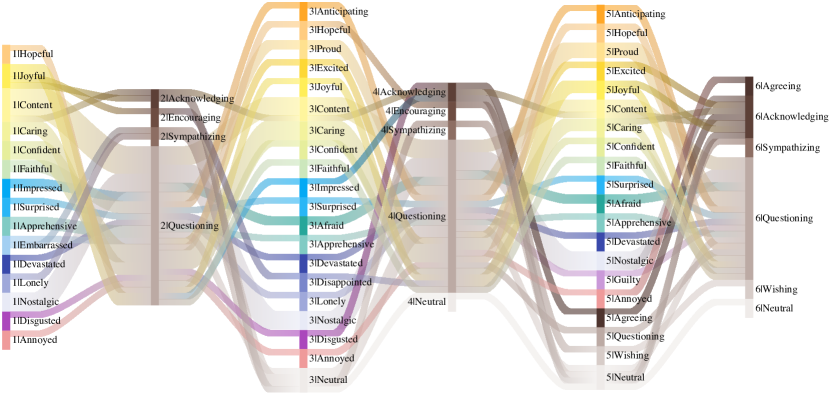
- LLM 在合成对话日志中的行为与人类对话模式高度相似,包括情绪和意图分布,尽管部分子流程(如表达感谢)因 RLHF 训练显示出模型个性的迹象。
- 该框架在其他对话语料(如 FED 和 DSTC9)上也表现出良好泛化能力,表明其在不同评估情境下的稳健性。
- 合成对话日志和评估注释已公开发布,支持可复现性与未来基准测试。
- 该框架实现了无需人工标注者的快速自动化聊天机器人评估,显著降低时间和成本,同时保持高可靠性。
阅读本论文
在 Nubint 阅读器中打开原文,边读边就任意段落提问。
在 Nubint 中阅读本论文本解读由 AI 根据论文原文生成,引用前请核对原文。