
[论文解读] Arbitrariness and Social Prediction: The Confounding Role of Variance in Fair Classification
本文将模型在不同训练运行中预测结果的方差识别为公平二分类中被严重忽视的任意性主要来源。本文提出自一致性——一种基于方差的度量指标——以量化这种任意性,设计了一种改进的袋装集成方法,对自一致性较低的样本拒绝分类,并通过迄今为止规模最大的相关研究证明,当考虑这种任意性时,大多数基准数据集实际上已接近公平,从而对许多现有公平性干预措施的必要性提出质疑。
Variance in predictions across different trained models is a significant, under-explored source of error in fair binary classification. In practice, the variance on some data examples is so large that decisions can be effectively arbitrary. To investigate this problem, we take an experimental approach and make four overarching contributions: We: 1) Define a metric called self-consistency, derived from variance, which we use as a proxy for measuring and reducing arbitrariness; 2) Develop an ensembling algorithm that abstains from classification when a prediction would be arbitrary; 3) Conduct the largest to-date empirical study of the role of variance (vis-a-vis self-consistency and arbitrariness) in fair binary classification; and, 4) Release a toolkit that makes the US Home Mortgage Disclosure Act (HMDA) datasets easily usable for future research. Altogether, our experiments reveal shocking insights about the reliability of conclusions on benchmark datasets. Most fair binary classification benchmarks are close-to-fair when taking into account the amount of arbitrariness present in predictions -- before we even try to apply any fairness interventions. This finding calls into question the practical utility of common algorithmic fairness methods, and in turn suggests that we should reconsider how we choose to measure fairness in binary classification.
研究动机与目标
- 研究预测方差在公平二分类中作为混淆因素的作用。
- 开发一种实用度量指标——自一致性,以量化模型预测中的任意性。
- 设计一种集成方法,对自一致性较低的样本拒绝分类,以减少任意性。
- 开展迄今为止规模最大的关于公平分类基准中方差的实证研究。
- 发布用于美国HMDA数据集的工具包,以支持未来的公平性研究。
提出的方法
- 自一致性定义为1减去在相同数据的不同子样本上训练的多个自助采样模型预测结果的方差。
- 基于袋装方法开发一种集成方法,修改为当自一致性低于阈值κ时拒绝分类。
- 该方法通过避免高方差预测,同时提升了自一致性和整体准确率。
- 作者在多个公平性基准上进行了广泛实验,每个样本使用100个自助采样模型来测量预测方差和自一致性。
- 将HMDA数据集打包为可重用、易访问的工具包,以支持未来公平性研究。
- 仅在通过自一致性考虑任意性之后,才评估公平性度量(如平等机会、均等机会)。
实验结果
研究问题
- RQ1不同模型运行之间的预测方差在多大程度上导致了公平二分类中的任意性?
- RQ2自一致性在多大程度上可作为模型预测中任意性的可靠代理指标?
- RQ3一种对低自一致性样本拒绝分类的集成方法,能否同时提升预测的可靠性和公平性指标?
- RQ4在考虑任意性后,对现有基准数据集的公平性感知会产生何种影响?
- RQ5如果基线任意性本身已掩盖或扭曲了公平性主张,那么当前的公平性干预措施是否必要?
主要发现
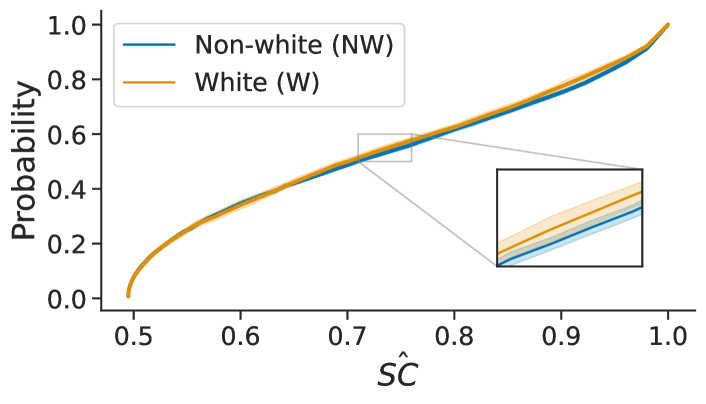
- 当考虑方差和任意性时,大多数公平二分类基准数据集实际上已接近公平,甚至在应用任何公平性干预措施之前即已如此。
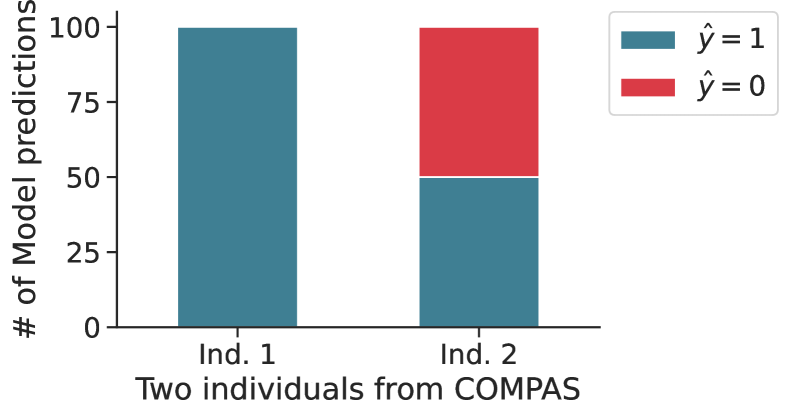
- 研究发现,部分个体的预测任意性水平极高,其分类结果近乎随机,严重削弱了对模型决策的信心。
- 所提出的带拒绝分类的集成方法通过避免高方差预测,显著提升了自一致性与整体准确率。
- 作者观察到,许多先前关于基准数据集中不公平性的主张,可能是未考虑预测方差所导致的伪影,而非真实的群体差异。
- HMDA数据集工具包的发布,使未来研究能够使用大规模真实世界数据开展公平性研究,显著提升可复现性与可扩展性。
- 研究结果对许多算法公平性方法的实际效用提出挑战,表明当任意性得到恰当度量时,这些方法在实证上可能是不必要的。
阅读本论文
在 Nubint 阅读器中打开原文,边读边就任意段落提问。
在 Nubint 中阅读本论文本解读由 AI 根据论文原文生成,引用前请核对原文。