
[论文解读] Arecibo Wow! I: An Astrophysical Explanation for the Wow! Signal
本文提出,1977年‘Wow!信号’是由短暂辐射爆发——极有可能来自磁星耀发或软伽马射电重复源——引发冷星际氢(HI)云中的受激辐射,从而在1420 MHz处产生短暂而强烈的类似激光(maser)的辐射爆发。作者在Arecibo数据中检测到类似但较弱的信号,并将其识别为HI辐射,认为Wow!信号是一种罕见的自然天体激光辐射爆发,而非外星或地球人为干扰。
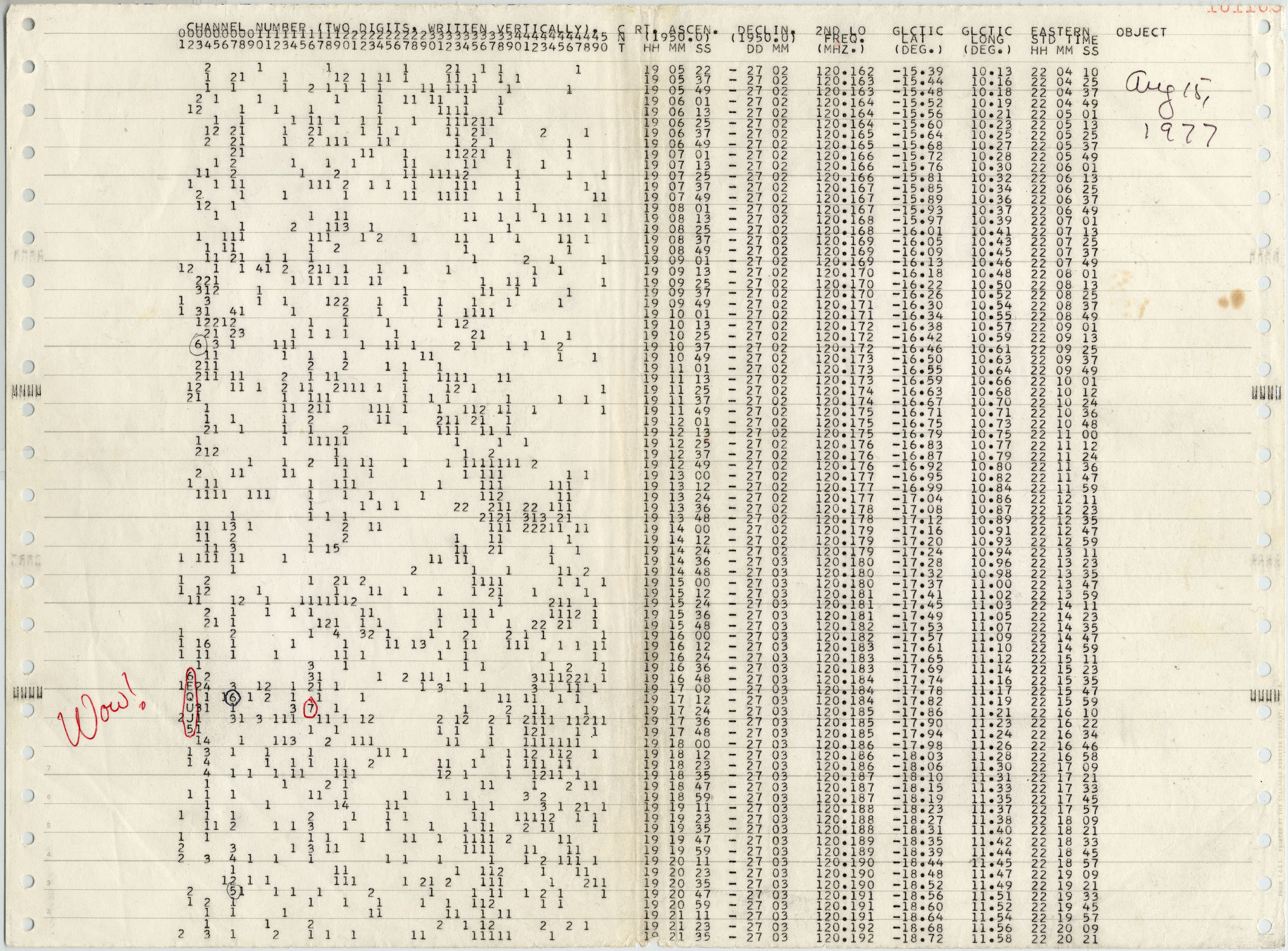
The Ohio State University Big Ear radio telescope detected in 1977 the Wow! Signal, one of the most famous and intriguing signals of extraterrestrial origin. Characterized by its strong relative intensity and narrow bandwidth near the 1420 MHz hydrogen line, its source has never been detected again despite numerous follow-up attempts. Arecibo Wow! is a new technosignature project using archived data from the Arecibo Observatory. Here we present our first results of drift scans made between February and May 2020 at 1420 MHz. The methods, frequency, and bandwidth of these observations are similar to those used to detect the Wow! Signal. However, our observations are more sensitive, have better temporal resolution, and include polarization measurements. We report the detection of narrowband signals (10 kHz) near the hydrogen line similar to the Wow! Signal, although two-orders of magnitude less intense and in multiple locations. Despite the similarities, these signals are easily identifiable as small interstellar clouds of cold hydrogen (HI) in the galaxy. We hypothesize that the Wow! Signal was caused by a sudden brightening of the hydrogen line in these clouds triggered by a strong transient radiation source, such as a magnetar flare or a soft gamma repeater (SGR). A maser flare or superradiance mechanisms can produce stimulated emission consistent with the Wow! Signal. Our hypothesis explains all observed properties of the Wow! Signal, proposes a new source of false positives in technosignature searches, and suggests that the Wow! Signal could be the first recorded event of an astronomical maser-like flare in the hydrogen line.
研究动机与目标
- 解释1977年Wow!信号这一神秘现象的起源,尽管数十年来持续搜寻仍未得到解答。
- 检验Wow!信号是否可被解释为自然发生的天体现象,而非外星或地球人为干扰。
- 在归档的Arecibo数据中识别出类似窄带信号,以验证所提出的机制。
- 利用HI云中受激辐射的理论框架,为Wow!信号的瞬态、窄带和高强度特性提供可检验的假说。
- 提出此类激光辐射爆发可能成为技术信号搜寻中的假阳性来源,呼吁在解释类似信号时保持谨慎。
提出的方法
- 使用Arecibo 305米望远镜(2020年)和12米望远镜(2023年)在1420 MHz进行漂移扫描,观测参数与原始Big Ear观测相似。
- 采用高灵敏度、高时间分辨率的观测,并进行完整的斯托克斯(Stokes)偏振测量,以区分天体现象信号与射频干扰(RFI)。
- 分析靠近氢线的窄带信号(Δν ≤ 10 kHz),比较其光谱和偏振特性与已知HI辐射特征的异同。
- 建立冷HI云受短时高强度辐射爆发(如磁星耀发或SGR爆发)照射时受激辐射的物理机制模型。
- 运用激光放大的理论框架,解释为何位于云后方的瞬变源可导致1420 MHz处产生短暂、强烈、窄带的信号。
- 建议使用高分辨率望远镜(如VLA)进行后续观测,以定位位于已识别HI云后方的源。
实验结果
研究问题
- RQ1Wow!信号是否可由自然天体现象解释,而非外星或地球人为干扰?
- RQ2何种物理机制可产生与Wow!信号特征相符的1420 MHz处窄带、高强度、瞬态射电信号?
- RQ3在归档的Arecibo数据中是否存在Wow!信号的可探测类比信号?它们是否具有相同的物理起源?
- RQ4冷星际HI云中的受激辐射能否在不依赖人工起源的前提下,解释该信号的强度、持续时间与频率特性?
- RQ5可采用何种观测策略来检验并证伪Wow!信号为氢激光辐射爆发的假说?
主要发现
- 在Arecibo数据中检测到靠近1420 MHz的窄带信号(Δν ≤ 10 kHz),其带宽和频率与Wow!信号相似,但强度弱两个数量级。
- 这些信号被识别为来自银河系氢背景前方的冷氢(HI)云,依据是其光谱和偏振特性。
- 作者提出,Wow!信号源于短暂辐射爆发(如磁星耀发或SGR爆发)激发前方HI云中的受激辐射,从而产生短暂的激光辐射爆发。
- 源必须位于云后方,这解释了为何原始源未被探测到——由于视线对齐及受激辐射导致的信号放大。
- 该假说可解释信号持续72秒(望远镜波束穿越时间)、窄带宽以及无重复探测的原因,因为此类对齐与瞬变事件极为罕见。
- Wow!信号可能是首次记录到的氢线波段的天体激光辐射爆发,揭示了一类新的瞬变射电现象,并可能成为SETI中假阳性的潜在来源。

阅读本论文
在 Nubint 阅读器中打开原文,边读边就任意段落提问。
在 Nubint 中阅读本论文本解读由 AI 根据论文原文生成,引用前请核对原文。