
[论文解读] Art or Artifice? Large Language Models and the False Promise of Creativity
该论文提出 TTCW,一种受 Torrance 启发、以工件为中心的短篇故事创意评价方法,显示 LLM 在创意测试上落后于人类作者3–10倍,并且LLMs也不能可靠评估创意。
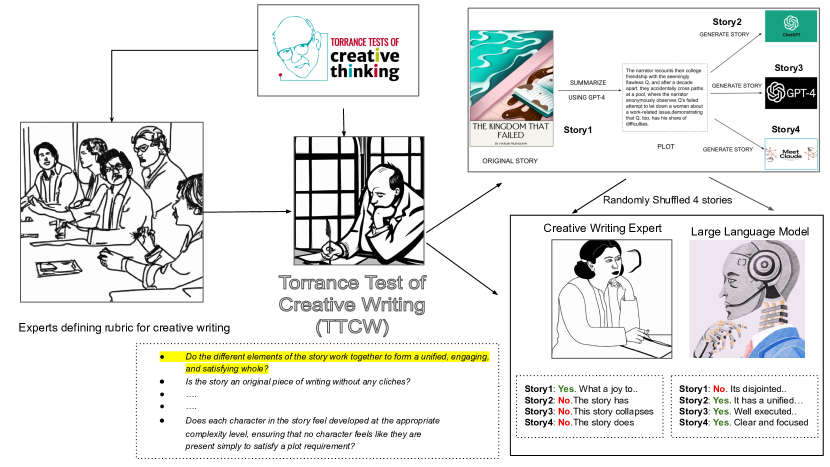
Researchers have argued that large language models (LLMs) exhibit high-quality writing capabilities from blogs to stories. However, evaluating objectively the creativity of a piece of writing is challenging. Inspired by the Torrance Test of Creative Thinking (TTCT), which measures creativity as a process, we use the Consensual Assessment Technique [3] and propose the Torrance Test of Creative Writing (TTCW) to evaluate creativity as a product. TTCW consists of 14 binary tests organized into the original dimensions of Fluency, Flexibility, Originality, and Elaboration. We recruit 10 creative writers and implement a human assessment of 48 stories written either by professional authors or LLMs using TTCW. Our analysis shows that LLM-generated stories pass 3-10X less TTCW tests than stories written by professionals. In addition, we explore the use of LLMs as assessors to automate the TTCW evaluation, revealing that none of the LLMs positively correlate with the expert assessments.
研究动机与目标
- 将 TTCT 翻译为一个以工件为中心的 Torrance 创造力测试(TTCW),用于评估短篇故事中的创造力。
- 在一致评估技术(Consensual Assessment Technique)下,使用专家对48个故事(专业人士 vs. LLM)做出的判断来验证 TTCW。
- 研究 LLM 是否可以作为 TTCW 测试的自治评估者。
- 比较不同 LLM 的表现以识别维度特定的优势与劣势。
- 发布大规模 TTCW 注释,以促进未来在 AI 辅助创作中的研究。
提出的方法
- 将 TTCW 基于 TTCT 的流畅性、灵活性、原创性和详细阐述等维度。
- 开发14个二元测试(是/否),并提供开放式理由,以在 TTCW 的维度上评估每个故事。
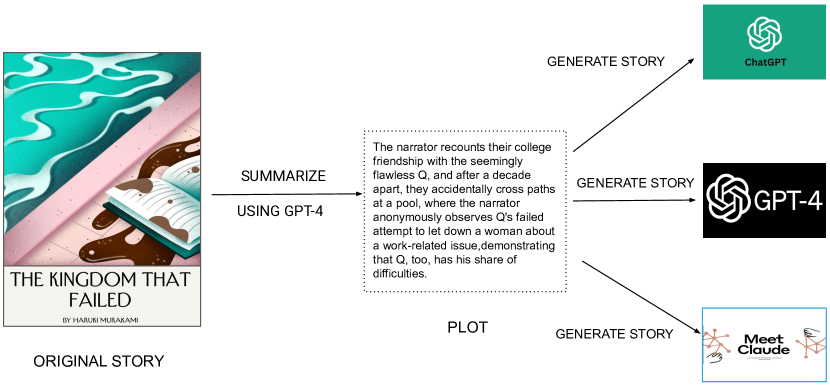
- 使用 Consensual Assessment Technique,10 名专家评审评估48个故事(12 份专业创作、36 份 LLM 生成)。
- 分析评审者间一致性(Fleiss Kappa)和聚合相关性(Pearson),以验证 TTCW。
- 将 LLM 生成的故事与专家撰写的故事在各测试中的表现进行比较,以量化通过率(例如 84.7% 对 9–30%)。
- 以 LLM 作为 TTCW 评估者进行实验,以测量与专家判断的相关性。
实验结果
研究问题
- RQ1RQ1: 基于 TTCW 的创造力评估在专家之间是否一致且可重复?
- RQ2RQ2: 专家撰写的故事在 TTCW 测试中的通过率是否高于 LLM 生成的故事,哪些测试显示最大的差距?
- RQ3RQ3: 不同的 LLM 在通过 TTCW 测试方面是否存在差异,是否存在维度特定的优势?
- RQ4RQ4: LLMs 是否能可靠评估 TTCW 测试,即它们的判断是否与专家判断相关?
主要发现
- 专家在单个 TTCW 测试上表现出中等程度的一致性(Fleiss Kappa ~0.41),在聚合所有测试时则呈现较强的一致性(Pearson ~0.69)。
- 专家撰写的故事平均通过 84.7% 的 TTCW 测试,而 ChatGPT 生成的故事通过约 9%,Claude 生成的故事通过约 30%。
- LLMs 展现出维度特定的优势(GPT-4 偏向原创性;Claude v1.3 偏向流畅性、灵活性、阐述性)。
- 将 LLM 作为 TTCW 评估者,与专家判断相关性基本为零。
- TTCW 框架在各测试间是可叠加的;更高的总体通过数量表示更高的感知创造力。
阅读本论文
在 Nubint 阅读器中打开原文,边读边就任意段落提问。
在 Nubint 中阅读本论文本解读由 AI 根据论文原文生成,引用前请核对原文。