
[论文解读] Asynchronous Trajectory Matching-Based Multimodal Maritime Data Fusion for Vessel Traffic Surveillance in Inland Waterways
该论文提出DeepSORVF,一种基于深度学习的异步多模态数据融合方法,用于内河航道船舶交通监控中的AIS与视频数据融合。通过从AIS和视频流中提取轨迹特征,并结合基于先验知识驱动的抗遮挡跟踪机制,该方法在遮挡和异步数据条件下仍能实现高精度、实时的数据融合,其有效性在新构建的FVessel基准数据集上得到验证,平均MOFA达到97.02%,MOFP为0.196。
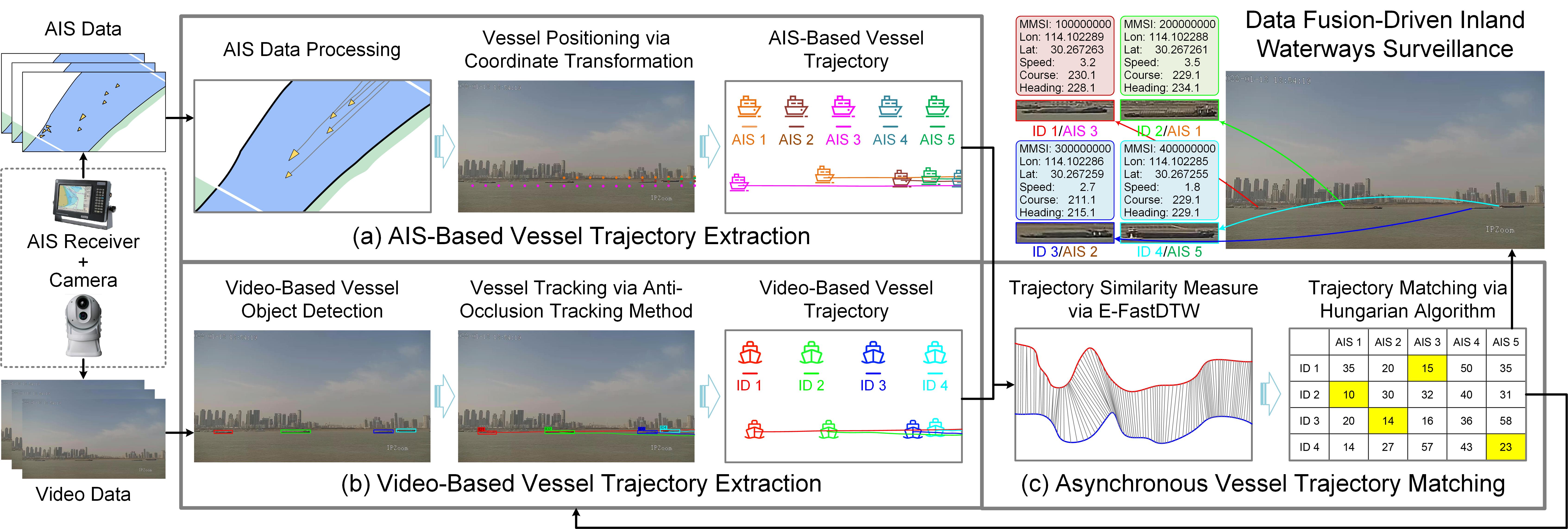
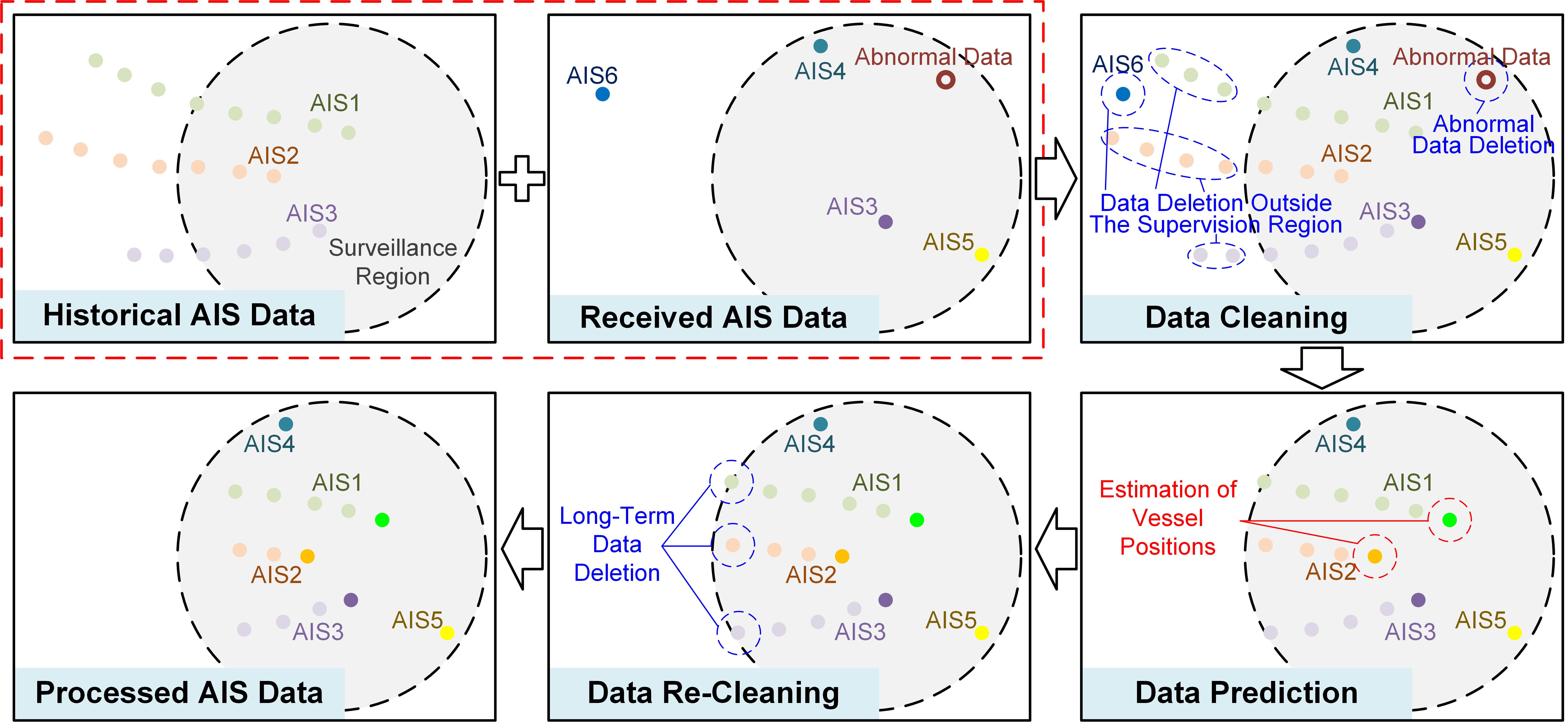
The automatic identification system (AIS) and video cameras have been widely exploited for vessel traffic surveillance in inland waterways. The AIS data could provide the vessel identity and dynamic information on vessel position and movements. In contrast, the video data could describe the visual appearances of moving vessels, but without knowing the information on identity, position and movements, etc. To further improve vessel traffic surveillance, it becomes necessary to fuse the AIS and video data to simultaneously capture the visual features, identity and dynamic information for the vessels of interest. However, traditional data fusion methods easily suffer from several potential limitations, e.g., asynchronous messages, missing data, random outliers, etc. In this work, we first extract the AIS- and video-based vessel trajectories, and then propose a deep learning-enabled asynchronous trajectory matching method (named DeepSORVF) to fuse the AIS-based vessel information with the corresponding visual targets. In addition, by combining the AIS- and video-based movement features, we also present a prior knowledge-driven anti-occlusion method to yield accurate and robust vessel tracking results under occlusion conditions. To validate the efficacy of our DeepSORVF, we have also constructed a new benchmark dataset (termed FVessel) for vessel detection, tracking, and data fusion. It consists of many videos and the corresponding AIS data collected in various weather conditions and locations. The experimental results have demonstrated that our method is capable of guaranteeing high-reliable data fusion and anti-occlusion vessel tracking.
研究动机与目标
- 解决在内河航道船舶交通监控中,来自AIS和视频摄像头的异步多模态数据融合挑战。
- 在遮挡、数据缺失和时间延迟等条件下,提升数据融合的准确性和鲁棒性。
- 开发一种实用的、实时的方法,整合身份、动态和视觉特征,以增强态势感知能力。
- 构建一个新的基准数据集(FVessel),用于评估在多样化环境条件下船舶检测、跟踪和数据融合的性能。
提出的方法
- 利用船舶动态信息(如MMSI、速度、航向)和时空定位,提取基于AIS的轨迹。
- 通过目标检测与跟踪模型识别并追踪视觉目标,提取基于视频的轨迹。
- 实现一种基于深度学习的异步轨迹匹配机制(DeepSORVF),以在时间错位情况下对齐AIS与视觉轨迹。
- 将船舶航行行为的先验知识融入运动模型,以提升遮挡情况下的跟踪鲁棒性。
- 采用混合融合策略,结合两种模态的运动特征,以预测并校正被遮挡的船舶位置。
- 应用轨迹匹配损失函数,最小化匹配后的AIS与视觉目标在时间维度上的距离。
实验结果
研究问题
- RQ1如何有效匹配异步的AIS与视频数据,以实现在内河航道中可靠的船舶身份与运动轨迹跟踪?
- RQ2在遮挡条件下,船舶航行行为的先验知识在多大程度上能提升跟踪性能?
- RQ3在存在时间延迟和数据缺失的情况下,轨迹匹配对数据融合准确性有何影响?
- RQ4在真实复杂场景中,所提出方法与基线融合与跟踪方法相比表现如何?
主要发现
- 所提出的DeepSORVF方法在FVessel数据集上实现了平均97.02%的Multiple Object Fusion Accuracy(MOFA)和0.196的Multiple Object Fusion Precision(MOFP),表明其具有高融合准确性。
- 引入抗遮挡跟踪策略后,MOFA显著提升,最高达11.7个百分点(例如,在clip-02上从87.77%提升至99.47%),表明对遮挡具有强鲁棒性。
- 尽管MOFP略有上升(在clip-02上从0.110增至0.140),但抗遮挡策略通过正确匹配被遮挡的船舶,显著提升了整体融合可靠性。
- 该方法平均仅需0.2562秒处理1秒数据,处理时间范围为0.175–0.500秒,证实其具备实际部署的实时可行性。
- 图9中的视觉对比显示,DeepSORVF能够成功预测并匹配被遮挡的船舶,但在复杂遮挡场景下仍存在轻微的边界框偏差。
阅读本论文
在 Nubint 阅读器中打开原文,边读边就任意段落提问。
在 Nubint 中阅读本论文本解读由 AI 根据论文原文生成,引用前请核对原文。