
[论文解读] Atacama Large Aperture Submillimeter Telescope (AtLAST) science: Gas and dust in nearby galaxies
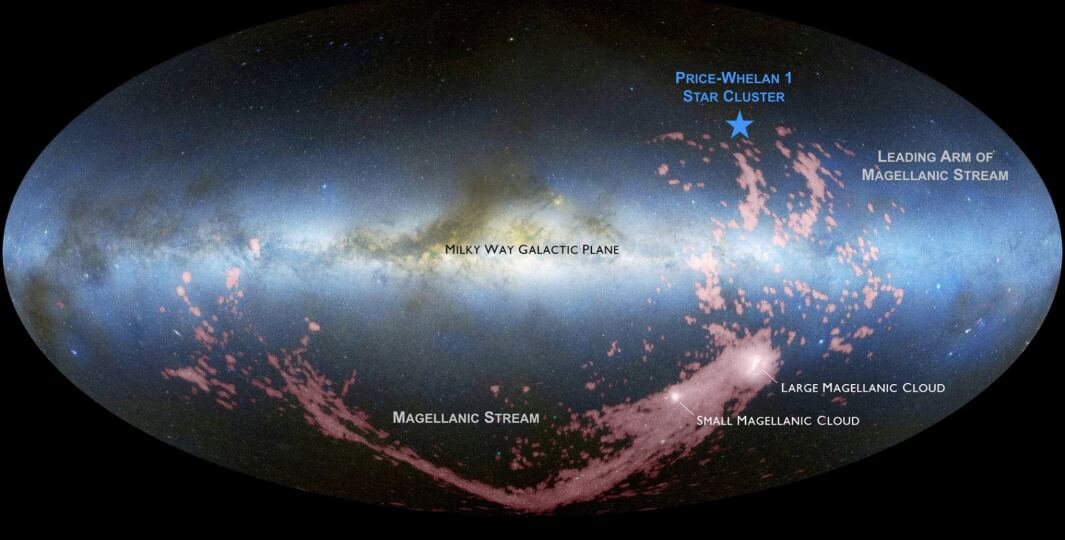
一个案例研究,概述了提议的50米亚毫米波望远镜 AtLAST 将如何通过在广阔天空区域进行深度尘埃/气体测绘并使用多种示踪物,改变对近邻星系中的 ISM 和恒星形成研究,特别是大麦哲伦云/小麦哲伦云。
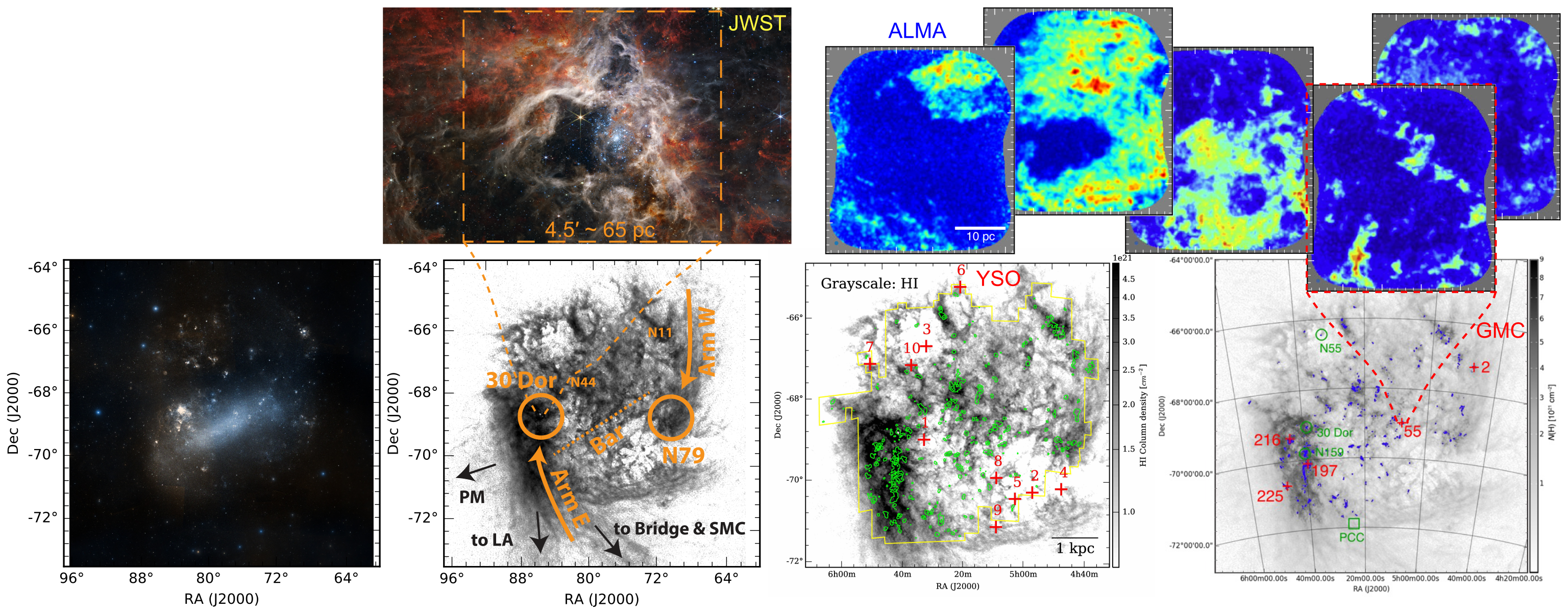
Understanding the physical processes that regulate star formation and galaxy evolution are major areas of activity in modern astrophysics. Nearby galaxies offer unique opportunities to inspect interstellar medium (ISM), star formation (SF), radiative, dynamic and magnetic physics in great detail from sub-galactic (kpc) scales to sub-cloud (sub-pc) scales, from quiescent galaxies to starbursts, and from field galaxies to overdensities. In this case study, we discuss the major breakthroughs in this area of research that will be enabled by the Atacama Large Aperture Submillimeter Telescope (AtLAST), a proposed 50-m single-dish submillimeter telescope. The new discovery space of AtLAST comes from its exceptional sensitivity, in particular to extended low surface brightness emission, a very large 2 degree field of view, and correspondingly high mapping efficiency. This paper focuses on four themes which will particularly benefit from AtLAST: 1) the LMC and SMC, 2) extragalactic magnetic fields, 3) the physics and chemistry of the interstellar medium, and 4) star formation and galaxy evolution. With ~1000-2000h surveys each, AtLAST could deliver deep dust continuum maps of the entire LMC and SMC fields at parsec-scale resolution, high-resolution maps of the magnetic field structure, gas density, temperature and composition of the dense and diffuse ISM in ~100 nearby galaxies, as well as the first large-scale blind CO survey in the nearby Universe, delivering molecular gas masses for up to 10^6 galaxies (3 orders of magnitude more than current samples). Through such observing campaigns, AtLAST will have a profound impact on our understanding of the baryon cycle and star formation across a wide range of environments.
研究动机与目标
- 激发并界定以近邻星系中的气体与尘埃为重点的 AtLAST 科学案例。
- 演示 AtLAST 将如何在多样化环境中探测 ISM 的物理、化学、磁场及恒星形成。
- 将 LMC/SMC 作为关键实验室并量化实现这些目标所需的观测要求。
- 说明潜在的 survey 策略及对理解星系重子循环的影响。
提出的方法
- 描述 AtLAST 的能力:50-m 单口径,对扩展发射具有卓越灵敏度,2°视场,以及高绘制效率。
- 提出 Band 3 至 Band 10 的多带连续与谱线成像,以绘制尘埃和气体示踪物。
- 勾勒面向 LMC/SMC 的具体观测方案,估计在源观测时间(总计约 2900 小时)和分辨力(Band 10 ~1.5–2″)。
- 将 AtLAST 的能力与现有设施(ALMA、APEX、Herschel)进行比较,并讨论 AtLAST 如何在 CO-暗气体和弥散 ISM 的研究中具独特作用。
- 讨论目标示踪物,包括 CO、[CI]、[CII] 以及尘埃发射,用以表征气相及尘埃性质。
- 提出将 AtLAST 数据转化为关于气体质量、尘埃质量、金属丰度效应和恒星形成过程约束的框架。
实验结果
研究问题
- RQ1大麦哲伦云/小麦哲伦云中的弥散与致密 ISM 如何与银河系环境不同,这对恒星形成有何含义?
- RQ2低金属环境中 CO 暗分子气体的范围与性质如何,以及如何通过 [CI] 等线来追踪?
- RQ3尘埃性质(温度、发射率、质量)如何随金属丰度与环境在大麦哲伦云/小麦哲伦云中变化?
- RQ4磁场在塑造近邻星系从银河尺度到亚千秒差距尺度的气体流动与恒星形成中的作用?
- RQ5在广泛的局部星系群中,全面观测下尘埃与分子气体的分布特征是什么?
主要发现
- CO-dark gas is significant in low-metallicity environments, with [CII] observations suggesting a large fraction of cold gas not traced by CO in the LMC.
- AtLAST can map the LMC/SMC in continuum across multiple bands with unprecedented sensitivity to diffuse emission and 10×–15× higher spatial resolution than Herschel, enabling sub-parsec scale studies over ∼100 deg² fields.
- A Large-Scale CO and [CI] survey with AtLAST will provide contiguous, high-sensitivity coverage rivaling or exceeding existing CO surveys in depth and resolution.
- Multi-band continuum data will allow disentangling dust from free-free emission and CMB/foreground confusion, improving dust mass and temperature estimates across environments.
- Line surveys (e.g., CO, [CI]) at higher frequencies will be feasible over significant areas, enabling detailed excitation and gas condition studies from cloud scales to galaxy scales.
- Survey strategies indicate substantial observing time (∼2900 hours for LMC/SMC continuum mapping) spread over years to enable comprehensive, multi-band coverage.
阅读本论文
在 Nubint 阅读器中打开原文,边读边就任意段落提问。
在 Nubint 中阅读本论文本解读由 AI 根据论文原文生成,引用前请核对原文。