
[论文解读] ATFNet: Adaptive Time-Frequency Ensembled Network for Long-term Time Series Forecasting
ATFNet 是一种用于长期时间序列预测的新型自适应时频集成网络,通过主导谐波序列能量加权机制,动态融合时域与频域表征。它引入扩展DFT以解决频率错位问题,并采用复值谱注意力机制建模频率组合,从而在8个真实世界数据集上实现最先进性能。
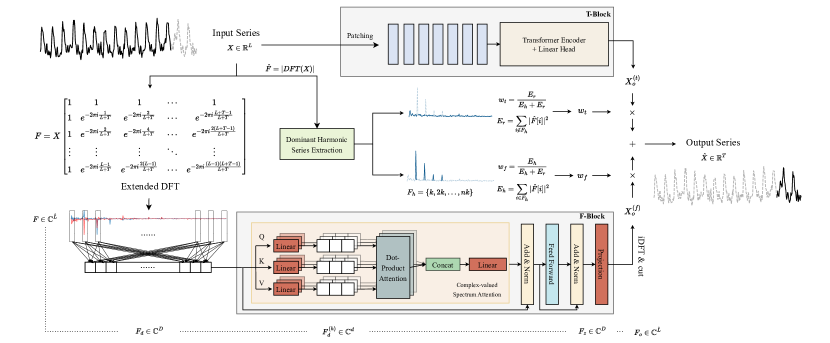
The intricate nature of time series data analysis benefits greatly from the distinct advantages offered by time and frequency domain representations. While the time domain is superior in representing local dependencies, particularly in non-periodic series, the frequency domain excels in capturing global dependencies, making it ideal for series with evident periodic patterns. To capitalize on both of these strengths, we propose ATFNet, an innovative framework that combines a time domain module and a frequency domain module to concurrently capture local and global dependencies in time series data. Specifically, we introduce Dominant Harmonic Series Energy Weighting, a novel mechanism for dynamically adjusting the weights between the two modules based on the periodicity of the input time series. In the frequency domain module, we enhance the traditional Discrete Fourier Transform (DFT) with our Extended DFT, designed to address the challenge of discrete frequency misalignment. Additionally, our Complex-valued Spectrum Attention mechanism offers a novel approach to discern the intricate relationships between different frequency combinations. Extensive experiments across multiple real-world datasets demonstrate that our ATFNet framework outperforms current state-of-the-art methods in long-term time series forecasting.
研究动机与目标
- 解决在长期时间序列预测中有效融合时域与频域表征的挑战。
- 克服基于离散傅里叶变换(DFT)的谱预测中因频率错位导致的预测精度下降问题。
- 建模频率分量之间的复杂关系,特别是谐波序列,以更好地捕捉全局依赖性。
- 设计一种动态融合机制,根据输入时间序列的周期性自适应调整,提升在多样化时间模式下的泛化能力。
- 通过充分利用时域与频域的互补优势,在长程预测基准上实现最先进性能。
提出的方法
- 提出双分支架构,分别通过时域模块与频域模块捕捉局部与全局依赖性。
- 引入主导谐波序列能量加权机制,根据输入周期性动态分配两个模块之间的注意力权重。
- 开发扩展DFT,对齐输入与目标谱的离散频率通道,减少频域表征中的错位误差。
- 设计复值谱注意力(CSA),在复谱空间中建模频率分量之间的相互作用,尤其针对谐波组。
- 采用轻量级线性头直接预测频域中的完整谱,实现端到端学习。
- 使用MSE与MAE作为损失函数进行训练,并通过逆DFT将模型输出重构回时域以进行评估。

实验结果
研究问题
- RQ1如何有效融合时域与频域表征以提升长期时间序列预测性能?
- RQ2何种机制可实现基于输入序列周期性的时域与频域模块之间的自适应加权?
- RQ3如何缓解基于DFT的谱预测中的频率错位问题以提升精度?
- RQ4谐波序列与频率组合在提升预测性能中起到何种作用?
- RQ5在频域中采用注意力机制进行直接谱预测,是否能优于传统时域预测模型?
主要发现
- ATFNet在8个真实世界长期预测数据集上达到最先进性能,在MSE与MAE指标上均优于现有SOTA方法。
- 在ETTm1数据集上,ATFNet的平均MSE为0.088,MAE为0.217,显著优于所有基线模型,包括F-Block与T-Block。
- 消融实验表明,完整ATFNet模型(在ETTm1上MSE为0.088,MAE为0.217)优于缺少主导谐波序列能量加权或CSA的变体。
- 扩展DFT有效减少频率错位,提升谱重构精度,尤其在具有强周期分量的信号中表现显著。
- 复值谱注意力通过建模频率间关系显著提升性能,消融实验已证实其有效性。
- 所提出的主导谐波序列能量加权机制能有效度量周期性,并实现动态模块融合,提升在多样化时间序列模式下的鲁棒性。
阅读本论文
在 Nubint 阅读器中打开原文,边读边就任意段落提问。
在 Nubint 中阅读本论文本解读由 AI 根据论文原文生成,引用前请核对原文。