
[论文解读] Audio-Visual Efficient Conformer for Robust Speech Recognition
本文提出 Audio-Visual Efficient Conformer (AVEC),一种多模态语音识别模型,通过使用轻量级 Efficient Conformer 后端融合音频和视觉(唇部运动)输入,提升了噪声鲁棒性。通过在中间层引入 CTC 残差模块实现中间 CTC 损失,并以更高效的块注意力机制替代分组注意力机制,AVEC 在 LRS2 上实现了 2.3% 的 SOTA WER,在 LRS3 上实现了 1.8% 的 SOTA WER,且训练步数仅为音频单模态基线的 1/4,显著降低了错误率。
End-to-end Automatic Speech Recognition (ASR) systems based on neural networks have seen large improvements in recent years. The availability of large scale hand-labeled datasets and sufficient computing resources made it possible to train powerful deep neural networks, reaching very low Word Error Rate (WER) on academic benchmarks. However, despite impressive performance on clean audio samples, a drop of performance is often observed on noisy speech. In this work, we propose to improve the noise robustness of the recently proposed Efficient Conformer Connectionist Temporal Classification (CTC)-based architecture by processing both audio and visual modalities. We improve previous lip reading methods using an Efficient Conformer back-end on top of a ResNet-18 visual front-end and by adding intermediate CTC losses between blocks. We condition intermediate block features on early predictions using Inter CTC residual modules to relax the conditional independence assumption of CTC-based models. We also replace the Efficient Conformer grouped attention by a more efficient and simpler attention mechanism that we call patch attention. We experiment with publicly available Lip Reading Sentences 2 (LRS2) and Lip Reading Sentences 3 (LRS3) datasets. Our experiments show that using audio and visual modalities allows to better recognize speech in the presence of environmental noise and significantly accelerate training, reaching lower WER with 4 times less training steps. Our Audio-Visual Efficient Conformer (AVEC) model achieves state-of-the-art performance, reaching WER of 2.3% and 1.8% on LRS2 and LRS3 test sets. Code and pretrained models are available at https://github.com/burchim/AVEC.
研究动机与目标
- 提升端到端自动语音识别(ASR)系统在环境噪声下的鲁棒性,因环境噪声导致其性能显著下降。
- 通过引入中间 CTC 监督,缓解 CTC 模型对条件独立性的依赖,从而放松该假设。
- 通过融合音频与视觉模态并采用轻量化、高效的架构,加速训练并提升性能。
- 在不牺牲识别准确率的前提下,降低注意力机制的计算复杂度,尤其在多模态设置中。
提出的方法
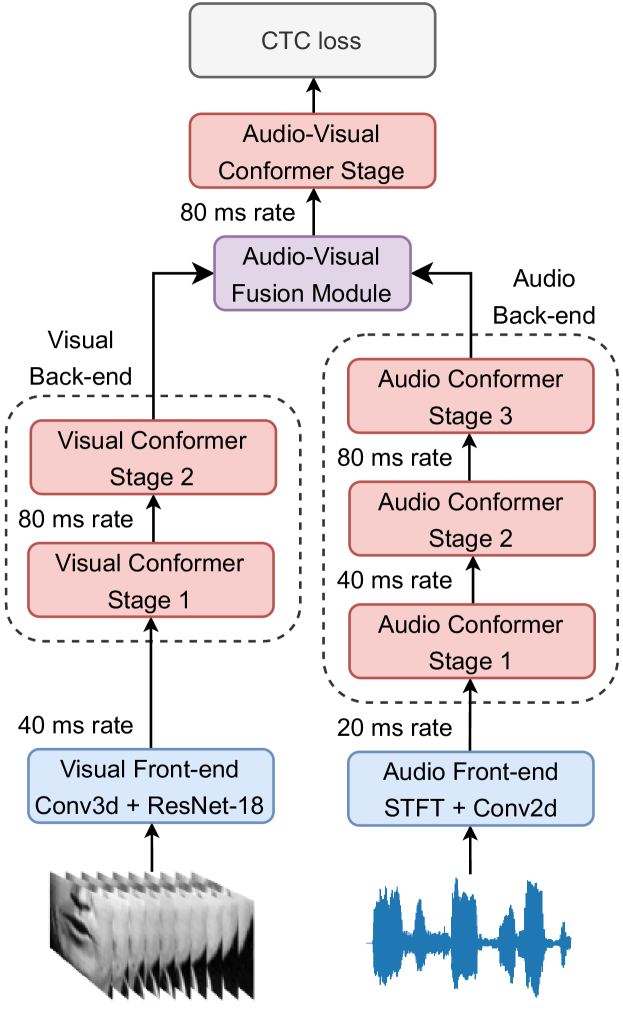
- 采用 ResNet-18 视觉前端从唇部运动中提取时空特征,并将其与原始音频波形融合。
- 采用带有注意力机制的 Efficient Conformer 后端,将分组注意力替换为更简单、更高效的块注意力机制,以减少 FLOPs。
- 通过 Inter CTC 残差模块在编码器块之间引入中间 CTC 损失,使块级特征基于早期预测进行条件化,从而放松 CTC 的条件独立性假设。
- 在编码器之前对音频与视觉特征进行早期融合,使网络从开始就联合建模两种模态。
- 使用连接时序分类(CTC)损失端到端训练模型,输入为多模态数据,以优化从原始音频与视频到文本的映射。
- 通过添加多种噪声类型(如 babble 噪声、白噪声、街道噪声)增强训练数据,以提升在低信噪比(SNR)条件下的鲁棒性。
实验结果
研究问题
- RQ1音频与视觉输入的多模态融合是否能显著提升端到端 ASR 系统的噪声鲁棒性?
- RQ2在编码器块之间引入中间 CTC 监督是否能提升识别性能,并缩小自回归与非自回归模型之间的差距?
- RQ3如块注意力等简化注意力机制是否能在降低计算复杂度的同时,达到与分组注意力相当的性能?
- RQ4在噪声数据上进行训练在多大程度上能提升模型在低 SNR 环境下的泛化能力与鲁棒性?
- RQ5当音频受损时,视觉模态特征是否能有效引导音频识别,尤其在高挑战性噪声条件下?
主要发现
- Audio-Visual Efficient Conformer (AVEC) 在 LRS2 测试集上实现了 2.3% 的 SOTA 词错误率(WER),在 LRS3 测试集上实现了 1.8% 的 SOTA WER,优于以往方法。
- 在 -5 dB babble 噪声条件下,AVEC 相较于先前工作将 WER 降低了最多 16.3 个百分点,实现 9.7% WER,而 Ma 等人 [29] 的方法为 16.3%。
- 仅使用 1/4 的训练步数,AVEC 的 WER 就低于其音频单模态基线,证明了训练效率的显著提升。
- 在 20 dB SNR 的 babble 噪声下,AVEC 在 LRS3 上实现 2.0% WER;在白噪声下也达到 2.0% WER,表明其在各类噪声下均具备强大鲁棒性。
- 通过 Inter CTC 残差模块引入中间 CTC 监督,有助于防止视觉模态的使用不足,并改善预测与特征之间的对齐。
- 块注意力在性能上与分组注意力相当,同时显著降低了计算复杂度,使模型更适用于实时应用。

阅读本论文
在 Nubint 阅读器中打开原文,边读边就任意段落提问。
在 Nubint 中阅读本论文本解读由 AI 根据论文原文生成,引用前请核对原文。