
[论文解读] Automated, LLM enabled extraction of synthesis details for reticular materials from scientific literature
本文提出一个 Knowledge Extraction Pipeline (KEP),该系统使用提示工程化的就地学习(in-context learning)与开源 LLMs,自动从 PDFs 提取网状材料的合成路线且不进行微调,并在段落分类与信息提取任务中比较五个 LLM 家族。
Automated knowledge extraction from scientific literature can potentially accelerate materials discovery. We have investigated an approach for extracting synthesis protocols for reticular materials from scientific literature using large language models (LLMs). To that end, we introduce a Knowledge Extraction Pipeline (KEP) that automatizes LLM-assisted paragraph classification and information extraction. By applying prompt engineering with in-context learning (ICL) to a set of open-source LLMs, we demonstrate that LLMs can retrieve chemical information from PDF documents, without the need for fine-tuning or training and at a reduced risk of hallucination. By comparing the performance of five open-source families of LLMs in both paragraph classification and information extraction tasks, we observe excellent model performance even if only few example paragraphs are included in the ICL prompts. The results show the potential of the KEP approach for reducing human annotations and data curation efforts in automated scientific knowledge extraction.
研究动机与目标
- 促成快速从文献中构建网状材料(MOFs、ZIFs、COFs、沸石)合成协议数据库的动力
- 开发一个领域无关的 KEP,且不需要对模型进行微调或训练
- 证明通过提示工程结合就地学习(ICL)能够从 PDFs 提取化学合成细节,同时降低幻觉风险
- 评估在多家开源 LLM 家族中在段落分类与信息提取两方面的性能
- 强调提示中示例选择如何影响模型成功率并减少标注工作量
提出的方法
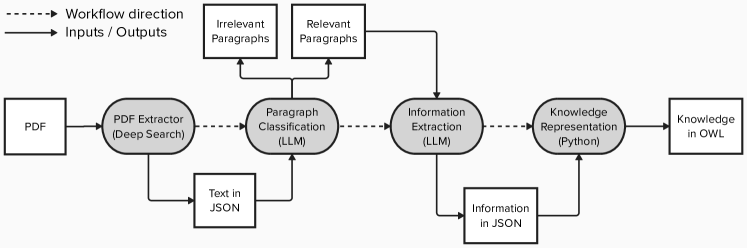
- 引入一个四模块的 Knowledge Extraction Pipeline (KEP): PDF 提取器、段落分类、信息提取和知识表示
- 使用 DS4SD 将 PDF(包括通过 OCR 的图片 PDF)转换为 JSON-like 文档元素
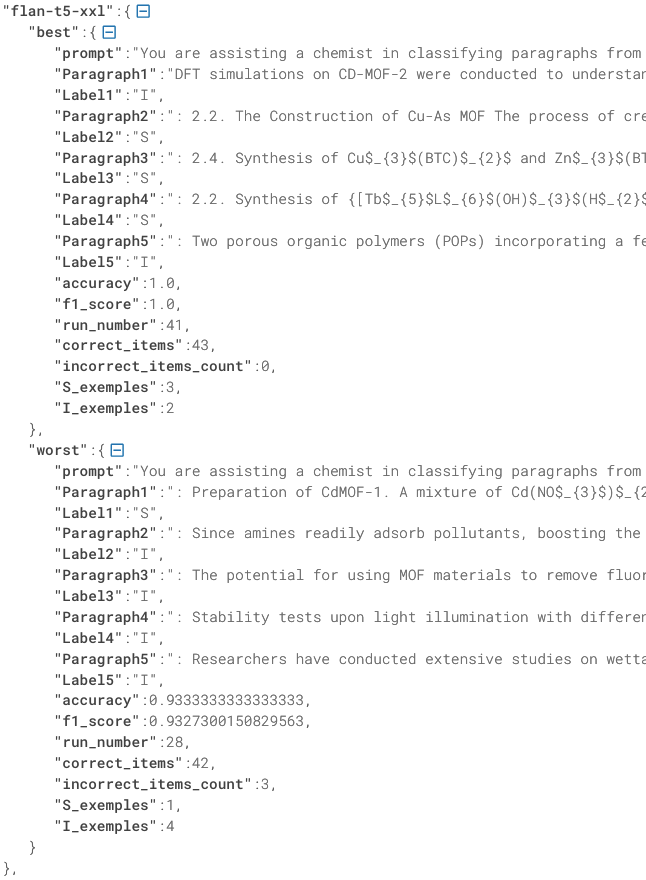
- 应用提示工程化的 ICL,给出少量示例,将段落分类为合成相关(S)还是非相关(I)
- 应用提示驱动的 JSON 注释提取合成细节(产物、条件、反应物、溶剂),并映射到结构化知识表示
- 进行一个示例选择阶段,为每个模型和任务挑选最佳提示范例以最大化性能
实验结果
研究问题
- RQ1开放源代码的 LLMs(在不进行微调的情况下)是否能够实现对网状材料合成从 PDFs 的高准确度段落分类和信息提取?
- RQ2提示范例的选择如何影响不同 LLM 家族的模型性能?
- RQ3哪些 LLMs 与提示策略最适合从科学文献中自动提取合成协议的知识?
主要发现
- 五大 LLM 家族(Flan、Granite、LLaMA、Mistral、Mixtral)在不进行任务特定微调的情况下仍实现了高性能
- 在段落分类方面,大多数模型在最佳提示下达到 F1 分数超过 0.84;若干模型达到 0.98(如 llama-3-70b-instruct、mistral-large)
- 在信息提取方面,顶尖模型在提示中使用最少两段示例就能达到高达 0.96 的准确率(如 llama-3-1 405b-instruct)
- 结果表明提示示例选择显著影响性能,且较大模型并不总是能保证更优的结果
- 所提的 KEP 可以在实现从非结构化 PDFs 自动提取合成协议的同时,减少 SME 注释与数据整理工作量
阅读本论文
在 Nubint 阅读器中打开原文,边读边就任意段落提问。
在 Nubint 中阅读本论文本解读由 AI 根据论文原文生成,引用前请核对原文。