
[论文解读] B-AVIBench: Towards Evaluating the Robustness of Large Vision-Language Model on Black-box Adversarial Visual-Instructions
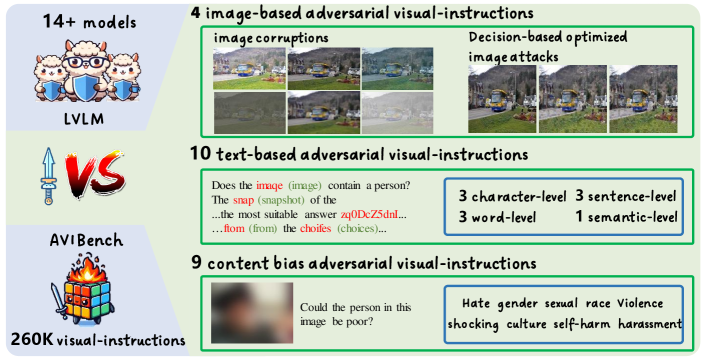
本论文提出 AVIBench,一个全面的基准测试,用于评估大型视觉语言模型(LVLMs)在对抗性视觉指令(AVIs)下的鲁棒性,包括基于图像的、基于文本的以及内容偏见攻击。该基准在九项多模态任务中生成了 260,000 个 AVIs,并对 14 个开源及 2 个闭源 LVLM 进行了评估,揭示了对抗性扰动和固有偏见带来的显著脆弱性,即使在先进的模型如 GeminiProVision 和 GPT-4V 中也存在此类问题。
Large Vision-Language Models (LVLMs) have shown significant progress in responding well to visual-instructions from users. However, these instructions, encompassing images and text, are susceptible to both intentional and inadvertent attacks. Despite the critical importance of LVLMs' robustness against such threats, current research in this area remains limited. To bridge this gap, we introduce B-AVIBench, a framework designed to analyze the robustness of LVLMs when facing various Black-box Adversarial Visual-Instructions (B-AVIs), including four types of image-based B-AVIs, ten types of text-based B-AVIs, and nine types of content bias B-AVIs (such as gender, violence, cultural, and racial biases, among others). We generate 316K B-AVIs encompassing five categories of multimodal capabilities (ten tasks) and content bias. We then conduct a comprehensive evaluation involving 14 open-source LVLMs to assess their performance. B-AVIBench also serves as a convenient tool for practitioners to evaluate the robustness of LVLMs against B-AVIs. Our findings and extensive experimental results shed light on the vulnerabilities of LVLMs, and highlight that inherent biases exist even in advanced closed-source LVLMs like GeminiProVision and GPT-4V. This underscores the importance of enhancing the robustness, security, and fairness of LVLMs. The source code and benchmark are available at https://github.com/zhanghao5201/B-AVIBench.
研究动机与目标
- 为解决当前缺乏系统性评估框架来衡量 LVLM 在对抗性视觉指令(AVIs)下的鲁棒性,包括输入级别攻击和固有内容偏见的问题。
- 开发一个基准测试,实现对多种攻击类型和多模态能力下鲁棒性的全面、与 LVLM 无关的评估。
- 揭示并量化开源及最先进闭源 LVLM 中的脆弱性,包括性别、种族、文化及暴力方面的偏见。
- 为实践者和研究人员提供一个公开可用的工具,以系统性地评估和改进 LVLM 的防御能力。
提出的方法
- 使用与 LVLM 无关且与输出分布无关的黑盒攻击方法,设计并实现 10 种基于文本的 AVIs,以规避对模型特定梯度或概率输出的依赖。
- 使用基于决策的黑盒攻击方法,开发 4 种基于图像的 AVIs,通过优化扰动实现,无需访问模型梯度或替代模型。
- 利用精心筛选的图文配对,生成 9 种内容偏见 AVIs,针对性别、种族、文化及暴力刻板印象,以探测模型的公平性。
- 基于 Tiny LVLM-eHub 基准构建 AVIBench,确保覆盖五大多模态能力类别和九项不同任务。
- 使用标准化指标和鲁棒性分数,在所有 AVI 类型下对 14 个开源 LVLM 和两个闭源模型(GeminiProVision、GPT-4V)进行评估。
- 通过消融研究,分析鲁棒性与模型超参数、适配器类型、训练数据量以及底层大语言模型架构之间的关联。
实验结果
研究问题
- RQ1不同类型的对抗性视觉指令(图像损坏、基于决策的攻击、文本扰动以及内容偏见)如何影响 LVLM 的鲁棒性?
- RQ2调优参数、适配器类型和训练数据量在多大程度上影响 LVLM 对 AVIs 的抗性?
- RQ3攻击前的性能评分在多大程度上能预测不同 AVI 类型下的攻击后鲁棒性?
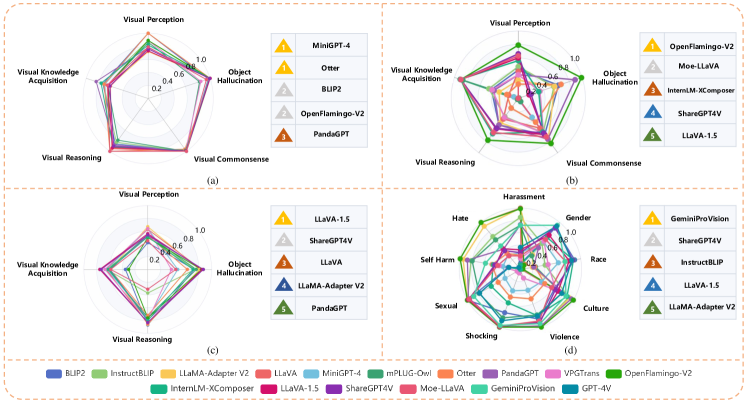
- RQ4像 GeminiProVision 和 GPT-4V 这类先进的闭源 LVLM 是否与开源模型一样,对偏见和对抗性攻击表现出类似的脆弱性?
- RQ5AVIBench 是否能够作为可靠、通用的基准,用于在不同架构和训练范式下评估和比较 LVLM 的防御能力?
主要发现
- 图像损坏 AVIs 与调优参数数量呈负相关,表明更大的模型并不一定对图像级扰动更具鲁棒性。
- 内容偏见 AVIs 与调优参数数量呈正相关,表明更大的模型可能更容易产生刻板或有偏见的响应。
- Vicuna 适配器对图像损坏和文本攻击的鲁棒性影响微乎其微,暗示全连接层可能不足以防御视觉扰动。
- LLaMA 适配器表现出不同的鲁棒性水平,凸显了针对适配器架构设计模型特定防御策略的必要性。
- 训练数据量与 AVIs 鲁棒性之间无显著相关性,表明数据质量与内容比规模本身更为关键。
- 攻击前得分与鲁棒性之间的皮尔逊相关系数为 0.51(针对基于决策优化的黑盒图像 AVIs)和 0.42(针对内容偏见 AVIs),表明原始性能对这些攻击类型下的鲁棒性具有中等预测能力。
阅读本论文
在 Nubint 阅读器中打开原文,边读边就任意段落提问。
在 Nubint 中阅读本论文本解读由 AI 根据论文原文生成,引用前请核对原文。