
[论文解读] BanglaAutoKG: Automatic Bangla Knowledge Graph Construction with Semantic Neural Graph Filtering
BanglaAutoKG 是一种新颖的全自动框架,利用多语言大语言模型、基于 BERT 的嵌入表示以及基于图神经网络(GNN)的语义过滤流水线,从任意文本中构建语义丰富的孟加拉语知识图谱。该框架在极少人工干预的情况下实现了高质量的知识图谱构建,展示了在多种孟加拉语文本类型中的通用适用性。
Knowledge Graphs (KGs) have proven essential in information processing and reasoning applications because they link related entities and give context-rich information, supporting efficient information retrieval and knowledge discovery; presenting information flow in a very effective manner. Despite being widely used globally, Bangla is relatively underrepresented in KGs due to a lack of comprehensive datasets, encoders, NER (named entity recognition) models, POS (part-of-speech) taggers, and lemmatizers, hindering efficient information processing and reasoning applications in the language. Addressing the KG scarcity in Bengali, we propose BanglaAutoKG, a pioneering framework that is able to automatically construct Bengali KGs from any Bangla text. We utilize multilingual LLMs to understand various languages and correlate entities and relations universally. By employing a translation dictionary to identify English equivalents and extracting word features from pre-trained BERT models, we construct the foundational KG. To reduce noise and align word embeddings with our goal, we employ graph-based polynomial filters. Lastly, we implement a GNN-based semantic filter, which elevates contextual understanding and trims unnecessary edges, culminating in the formation of the definitive KG. Empirical findings and case studies demonstrate the universal effectiveness of our model, capable of autonomously constructing semantically enriched KGs from any text.
研究动机与目标
- 为解决孟加拉语知识资源(包括知识图谱、命名实体识别模型和编码器)严重缺乏的问题。
- 开发一种通用的全自动框架,无需人工标注数据,即可从多样化文本源构建高质量的孟加拉语知识图谱。
- 克服预训练嵌入表示中的噪声问题,通过基于图的过滤和图神经网络提升语义相关性。
- 实现可扩展的、上下文感知的知识抽取,支持信息检索、文化保存和人工智能等应用。
提出的方法
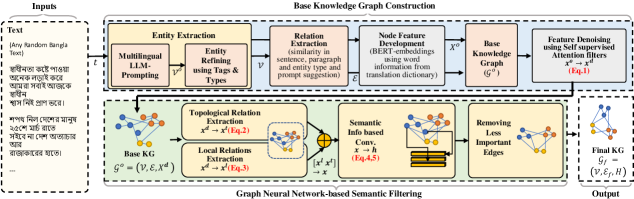
- 利用多语言大语言模型从原始孟加拉语文本中提取命名实体及其类型。
- 采用翻译词典将孟加拉语实体映射到英文对应词,实现跨语言语义对齐。
- 使用微调过的孟加拉语 BERT 预训练模型构建初始词嵌入。
- 应用基于图的多项式滤波器,通过利用局部邻域和拓扑结构来去除嵌入噪声。
- 实施基于图神经网络的语义过滤器,结合自监督注意力机制,剔除无关边并保留具有上下文意义的关系。
- 通过迭代式过滤和上下文优化,自动将初始知识图谱精炼为最终的语义增强图谱。
实验结果
研究问题
- RQ1在不进行微调的情况下,多语言大语言模型能否有效从多样化孟加拉语文本类型中提取实体和关系?
- RQ2基于词典的跨语言映射在提升孟加拉语知识图谱语义一致性方面效果如何?
- RQ3基于图的多项式滤波在低资源语言知识图谱中能在多大程度上减少嵌入噪声?
- RQ4基于图神经网络的语义过滤器能否显著通过去除虚假或无关关系来提升知识图谱质量?
- RQ5该框架在新闻、维基百科和文学文本等不同文本领域中的通用适用性如何?
主要发现
- 该框架能够从多样化文本源(包括维基百科、新闻和文学内容)中成功构建语义一致的孟加拉语知识图谱,且人工干预极少。
- 消融实验表明,与基线方法相比,基于图神经网络的语义过滤器和多项式滤波均显著提升了知识图谱质量。
- 多语言大语言模型与翻译词典的结合,即使在低资源环境下也能实现稳健的跨语言实体对齐。
- 模型在不同文本类型中表现出强大的泛化能力,包括复杂和隐喻性文本,尽管在古语或高度诗意文本上的性能略有下降。
- 实证结果与案例研究验证了该框架自主生成高质量知识图谱的能力,显著提升了实体相关性和关系准确性。
阅读本论文
在 Nubint 阅读器中打开原文,边读边就任意段落提问。
在 Nubint 中阅读本论文本解读由 AI 根据论文原文生成,引用前请核对原文。