
[论文解读] Basic syntax from speech: Spontaneous concatenation in unsupervised deep neural networks
该论文表明,仅在原始语音上进行训练的无监督深度卷积神经网络(CNN)可自发生成连接词序列——如双词或三词复合词——而无需接触多词输入。通过 ciwGAN 架构,模型学会将单个词汇项组合成新颖的、未见过的词组合,甚至产生完整的重叠形式,表明基本的句法操作(如连接)可仅从声学输入中自发产生。
Computational models of syntax are predominantly text-based. Here we propose that the most basic first step in the evolution of syntax can be modeled directly from raw speech in a fully unsupervised way. We focus on one of the most ubiquitous and elementary suboperation of syntax -- concatenation. We introduce spontaneous concatenation: a phenomenon where convolutional neural networks (CNNs) trained on acoustic recordings of individual words start generating outputs with two or even three words concatenated without ever accessing data with multiple words in the input. We replicate this finding in several independently trained models with different hyperparameters and training data. Additionally, networks trained on two words learn to embed words into novel unobserved word combinations. We also show that the concatenated outputs contain precursors to compositionality. To our knowledge, this is a previously unreported property of CNNs trained in the ciwGAN/fiwGAN setting on raw speech and has implications both for our understanding of how these architectures learn as well as for modeling syntax and its evolution in the brain from raw acoustic inputs. We also propose a potential neural mechanism called disinhibition that outlines a possible neural pathway towards concatenation and compositionality and suggests our modeling is useful for generating testable prediction for biological and artificial neural processing of speech.
研究动机与目标
- 探究无监督深度神经网络是否能直接从原始语音中学习基本句法特性(如词连接)。
- 检验仅在单个词上训练的卷积神经网络是否能在未接触多词数据的情况下自发产生多词输出。
- 探索在单个词和双词输入上训练的模型是否能将词汇嵌入新颖的、未见过的组合中,以模拟早期语言习得阶段。
- 考察潜在空间在编码未观察到的语言结构(如复合词和重叠形式)中的作用。
- 评估自发连接对建模神经架构中句法演化和语言习得的启示。
提出的方法
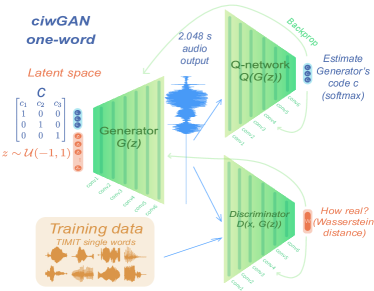
- 在 TIMIT 数据集的原始音频上,仅使用单个词输入,对 ciwGAN 和修改后的 fiwGAN 进行训练。
- 使用生成器网络,结合潜在码 c(独热编码或二值)和随机噪声 z,生成 2.048 秒的音频样本。
- 采用带有 Wassertein 损失的判别器来区分真实与生成的音频,并使用独立的 Q 网络从生成音频中解码潜在码 c。
- 训练生成器以最大化判别器误差并最小化 Q 网络误差,从而鼓励对语言单位进行信息丰富且解耦的表征。
- 评估模型输出中自发连接、重叠和训练数据中未出现的新词组合。
- 采用两阶段实验设计:先进行单个词训练,再进行双词输入训练,并保留部分组合以测试对新颖组合的嵌入能力。
实验结果
研究问题
- RQ1仅在单个词音频输入上训练的无监督深度神经网络是否能自发生成连接的双词或三词序列?
- RQ2尽管在训练过程中从未接触过重复词,这些模型是否表现出自发的重叠(即完整重复词)?
- RQ3在单个词和双词输入上训练的模型是否能将单个词汇嵌入新颖的、未见过的双词组合中?
- RQ4生成器的潜在空间如何编码未观察到的语言结构(如复合词和重叠形式)?
- RQ5这些模型中的自发连接在多大程度上能模拟人类语言习得的早期阶段或句法演化?
主要发现
- 在 10 次试验中,单个词模型对潜在码 [0,0,-40,0,0] 生成了 'greasy greasy',表明在未接触重复词的情况下实现了自发的完整重叠。
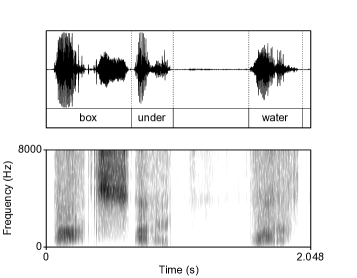
- 在无任何多词训练数据的情况下,生成器成功产生了新颖的双词和三词连接序列,表明存在自发连接。
- 在双词输入上训练的模型成功将词汇嵌入未见过的组合中,表明其具备超越训练数据的泛化能力。
- 潜在码中的负值被用于编码新颖的连接输出,表明网络利用了未使用的潜在空间进行语言创新。
- 模型生成了显著、可解释且极少产生歧义的输出,转录工作由作者完成以确保准确性。
- 结果表明,即使缺乏语言特异的归纳偏置,基本句法操作(如连接)也能从原始声学输入中自发涌现。
阅读本论文
在 Nubint 阅读器中打开原文,边读边就任意段落提问。
在 Nubint 中阅读本论文本解读由 AI 根据论文原文生成,引用前请核对原文。