
[论文解读] Bayesian Learning-driven Prototypical Contrastive Loss for Class-Incremental Learning
该论文提出了一种基于贝叶斯学习的原型对比损失(BLCL),用于类别增量学习,通过贝叶斯动态加权结合交叉熵损失与对比损失,减轻灾难性遗忘。通过原型嵌入优化改进特征表示,BLCL在CIFAR-10数据集上达到86.57%的最先进准确率,在GNSS干扰数据集上达到96.16%,并显著提升了聚类指标。
The primary objective of methods in continual learning is to learn tasks in a sequential manner over time (sometimes from a stream of data), while mitigating the detrimental phenomenon of catastrophic forgetting. This paper proposes a method to learn an effective representation between previous and newly encountered class prototypes. We propose a prototypical network with a Bayesian learning-driven contrastive loss (BLCL), tailored specifically for class-incremental learning scenarios. We introduce a contrastive loss that incorporates novel classes into the latent representation by reducing intra-class and increasing inter-class distance. Our approach dynamically adapts the balance between the cross-entropy and contrastive loss functions with a Bayesian learning technique. Experimental results conducted on the CIFAR-10, CIFAR-100, and ImageNet100 datasets for image classification and images of a GNSS-based dataset for interference classification validate the efficacy of our method, showcasing its superiority over existing state-of-the-art approaches. Git: https://gitlab.cc-asp.fraunhofer.de/darcy_gnss/gnss_class_incremental_learning
研究动机与目标
- 通过动态平衡分类损失与对比损失,缓解类别增量学习中的灾难性遗忘。
- 通过最小化类内距离并最大化类间距离,利用原型嵌入改进特征表示。
- 通过贝叶斯推断消除损失权重的手动超参数调优。
- 在图像分类(CIFAR-10)和真实世界干扰检测(GNSS)数据集上验证该方法。
- 与最先进方法相比,展示更优的聚类质量和分类准确率。
提出的方法
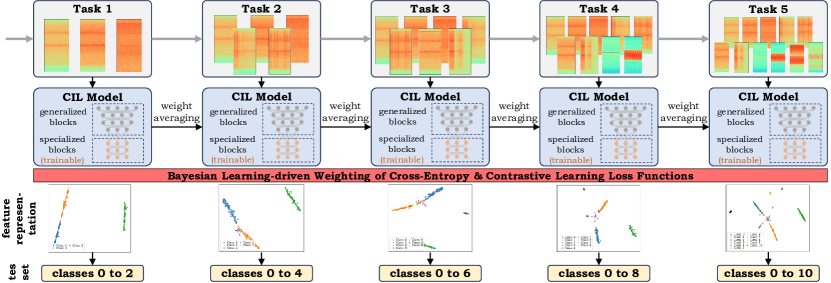
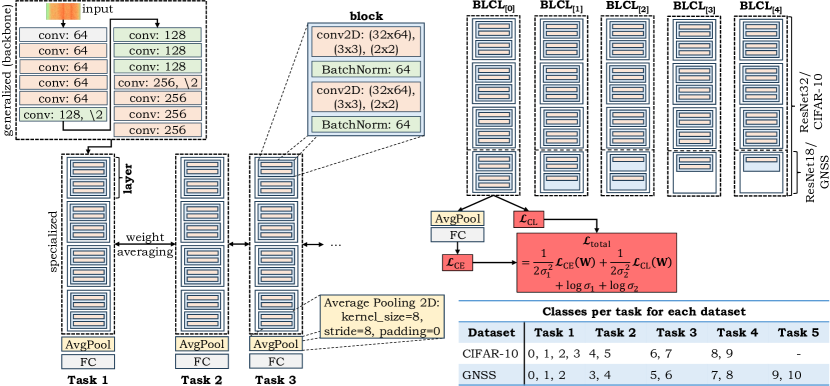
- 该方法采用基于ResNet的架构,并为每个任务引入动态专用组件,以保留任务特定知识。
- 提出一种新型原型对比损失,旨在嵌入空间中最小化同类样本间的距离,同时最大化不同类别间的距离。
- 损失函数结合交叉熵损失与对比损失,其平衡通过贝叶斯学习实现动态调整,以适应新旧任务。
- 使用贝叶斯推断估计损失权重的后验概率,实现无需网格搜索的自动、数据驱动的适应。
- 框架通过t-SNE可视化和聚类指标(DB与CH分数)评估表示质量。
- 模型采用增量训练策略,分别对共享组件和任务专用组件应用特征提取与微调。
实验结果
研究问题
- RQ1基于贝叶斯学习的动态损失加权机制是否能提升类别增量学习中的泛化能力并减少遗忘?
- RQ2引入原型对比损失是否能增强顺序学习中的特征分离性与类内紧凑性?
- RQ3与MEMO、iCaRL和EWC等最先进方法相比,BLCL在准确率与聚类质量方面表现如何?
- RQ4该方法在适应新类别的同时,对先前学习类别的性能保持程度如何?
- RQ5所提方法是否能在包括标准图像与真实世界GNSS干扰数据在内的多样化数据集上实现良好泛化?
主要发现
- BLCL在CIFAR-10上达到84.78%的平均准确率,在GNSS数据集上达到95.34%,优于包括MEMO在内的最先进方法。
- 该方法在CIFAR-10上达到86.57%的峰值准确率,在GNSS数据集上达到96.16%,在两个基准上均表现出强劲性能。
- BLCL在CIFAR-10上取得最低的Davies-Bouldin分数(0.81),在GNSS数据集上取得最高的Caliński-Harabasz分数(163,420),表明聚类质量更优。
- t-SNE可视化结果证实,BLCL显著减小了类内距离并增强了类间分离,尤其优于Replay与MEMO。
- 即使减少专用组件块数量(如BLCL₈[*]),模型仍保持高准确率,表明在不损失性能的前提下具备参数效率。
- 贝叶斯加权机制消除了手动超参数调优的需要,实现了跨增量任务的自适应与稳定训练。
阅读本论文
在 Nubint 阅读器中打开原文,边读边就任意段落提问。
在 Nubint 中阅读本论文本解读由 AI 根据论文原文生成,引用前请核对原文。