
[论文解读] Benchmarking Cognitive Biases in Large Language Models as Evaluators
本论文提出 CoBBLEr,一种基准,用于衡量在作为 QA 输出评估者的 15 个 LLM 中的六种认知偏见,揭示广泛存在的偏见以及与人类偏好不一致。
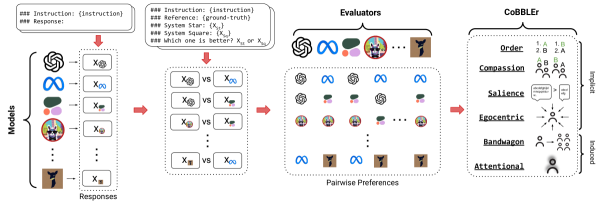
Large Language Models are cognitively biased judges. Large Language Models (LLMs) have recently been shown to be effective as automatic evaluators with simple prompting and in-context learning. In this work, we assemble 15 LLMs of four different size ranges and evaluate their output responses by preference ranking from the other LLMs as evaluators, such as System Star is better than System Square. We then evaluate the quality of ranking outputs introducing the Cognitive Bias Benchmark for LLMs as Evaluators (CoBBLEr), a benchmark to measure six different cognitive biases in LLM evaluation outputs, such as the Egocentric bias where a model prefers to rank its own outputs highly in evaluation. We find that LLMs are biased text quality evaluators, exhibiting strong indications on our bias benchmark (average of 40% of comparisons across all models) within each of their evaluations that question their robustness as evaluators. Furthermore, we examine the correlation between human and machine preferences and calculate the average Rank-Biased Overlap (RBO) score to be 49.6%, indicating that machine preferences are misaligned with humans. According to our findings, LLMs may still be unable to be utilized for automatic annotation aligned with human preferences. Our project page is at: https://minnesotanlp.github.io/cobbler.
研究动机与目标
- 推动不仅评估 LLMs 生成能力,也评估其对生成文本的评估能力。
- 引入 CoBBLEr 用以衡量 LLM 评估者的六种认知偏见。
- 在问答风格任务上评估一系列广泛的模型(3B 到>175B 参数)。
- 分析机器评估与人类偏好之间的一致性。
提出的方法
- 使用 Eli5 和来自 BigBench 的提示为每个模型生成 50 个问答响应。
- 为 15 种模型在 50 个实例上创建所有唯一成对比较(5250 对)。
- 提示评估者选择更优的响应,每对两次,顺序随机打乱。
- 将偏见分为隐含偏见或诱导偏见,并使用随机基线对偏见进行量化。
- 计算人类与机器偏好之间的秩偏重重叠(RBO,p=0.8)。
- 提供公开的排行榜式基准和海报展示风格的结果。
实验结果
研究问题
- RQ1在 QA 任务中,LLMs 在评估其他 LLM 输出时是否会表现出认知偏见?
- RQ2在多样化模型中,隐含偏见与诱导偏见的普遍性和强度如何?
- RQ3作为评估者的机器偏好与人类偏好在 QA 评价中的一致性如何?
- RQ4CoBBLEr 能否可靠识别有偏的评估者并将模型稳健性作为评估者区分开?
主要发现
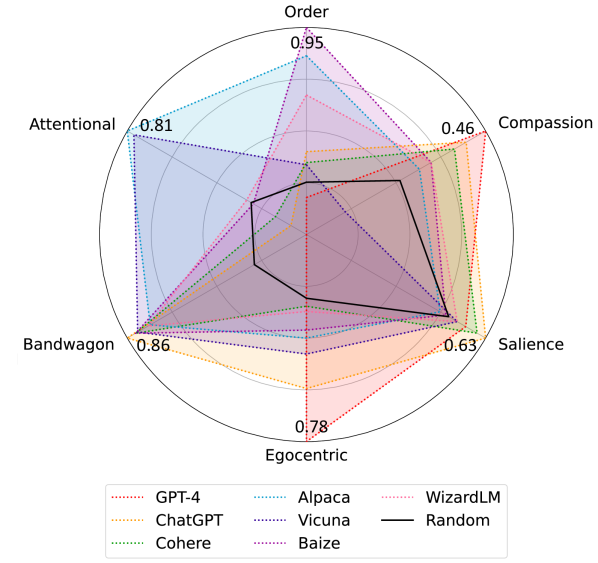
- 大多数模型在多个基准测试中显示出显著偏见(平均偏见存在于约 40% 的比较中)。
- 隐性偏见在不同模型规模上持续存在,扩大规模并未消除评估偏见。
- 从众偏见和注意力偏见在诱导偏见测试中尤为明显。
- 人类与机器偏好之间的对齐程度仅为中等(平均 Rank-Biased Overlap 约 0.496)。
- 较小的模型(≤10B)对偏见尤为敏感,一些非常大的模型则表现出与名称相关的自我中心效应。
- 大多数经过指令微调或人类反馈训练的模型在被用作评估者时显示出认知偏见。
阅读本论文
在 Nubint 阅读器中打开原文,边读边就任意段落提问。
在 Nubint 中阅读本论文本解读由 AI 根据论文原文生成,引用前请核对原文。