
[论文解读] Benchmarking Out-of-Distribution Generalization Capabilities of DNN-based Encoding Models for the Ventral Visual Cortex
本文介绍了 MacaqueITBench,一个大规模的猕猴腹侧视觉皮层对超过30万张图像的响应数据集,并在分布外(OOD)分布偏移下对基于深度神经网络(DNN)的编码模型进行了基准测试。研究发现,当图像属性发生简单偏移(如对比度、色相)时,模型性能下降至分布内性能的最低20%;同时表明,使用预训练DNN特征之间的余弦距离度量可强烈预测OOD泛化失败。
We characterized the generalization capabilities of DNN-based encoding models when predicting neuronal responses from the visual cortex. We collected extit{MacaqueITBench}, a large-scale dataset of neural population responses from the macaque inferior temporal (IT) cortex to over $300,000$ images, comprising $8,233$ unique natural images presented to seven monkeys over $109$ sessions. Using extit{MacaqueITBench}, we investigated the impact of distribution shifts on models predicting neural activity by dividing the images into Out-Of-Distribution (OOD) train and test splits. The OOD splits included several different image-computable types including image contrast, hue, intensity, temperature, and saturation. Compared to the performance on in-distribution test images -- the conventional way these models have been evaluated -- models performed worse at predicting neuronal responses to out-of-distribution images, retaining as little as $20\%$ of the performance on in-distribution test images. The generalization performance under OOD shifts can be well accounted by a simple image similarity metric -- the cosine distance between image representations extracted from a pre-trained object recognition model is a strong predictor of neural predictivity under different distribution shifts. The dataset of images, neuronal firing rate recordings, and computational benchmarks are hosted publicly at: https://bit.ly/3zeutVd.
研究动机与目标
- 研究基于深度神经网络(DNN)的编码模型在灵长类腹侧视觉皮层中的分布外(OOD)泛化能力。
- 识别并探究低层次图像属性(如对比度、饱和度)的分布偏移在多大程度上损害神经元响应预测性能。
- 开发并验证一种可计算的度量方法,用于基于图像表征相似性预测OOD模型性能下降。
- 提供一个公开可获取的大规模神经数据集(MacaqueITBench),以支持未来关于神经编码与泛化能力的研究。
提出的方法
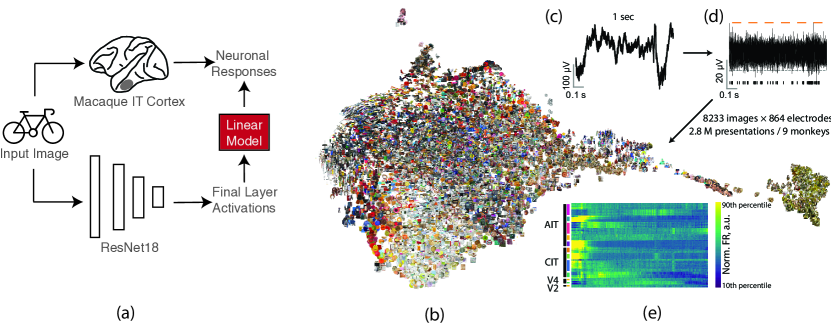
- 从猕猴IT皮层的109个会话中收集神经元群体响应,使用8,233张独特的自然图像,每张图像呈现超过300,000次。
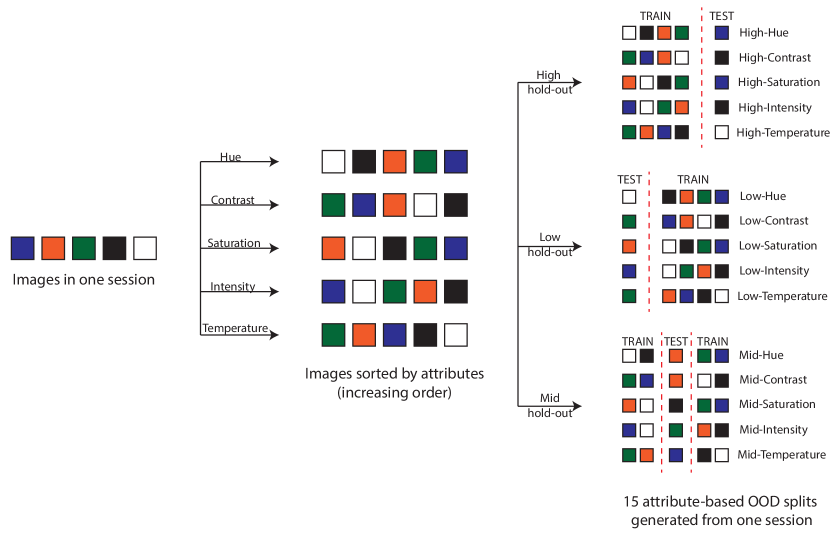
- 通过改变图像属性(对比度、色相、亮度、温度、饱和度)构建OOD划分,创建近OOD和远OOD测试集。
- 利用预训练ResNet18的特征训练线性编码模型,从图像输入预测神经元放电率。
- 提出最近似余弦距离(DCCD)度量,用于量化训练与测试图像表征之间的分布偏移大小。
- 使用Spearman等级相关系数评估DCCD、MMD和协变量偏移度量在OOD性能下降上的预测能力。
- 在多个OOD划分和会话中评估模型性能,比较分布内、近OOD和远OOD测试分布下的表现。
实验结果
研究问题
- RQ1与分布内泛化相比,基于DNN的腹侧视觉皮层编码模型在分布外图像偏移下的表现如何?
- RQ2低层次图像属性偏移(如对比度、色相、饱和度)在多大程度上会降低神经响应预测性能?
- RQ3可计算的图像相似性度量能否预测OOD偏移下的性能下降幅度?
- RQ4在Closest-Cosine Distance、MMD和Covariate-Shift三种度量中,哪一种最能预测神经编码模型的OOD泛化失败?
主要发现
- 基于DNN的编码模型在OOD偏移下遭受严重性能下降,其性能最低仅保留分布内性能的20%。
- OOD偏移下的性能下降与分布偏移大小密切相关,该偏移大小由最近似余弦距离(DCCD)度量所测得。
- 在三种分布偏移水平(InD、Near OOD、Far OOD)下,DCCD与OOD性能下降的Spearman相关系数为-0.49。
- 在15种基于属性的OOD划分(色相、饱和度、温度、对比度、亮度)中,DCCD与OOD性能下降的Spearman相关系数为-0.45,优于MMD和Covariate-Shift度量。
- 模型性能在配对t检验中从分布内到近OOD再到远OOD测试集显著且逐步下降,p < 0.01。
- 基于ResNet18特征计算的最近似余弦距离度量,是OOD神经可预测性的强预测因子,表明表征相似性驱动了泛化失败。
阅读本论文
在 Nubint 阅读器中打开原文,边读边就任意段落提问。
在 Nubint 中阅读本论文本解读由 AI 根据论文原文生成,引用前请核对原文。