
[论文解读] Benchmarking Robustness in Neural Radiance Fields
该论文提出了首个针对视觉退化下神经辐射场(NeRF)鲁棒性的全面基准测试。结果表明,基于NeRF的方法在受到退化影响时性能显著下降,特征编码器对鲁棒性的提升微乎其微,且标准数据增强技术无法改善鲁棒性,凸显了在真实场景部署中仍存在关键差距。
Neural Radiance Field (NeRF) has demonstrated excellent quality in novel view synthesis, thanks to its ability to model 3D object geometries in a concise formulation. However, current approaches to NeRF-based models rely on clean images with accurate camera calibration, which can be difficult to obtain in the real world, where data is often subject to corruption and distortion. In this work, we provide the first comprehensive analysis of the robustness of NeRF-based novel view synthesis algorithms in the presence of different types of corruptions. We find that NeRF-based models are significantly degraded in the presence of corruption, and are more sensitive to a different set of corruptions than image recognition models. Furthermore, we analyze the robustness of the feature encoder in generalizable methods, which synthesize images using neural features extracted via convolutional neural networks or transformers, and find that it only contributes marginally to robustness. Finally, we reveal that standard data augmentation techniques, which can significantly improve the robustness of recognition models, do not help the robustness of NeRF-based models. We hope that our findings will attract more researchers to study the robustness of NeRF-based approaches and help to improve their performance in the real world.
研究动机与目标
- 为解决缺乏对NeRF在真实世界图像退化下鲁棒性的系统性评估这一问题。
- 识别不同类型的退化及其严重程度对基于NeRF的新视角合成性能的影响。
- 探究标准数据增强和特征编码器缩放是否能提升通用型NeRF方法的鲁棒性。
- 评估退化对基于结构从运动(SfM)流程的相机位姿估计可靠性的影响。
- 建立新的基准数据集(LLFF-C 和 Blender-C),用于评估基于NeRF系统的鲁棒性。
提出的方法
- 构建了两个受控退化后的基准数据集:LLFF-C 和 Blender-C,分别源自标准NeRF数据集。
- 设计了评估指标,用于衡量在退化条件下图像质量(PSNR)和几何保真度(网格重建)的表现。
- 在干净和退化数据上评估了最先进基于NeRF的方法(如IBRNet、MVSNeRF、GPNR),以测量其鲁棒性下降程度。
- 在通用型NeRF模型上测试了数据增强技术(如Augmix),以评估其对鲁棒性的影响。
- 通过改变特征编码器的规模并观察性能变化,分析其在通用型NeRF中的作用。
- 利用COLMAP评估在退化图像上的位姿估计可靠性,测量三角化点数、轨迹长度和注册成功率。
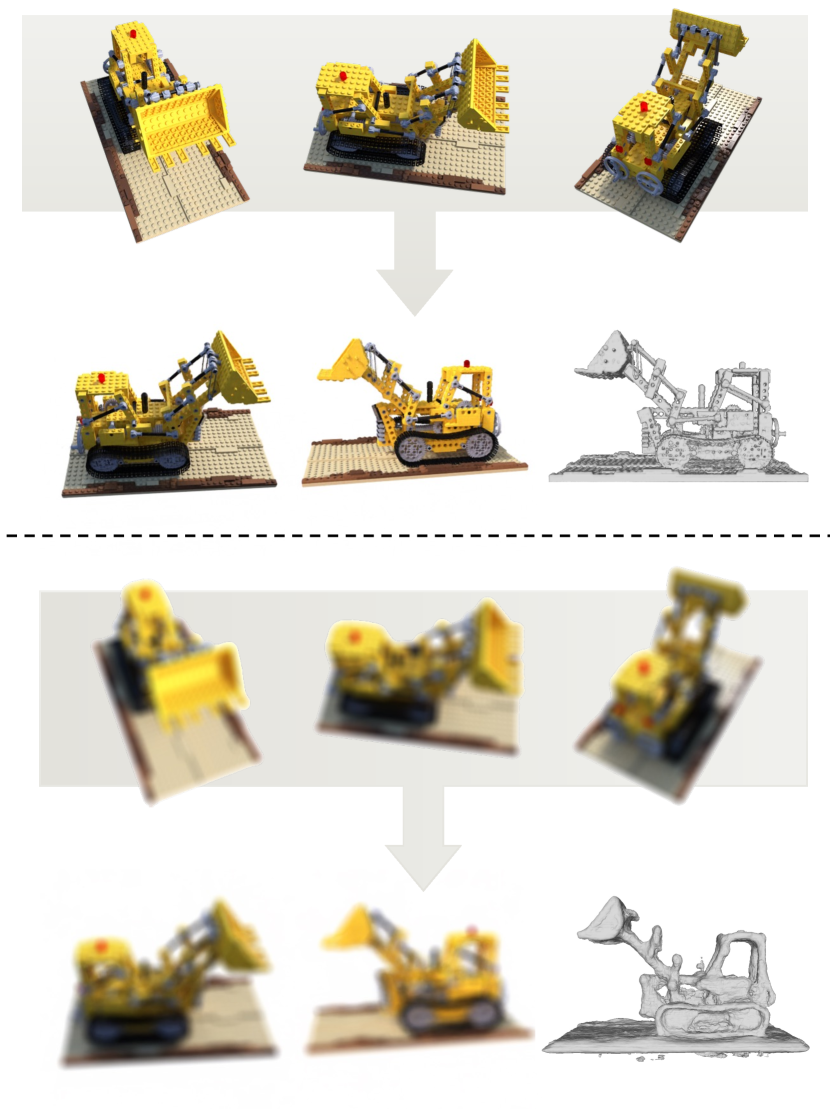
实验结果
研究问题
- RQ1不同类型的视觉退化及其严重程度如何影响基于NeRF的新视角合成模型的性能?
- RQ2在真实场景中,退化如何影响通过SfM流程进行相机位姿估计的可靠性?
- RQ3标准图像数据增强技术在多大程度上能提升基于NeRF模型的鲁棒性?
- RQ4在通用型NeRF方法中,扩大特征编码器规模是否能增强对图像退化的鲁棒性?
- RQ5为何尽管使用了预训练的特征提取器,通用型NeRF方法仍表现出有限的鲁棒性?
主要发现
- 所有测试的退化条件下,基于NeRF的模型均出现显著性能下降,即使在低退化水平下PSNR也大幅降低。
- NeRF对退化的敏感性与图像识别模型存在根本性差异,表现出不同的失效模式和脆弱性特征。
- 在通用型NeRF方法中扩大特征编码器规模仅带来微小的鲁棒性提升,表明其对退化鲁棒性的贡献有限。
- 在退化数据上微调通用型NeRF模型易导致过拟合,且性能通常劣于直接使用预训练模型。
- 标准数据增强技术(如Augmix)无法提升NeRF的鲁棒性,因为增强图像不对应于有效的三维场景,破坏了跨视角一致性。
- 通过COLMAP进行位姿估计随退化比例和严重程度的增加而下降,当退化比例达到50%时,三角化点数减少约30%,平均轨迹长度减少约20%。
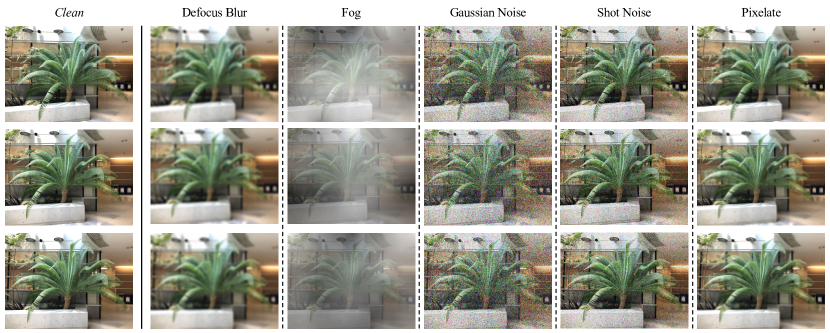
阅读本论文
在 Nubint 阅读器中打开原文,边读边就任意段落提问。
在 Nubint 中阅读本论文本解读由 AI 根据论文原文生成,引用前请核对原文。