
[论文解读] Beyond Chain-of-Thought, Effective Graph-of-Thought Reasoning in Language Models
介绍 Graph-of-Thought (GoT) 推理,一种非线性图结构方法,通过将思维图与文本和视觉结合,提升大语言模型的推理能力,在 GSM8K 和 ScienceQA 上实现了最先进的结果,参数更少。
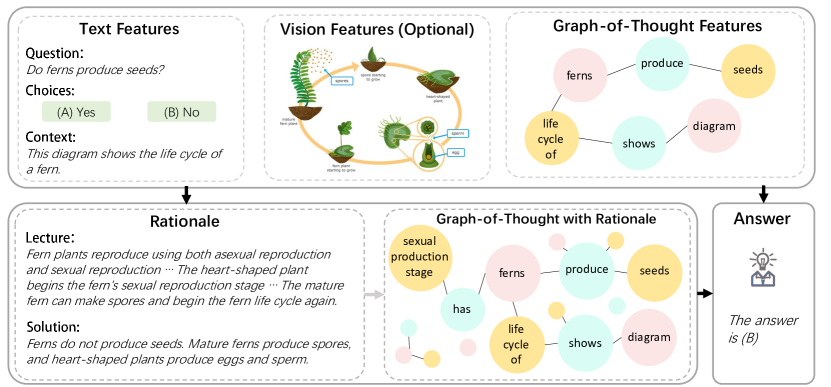
With the widespread use of language models (LMs) in NLP tasks, researchers have discovered the potential of Chain-of-thought (CoT) to assist LMs in accomplishing complex reasoning tasks by generating intermediate steps. However, human thought processes are often non-linear, rather than simply sequential chains of thoughts. Therefore, we propose Graph-of-Thought (GoT) reasoning, which models human thought processes not only as a chain but also as a graph. By representing thought units as nodes and connections between them as edges, our approach captures the non-sequential nature of human thinking and allows for a more realistic modeling of thought processes. GoT adopts a two-stage framework with an additional GoT encoder for thought graph representation and fuses the graph representation with the original input representation through a gated fusion mechanism. We evaluate GoT's performance on a text-only reasoning task (AQUA-RAT) and a multimodal reasoning task (ScienceQA). Our model achieves significant improvement over the strong CoT baseline on the AQUA-RAT test set and boosts accuracy from 85.19% to 87.59% using the T5-base model over the state-of-the-art Multimodal-CoT on the ScienceQA test set.
研究动机与目标
- 将人类推理建模为非线性图而非线性链路的动机。
- 提出基于 ECC 的图构建,以创建密集、便于推理的思维图。
- 开发一个 GoT 编码器,配备图注意力网络(GAT)和门控融合,以整合图、文本和视觉特征。
- 在文本和多模态任务上展示两阶段推理(推理过程生成再给出答案)。
- 展示 GoT 相较于 CoT 与 Multimodal-CoT 基线的有效性及参数效率。
提出的方法
- 通过 Extract-Cluster-Coreference (ECC) 构建思维图,以从演绎三元组中产生节点和边。
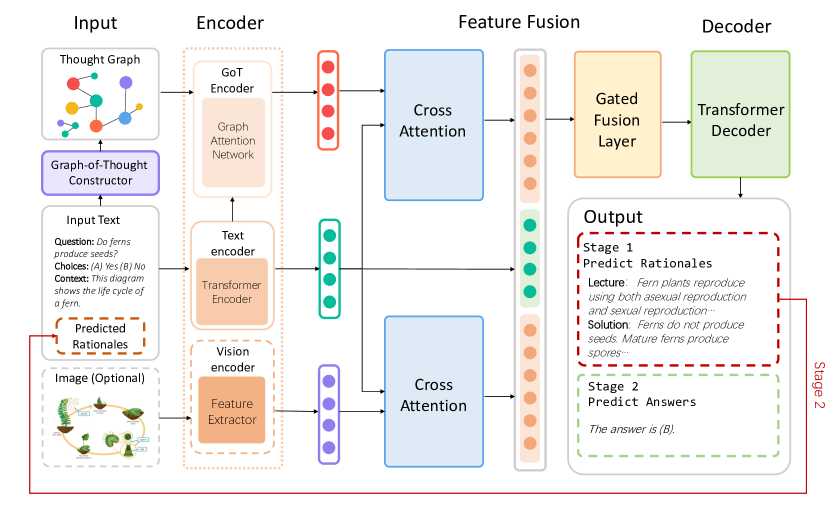
- 用 Transformer 对文本进行编码,用 Graph Attention Network (GAT) 对图进行编码,必要时对视觉进行编码。
- 使用跨注意力将文本与视觉和图节点对齐,随后进行门控融合,产生融合表示。
- 应用两阶段框架:推理过程生成(rationale generation)然后生成最终答案,第二阶段使用预测的推理过程。
- 在 GSM8K 和 ScienceQA 上对基于 T5 的 UnifiedQA 模型(base 和 large)进行微调,采用两阶段 GoT 设置和门控融合。
- 可选的多模态扩展通过单头注意力对齐和门控融合机制,将文本、视觉与 GoT 表征进行融合。
实验结果
研究问题
- RQ1图中思维单元比起链式思维在 LLM 中能否更好地捕捉非线性推理?
- RQ2将推理图与文本(以及视觉)结合是否能提升文本仅任务和多模态数学/科学任务的性能?
- RQ3相比于更大规模的 Multimodal-CoT 基线,GoT 的参数效率是否能在实现 SOTA 的同时保持?
- RQ4GoT 在不同科目和题型(包括图像辅助任务)上的表现如何?
- RQ5基于 ECC 的图构建和多头 GoT 编码对最终推理准确性有何影响?
主要发现
- GoT 将 GSM8K 的端到端准确率提升了 3.41%(GoT-base)和 5.08%(GoT-large),相对于 CoT 基线。
- GoT 在 ScienceQA 上的准确率为 91.54%(GoT-base)和 92.77%(GoT-large),超越了具有类似或更少参数的 Multimodal-CoT 基线。
- 在 GSM8K 上,GoT-base 达到 66.11%、GoT-large 达到 82.18%,对比 UnifiedQA 基线,且参数更少时展现显著提升。
- 在 ScienceQA 上,GoT base 为 91.68%,large 为 92.77%,接近或超越大型 Multimodal-CoT,并且与更大模型具有竞争力。
- 消融研究证实多头 GoT 编码器的必要性以及相较于随机图的真实思维图的有效性;GoT 相对扩大的 Multimodal-CoT 提升了 3.00%。
阅读本论文
在 Nubint 阅读器中打开原文,边读边就任意段落提问。
在 Nubint 中阅读本论文本解读由 AI 根据论文原文生成,引用前请核对原文。