
[论文解读] Beyond Demographic Parity: Redefining Equal Treatment
本文通过分析基于Shapley值的特征级模型解释,提出了一种机器学习中公平性的新形式化方法,定义了受保护群体间的解释分布,并基于AUC的分类器两样本检验(C2ST)检测不平等对待。研究表明,人口均等性可能掩盖不公平现象,而所提出的方法能识别出传统度量方法所遗漏的差异,同时发布了开源工具explanationspace以供实际应用。
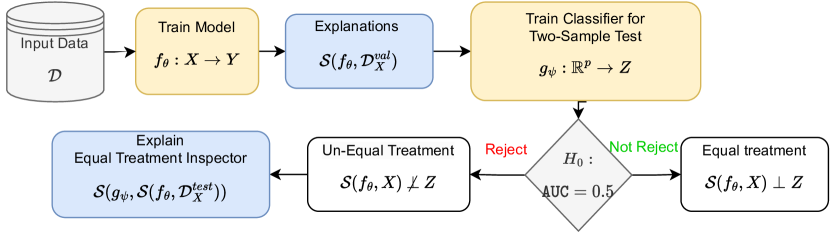
Liberalism-oriented political philosophy reasons that all individuals should be treated equally independently of their protected characteristics. Related work in machine learning has translated the concept of \emph{equal treatment} into terms of \emph{equal outcome} and measured it as \emph{demographic parity} (also called \emph{statistical parity}). Our analysis reveals that the two concepts of equal outcome and equal treatment diverge; therefore, demographic parity does not faithfully represent the notion of \emph{equal treatment}. We propose a new formalization for equal treatment by (i) considering the influence of feature values on predictions, such as computed by Shapley values decomposing predictions across its features, (ii) defining distributions of explanations, and (iii) comparing explanation distributions between populations with different protected characteristics. We show the theoretical properties of our notion of equal treatment and devise a classifier two-sample test based on the AUC of an equal treatment inspector. We study our formalization of equal treatment on synthetic and natural data. We release exttt{explanationspace}, an open-source Python package with methods and tutorials.
研究动机与目标
- 为解决哲学上的平等对待与机器学习公平性度量(如人口均等性)之间的分歧。
- 基于特征级模型解释而非结果分布来形式化平等对待。
- 开发一种即使在各群体结果表现均衡时也能检测不平等对待的方法。
- 为从业者创建一个可解释、开源的工具,用于审计模型是否存在不公平对待。
- 为通过解释分布衡量公平性提供理论与实证基础。
提出的方法
- 使用Shapley值将每个个体的模型预测分解为特征级归因。
- 将解释分布定义为每个受保护群体中个体的Shapley值集合。
- 基于AUC的分类器两样本检验(C2ST)比较不同群体间的解释分布。
- 设计“平等对待检查器”作为诊断工具,可标记不平等对待并解释其贡献特征。
- 在兼容scikit-learn的开源Python包explanationspace中实现该方法。
- 在合成数据集和真实世界数据集(包括UCI和美国人口普查数据)上验证该方法。
实验结果
研究问题
- RQ1人口均等性是否可靠地反映哲学意义上的平等对待?还是可能掩盖不公平对待?
- RQ2基于Shapley值推导出的解释分布能否有效捕捉受保护群体间的不平等对待?
- RQ3所提出的基于C2ST的方法在检测隐藏差异方面,与现有公平性度量相比表现如何?
- RQ4平等对待检查器揭示出哪些特征对不平等对待贡献最大?
- RQ5该方法能否在真实世界模型中实际应用,并提供可解释的诊断支持?
主要发现
- 该方法即使在人口均等性满足的情况下,也能检测到不平等对待,揭示出结果均等性并不保证真正意义上的平等对待。
- 在UCI Adult数据集上,平等对待检查器识别出不同种族群体间解释分布存在显著差异,AUC值显示分布可区分(例如,就业相关White-Black的AUC为0.651 ± 0.009)。
- 基于LIME的解释在稳定性与运行时间方面表现较差,而SHAP在准确率与效率方面始终更优。
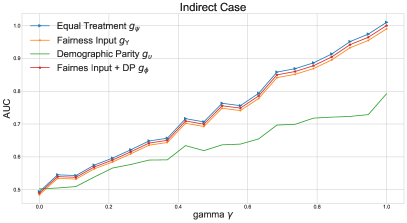
- 在合成数据上,C2ST的AUC值表现出强检测能力,即使在间接影响和无信息情形下,AUC值也高于0.6。
- explanationspace包可实现对模型不平等对待的端到端审计,且集成开销极低。
- 在与出行相关的任务中,该方法检测到有意义的差异(例如,亚洲人-混血群体的AUC为0.753 ± 0.02),即使基于结果的公平性度量接近均等。
阅读本论文
在 Nubint 阅读器中打开原文,边读边就任意段落提问。
在 Nubint 中阅读本论文本解读由 AI 根据论文原文生成,引用前请核对原文。