
[论文解读] Bi-level Contrastive Learning for Knowledge-Enhanced Molecule Representations
本文提出 Gode,一种双层对比学习框架,通过在分子图和知识图子结构上联合预训练,增强分子表征。通过对比学习对齐两个层次的嵌入表示,Gode 实现了最先进性能,在11项分子性质预测任务中,平均ROC-AUC提升12.7%,RMSE/MAE降低34.4%。
Molecular representation learning is vital for various downstream applications, including the analysis and prediction of molecular properties and side effects. While Graph Neural Networks (GNNs) have been a popular framework for modeling molecular data, they often struggle to capture the full complexity of molecular representations. In this paper, we introduce a novel method called GODE, which accounts for the dual-level structure inherent in molecules. Molecules possess an intrinsic graph structure and simultaneously function as nodes within a broader molecular knowledge graph. GODE integrates individual molecular graph representations with multi-domain biochemical data from knowledge graphs. By pre-training two GNNs on different graph structures and employing contrastive learning, GODE effectively fuses molecular structures with their corresponding knowledge graph substructures. This fusion yields a more robust and informative representation, enhancing molecular property predictions by leveraging both chemical and biological information. When fine-tuned across 11 chemical property tasks, our model significantly outperforms existing benchmarks, achieving an average ROC-AUC improvement of 12.7% for classification tasks and an average RMSE/MAE improvement of 34.4% for regression tasks. Notably, GODE surpasses the current leading model in property prediction, with advancements of 2.2% in classification and 7.2% in regression tasks.
研究动机与目标
- 为解决标准分子图表征在捕捉生化知识图谱中丰富上下文知识方面的局限性。
- 通过整合分子图的结构信息与知识图的关系知识,提升分子性质预测性能。
- 开发一种稳健的自监督预训练范式,实现对分子图与知识图子结构两个不同图层次表示的对齐。
- 构建一个综合性的分子知识图(MolKG),以支持知识驱动的分子表征学习。
- 证明双层对比学习可增强表征的鲁棒性与泛化能力,适用于多样化的分子性质预测任务。
提出的方法
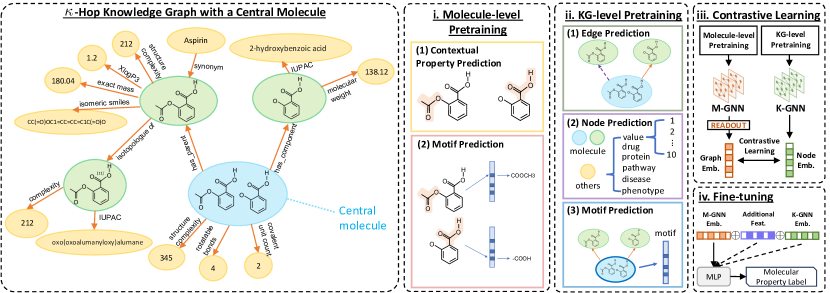
- Gode采用两个专用图神经网络:M-GNN用于学习分子图表征,K-GNN用于学习以目标分子为中心的知识图子结构表征。
- 该方法执行双层自监督预训练:M-GNN在分子图上进行预训练,K-GNN在以分子为中心的知识图子图(MolKG)上进行预训练。
- 通过对比学习对同一分子的M-GNN与K-GNN嵌入表示进行对齐,确保模态间知识迁移。
- 利用RDKit提取功能团特征,并与最终嵌入表示拼接,以丰富分子表征。
- 在微调阶段,模型支持两种推理模式:仅使用M-GNN嵌入,或拼接M-GNN与K-GNN输出以提升性能。
- MolKG知识图从多源生化数据构建,包括PubChemRDF、UMLS和PrimeKG,以支持全面的分子知识整合。
实验结果
研究问题
- RQ1在分子图与知识图子结构上联合预训练,是否能提升分子表征学习在性质预测中的性能?
- RQ2分子图与知识图表征之间的双层对比学习,如何增强嵌入表示的鲁棒性与泛化能力?
- RQ3集成功能团特征对下游分子性质预测性能有何影响?
- RQ4Gode与SOTA模型(如GROVER、MolCLR和KANO)相比,在多样化分子性质预测基准上的表现如何?
- RQ5在分子图与知识图结构上同时进行预训练,在分布外分子数据集上能否有效减少性能下降?
主要发现
- 在11项分类任务中,Gode相较基线模型平均ROC-AUC提升12.7%,显著优于现有方法。
- 在回归任务中,Gode将平均RMSE/MAE降低34.4%,表明其在连续分子性质预测中具有更优的预测精度。
- Gode在平均分类性能上超越当前领先模型2.1%,在平均回归性能上超越6.4%。
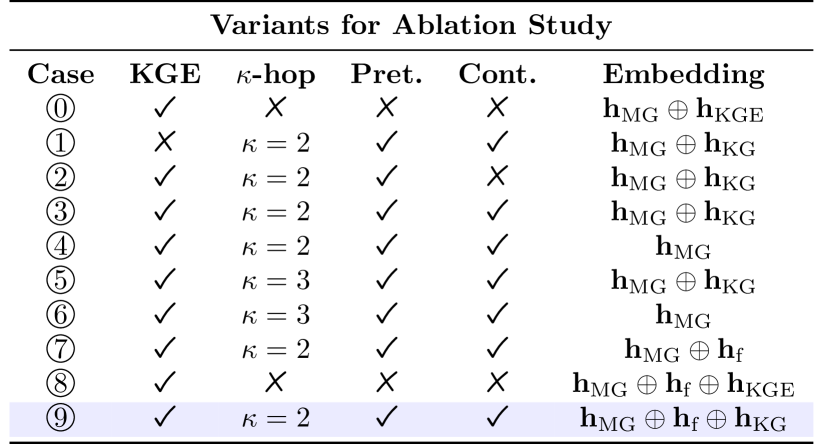
- 消融实验表明,同时对M-GNN与K-GNN进行预训练可获得最高性能增益,若两者均随机初始化,ROC-AUC下降5.6%。
- 功能团特征的引入以及M-GNN与K-GNN嵌入之间的对比对齐,对性能提升有显著贡献,尤其在回归任务中表现突出。
- 即使在微调阶段仅使用M-GNN嵌入,模型仍保持强劲性能,表明所学表征具有高度鲁棒性与灵活性。
阅读本论文
在 Nubint 阅读器中打开原文,边读边就任意段落提问。
在 Nubint 中阅读本论文本解读由 AI 根据论文原文生成,引用前请核对原文。