
[论文解读] Bidirectional quantum teleportation of even and odd coherent states through the multipartite Glauber coherent state: Theory and implementation
本文提出了一种基于多体Glauber相干态——特别是Greenberger-Horne-Zeilinger (GHZ)、基态和Werner态——作为纠缠量子资源的双向量子隐形传态(BQT)协议,用于偶数和奇数相干态。通过优化重叠参数(p)、分划数(n)和触发相位,该协议在两个方向上均实现了高保真度的隐形传态,保真度在最大纠缠条件下达到最大值,并通过IBM量子模拟器得到验证。
Quantum teleportation has become a fundamental building block of quantum technologies, playing a vital role in the development of quantum communication networks. Here, we present a bidirectional quantum teleportation (BQT) protocol that enables even and odd coherent states to be transmitted and reconstructed over arbitrary distances in two directions. To this end, we employ the multipartite Glauber coherent state, comprising the Greenberger-Horne-Zeilinger, ground and Werner states, as a quantum resource linking distant partners Alice and Bob. The pairwise entanglement existing in symmetric and antisymmetric multipartite coherent states is explored, and by controlling the overlap and number of probes constructing various types of quantum channels, the teleportation efficiency of teleported states in both directions may be maximized. Besides, Alice's and Bob's trigger phases are estimated to explore their roles in our protocol using two kinds of quantum statistical speed referred to as quantum Fisher information (QFI) and Hilbert-Schmidt speed (HSS). Specifically, we show that the lower bound of the statistical estimation error, quantified by QFI and HSS, corresponds to the highest fidelity from Alice to Bob and conversely from Bob to Alice, and that the choice of the pre-shared quantum channel has a critical role in achieving high BQT efficiency. Finally, we show how to implement the suggested scheme on current experimental tools, where Alice can transfer her even coherent state to Bob, and at the same time, Bob can transfer his odd coherent state to Alice.
研究动机与目标
- 开发一种双向量子隐形传态(BQT)协议,实现在远距离参与者之间同时传输偶数和奇数相干态。
- 研究多体Glauber相干态(GHZ、基态、Werner)作为量子资源时,如何在两个方向上最大化隐形传态保真度。
- 分析触发相位参数(θ_e, θ_o)在隐形传态效率中的作用,利用量子费舍尔信息(QFI)和希尔伯特-施密特速度(HSS)进行分析。
- 通过量子模拟器(Qasm、Aer、Belem)验证理论协议,并将模拟概率与理论预测进行比较。
- 探讨环境噪声和非最大纠缠对BQT性能的影响,为未来在噪声信道中的研究奠定基础。
提出的方法
- 利用多体Glauber相干态——包括对称/反对称GHZ态、基态和Werner态——作为爱丽丝与鲍勃之间预共享的纠缠量子信道。
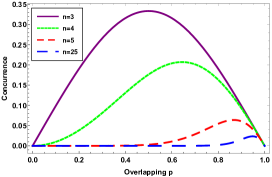
- 采用concurrence作为纠缠度量,基于重叠参数(p)和分划数(n)评估共享资源中的纠缠程度。
- 应用量子费舍尔信息(QFI)和希尔伯特-施密特速度(HSS)量化在两个隐形传态方向中对触发相位参数(θ_e, θ_o)估计的精度。
- 以保真度为主要指标评估隐形传态效率,将理论预测与IBM量子模拟器(Qasm、Aer、Belem)的结果进行比较。
- 通过调节参数p(重叠)、m(对称/反对称态)和n(探测器数量)来优化隐形传态性能,使两个方向的保真度最大化。
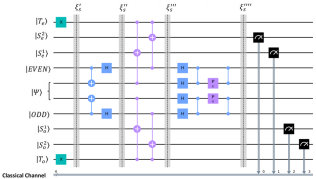
- 通过将理论预测的概率与量子线路模拟结果进行比较,验证协议,确认其高度一致性和高保真度。
实验结果
研究问题
- RQ1选择多体Glauber相干态(GHZ、基态、Werner)作为量子资源时,如何影响偶数和奇数相干态的双向隐形传态保真度?
- RQ2重叠(p)、分划数(n)和对称性(m)的最优配置是什么,才能在BQT的两个方向上实现最大保真度?
- RQ3量子费舍尔信息(QFI)和希尔伯特-施密特速度(HSS)与隐形传态保真度及相位估计精度在两个方向上的相关性如何?
- RQ4为何在鲍勃到爱丽丝方向存在保真度与相位估计精度之间的反比关系?该现象如何通过HSS得到证实?
- RQ5量子模拟器(Qasm、Aer、Belem)在保真度和概率分布方面在多大程度上复现了理论预测?
主要发现
- 当共享资源为最大纠缠态时,保真度达到最大值,具体为GHZ型(p=0, m=0)或Werner态(p=1, m=1),在n=3个探测器时性能最优。
- 对于对称态(m=0),当p=1时保真度最大,表明高重叠可提升隐形传态效率。
- 在反对称情形(m=1)下,保真度在p=1时达到峰值,对应Werner态,证实了特定纠缠结构的作用。
- 量子费舍尔信息(QFI)和希尔伯特-施密特速度(HSS)与保真度高度相关,HSS进一步证实了QFI在相位估计精度中的作用。
- 观察到反比关系:从爱丽丝到鲍勃方向保真度越高,对θ_e(爱丽丝的相位)的估计越精确;而从鲍勃到爱丽丝方向保真度越低,对θ_o(鲍勃的相位)的估计越精确,该现象通过HSS得到验证。
- IBM Qiskit模拟器(Qasm、Aer、Belem)生成的模拟概率与理论预测高度吻合,验证了该协议的可行性及高保真度表现。
阅读本论文
在 Nubint 阅读器中打开原文,边读边就任意段落提问。
在 Nubint 中阅读本论文本解读由 AI 根据论文原文生成,引用前请核对原文。