
[论文解读] Binary black hole spins: model selection with GWTC-3
本研究基于GWTC-3中的59个确定的双黑洞事件,采用分层贝叶斯推断方法,检验了基于大质量恒星角动量输运的自旋模型。结果表明,仅预测黑洞自旋趋近于零的模型与数据不一致,而包含潮汐自旋加速子群体的模型则能良好拟合数据,凸显了前向自旋参数在约束形成情景中的关键作用。
The origin of the spins of stellar-mass black holes is still controversial, and angular momentum transport inside massive stars is one of the main sources of uncertainty. Here, we apply hierarchical Bayesian inference to derive constraints on spin models from the 59 most confident binary black hole merger events in the third gravitational-wave transient catalogue (GWTC-3). We consider up to five parameters: chirp mass, mass ratio, redshift, effective spin, and precessing spin. For model selection, we use a set of binary population synthesis simulations spanning drastically different assumptions for black hole spins and natal kicks. In particular, our spin models range from maximal to minimal efficiency of angular momentum transport in stars. We find that, if we include the precessing spin parameter into our analysis, models predicting only vanishingly small spins are in tension with GWTC-3 data. On the other hand, models in which most spins are vanishingly small, but that also include a sub-population of tidally spun-up black holes are a good match to the data. Our results show that the precessing spin parameter has a crucial impact on model selection.
研究动机与目标
- 利用第三份数据目录(GWTC-3)中的引力波数据,约束黑洞自旋模型。
- 检验大质量恒星中角动量输运效率对黑洞自旋分布的影响。
- 评估预测自旋普遍趋近于零的模型是否与观测到的双黑洞并合事件一致。
- 评估新生冲量与前向自旋在模型选择中的作用。
提出的方法
- 将分层贝叶斯推断应用于GWTC-3中59个确定的双黑洞并合事件。
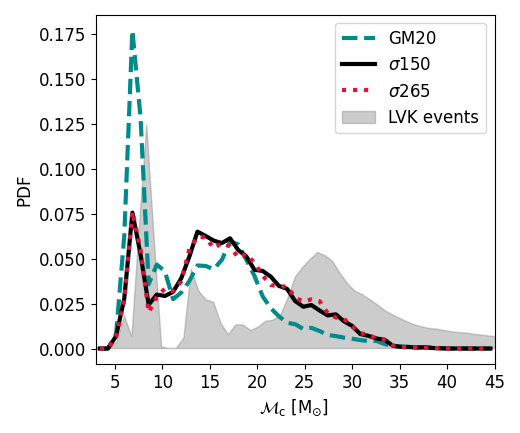
- 建模五个参数:啁啾质量、质量比、红移、有效自旋和前向自旋。
- 使用一系列双星群体合成模拟,涵盖从低效到非常高效的角动量输运假设,以及不同的新生冲量模型。
- 模型范围从最小自旋(F)到高效输运(M、Max),在部分情况下引入潮汐自旋加速黑洞(B21)。
- 通过在不同自旋与冲量假设下比较对数似然值,完成模型选择。
- 显式引入前向自旋参数χp,以评估其对模型区分的影响。
实验结果
研究问题
- RQ1哪些黑洞自旋模型与GWTC-3中观测到的自旋分布最为一致?
- RQ2是否包含前向自旋参数χp会显著改变模型选择的结果?
- RQ3预测自旋普遍趋近于零的模型是否与GWTC-3数据相容?
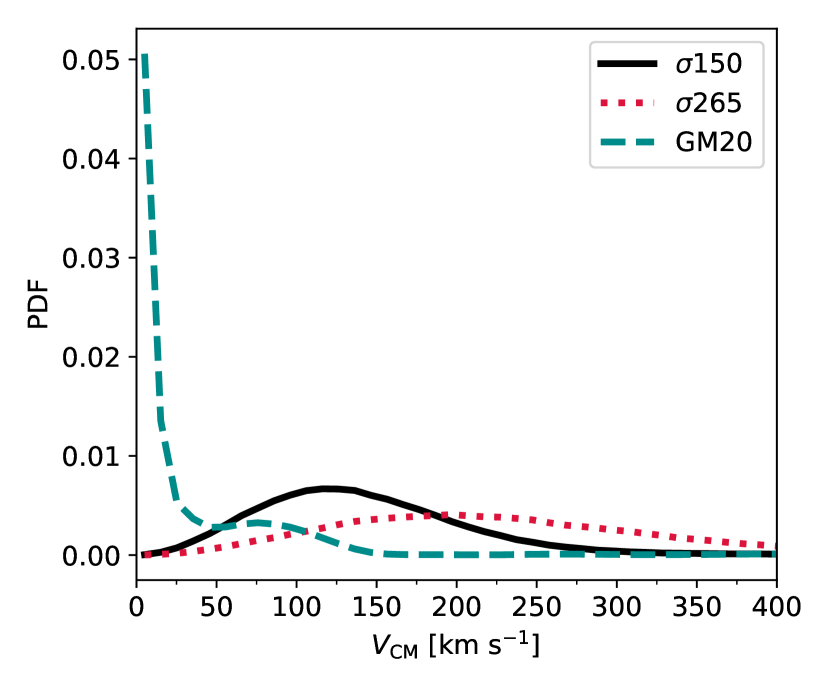
- RQ4不同新生冲量模型(σ=150、265 km/s,以及G20)如何影响与观测数据的拟合程度?
- RQ5潮汐自旋加速黑洞在解释观测到的自旋分布中起到什么作用?
主要发现
- 仅预测黑洞自旋趋近于零的模型(F模型)与GWTC-3数据存在矛盾,被拒绝。
- 包含大部分低自旋但含一个潮汐自旋加速子群体的模型(F_B21)能良好拟合数据。
- 自旋输运效率低的模型(G和G_21)的对数似然值显著低于高效输运模型(M、M_B21、Max、Max_B21)。
- 采用大新生冲量的模型(σ=265和σ=150 km/s)优于低冲量的G20模型。
- 前向自旋参数χp在区分自旋模型中起到关键作用,提升了模型选择的敏感性。
- 数据对自旋-轨道倾角不一致提供了温和证据,支持在分析中包含前向自旋。
阅读本论文
在 Nubint 阅读器中打开原文,边读边就任意段落提问。
在 Nubint 中阅读本论文本解读由 AI 根据论文原文生成,引用前请核对原文。